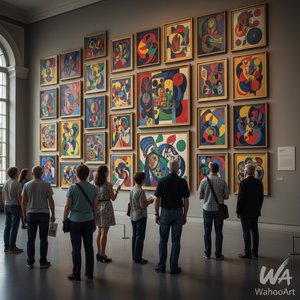
The Luminous Legacy of Anna Letycia Quadros
In the vibrant tapestry of Brazilian modernism, few threads shine with as much precision and expressive grace as those woven by Anna Letycia Quadros. Born in the serene landscape of Teresópolis in 1929, Quadros emerged as a formidable force in the mid-twentieth century, a period when Brazil was redefining its visual identity through the lens of abstraction and experimental printmaking. Her journey was not merely one of personal discovery but a profound engagement with the very essence of line and color, a pursuit that would eventually establish her as a cornerstone of the nation's artistic heritage.
The foundation of her mastery was laid through an extraordinary lineage of mentorship. Quadros did not simply learn techniques; she absorbed the philosophies of the masters. Her early studies in drawing and painting under Bustamante Sá at the Associação Brasileira de Desenho e Artes Visues provided the structural discipline that would later allow her to manipulate form with such ease. As she moved through the prestigious halls of the Escola Nacional de Belas Artes and the Instituto Municipal de Belas Artes, she encountered titans such as André Lhote, Darel Valença Lins, and Iberê Camargo. Each encounter added a new layer to her artistic vocabulary, blending European avant-garde sensibilities with a burgeoning Brazilian modernism that sought to capture both the physical and the spiritual.
A Mastery of Metal and Motion
While many artists of her era drifted between mediums, Quadros found her true voice in the rigorous, tactile world of engraving. Her devotion to metalcut printing—a process demanding immense patience and technical precision—became the hallmark of her career. During her influential tenure at the Museum of Modern Art Rio de Janeiro from 1960 to 1966, she became a vital figure in the teaching and development of printmaking. Her work during this period was characterized by a breathtaking economy of line and a sophisticated use of color that suggested weightlessness even within solid forms. She possessed a rare ability to translate complex abstract concepts into tangible, etched realities, often collaborating with fellow visionaries like Anna Bella Geiger to push the boundaries of what the medium could achieve.
Her artistic evolution was deeply intertwined with the collective movements of her time. As a participant in the creation of Grupo Frente alongside Ivan Serpa, she stood at the epicenter of a movement that championed experimentation and broke away from traditional figurative constraints. This period of her life was marked by an intense dialogue between the physical act of carving into metal and the intellectual pursuit of abstraction. Her work often oscillated between the raw energy of expressionism and the refined clarity of geometric abstraction, creating a tension that kept her compositions perpetually alive.
A Life Dedicated to Art and Education
Beyond the studio, Quadros was a dedicated educator whose influence stretched far beyond the borders of Brazil. Her pedagogical reach extended to Santiago, Chile, where her contributions to the arts were recognized with the prestigious title of Professor Honoris Causa from the Pontifícia Universidade Católica do Chile in 1961. This international recognition underscored her role not just as a creator, but as a global ambassador for Brazilian printmaking. In Niterói, she continued her lifelong commitment to the craft by establishing the Oficina de Gravura at the Museu do Ingá, which she directed until 1998, nurturing new generations of engravers and ensuring that the technical secrets of the metalcut would not be lost to time.
The breadth of her creativity even touched the theatrical realms of scenography and costume design, often working in partnership with Maria Clara Machado. This versatility speaks to an artist who viewed all forms of visual expression as interconnected parts of a single, grand narrative. When she passed away in Rio de Janeiro in 2018, she left behind more than just a collection of prints; she left a legacy of structural elegance and emotional depth. To look upon a work by Anna Letycia Quadros is to witness the perfect balance of strength and lightness, a testament to a life spent mastering the delicate dance between the hand, the tool, and the infinite possibilities of the abstract imagination.