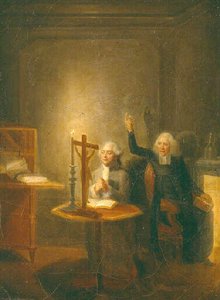
A Brush with History: The Life and Art of Jean-Jacques Hauer
Jean-Jacques Hauer, born Johann Jakob Hauer in the modest German village of Gau-Alsheim in 1751, lived a life deeply intertwined with the tumultuous currents of late 18th-century Europe. While not a household name like his more celebrated contemporaries, Hauer occupies a unique and poignant position in
art history—a chronicler of revolution, regicide, and the fragile human spirit caught within them. His story is one of an artist navigating a world irrevocably changed by upheaval, finding himself tasked with immortalizing some of its most dramatic moments. Hauer’s early life remains somewhat shrouded in mystery; details regarding his initial training are scarce. However, it's clear he possessed the technical skill and observational acuity to establish himself as a portraitist, eventually leading him to France where he would make his mark on history. He wasn’t merely painting faces; he was capturing an era—its anxieties, its ideals, and its tragedies.
The Portrait of a Revolutionary: Corday and Beyond
Hauer's enduring legacy rests primarily upon his portraits of Charlotte Corday, the
young woman who assassinated Jean-Paul Marat during the Reign of Terror. In 1793, Hauer was commissioned to paint Corday both before and after her trial—a remarkable feat considering the political sensitivity surrounding the case. The circumstances surrounding these commissions are as compelling as the paintings themselves. Following her conviction, Corday requested that Hauer be permitted to complete his work in her cell, a testament to her composure and perhaps a desire for posterity. The resulting portraits aren’t simply likenesses; they offer an intimate glimpse into the mind of a radicalized individual. They depict a woman of striking serenity, devoid of remorse or fear—a deliberate presentation that fueled both admiration and condemnation. The artist himself seems to have been moved by Corday's stoicism, noting her graciousness and willingness to pose despite her impending fate. Beyond Corday, Hauer’s oeuvre included depictions of other significant events of the French Revolution, such as *
Les adieux de Louis XVI à sa famille* and *La
mort de Marat*, though these works are less widely known. These paintings demonstrate his ability to capture both grand historical narratives and intimate emotional moments.
Technique and Style: A Neoclassical Sensibility
Hauer’s artistic style is firmly rooted in the
neoclassical tradition, characterized by its emphasis on clarity, order, and idealized forms. His portraits exhibit a meticulous attention to detail—the precise rendering of fabrics, the subtle modeling of faces, and the careful arrangement of composition. However, his work isn't devoid of
emotional depth. He skillfully employs
light and shadow to create a sense of drama and psychological intensity, particularly evident in his depictions of Corday. While adhering to
neoclassical conventions, Hauer’s paintings possess a certain
realism—a willingness to portray his subjects with honesty and nuance. This balance between idealization and observation is what sets his work apart. He wasn't simply creating propaganda; he was striving for a truthful representation of the individuals before him, even within the constraints of his artistic style.
Historical Context and Lasting Significance
To understand Hauer’s art, one must consider the volatile political landscape in which it was created. The French Revolution had shattered the old order, giving rise to radical ideologies and unprecedented violence. Hauer found himself working for a government constantly shifting its allegiances and grappling with internal conflicts. His commissions were often politically charged—intended to shape public opinion or commemorate key events. The portraits of Charlotte Corday, in particular, became symbols of both revolutionary fervor and counter-revolutionary sentiment. They continue to fascinate and provoke debate today, offering insights into the complexities of the French Revolution and the enduring power of individual conviction. While Hauer may not be celebrated as a groundbreaking innovator, his work serves as a valuable historical document—a visual record of a pivotal moment in
European history. He died in Blois in 1829, leaving behind a legacy that extends beyond mere artistic skill; he left a poignant reflection on the human cost of revolution and the enduring power of art to capture the spirit of an age.
Selected Works