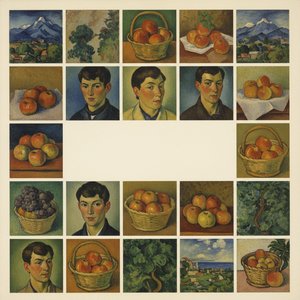
The Dawn of a Korean Visionary
Born in the heart of Daegu in 1912, Lee In-sung emerged as a singular force in the evolution of Korean modern art, an artist whose brush captured the very soul of a changing nation. Raised within an artistic lineage, his early years were steeped in a profound appreciation for visual expression, nurtured by parents who were artists themselves. As Korea navigated the turbulent waters of rapid modernization and Japanese colonial rule, Lee sought to forge a path that was both contemporary and deeply rooted in his heritage. His journey through the Seoul Art School allowed him to absorb the whispers of the European avant-garde, yet his heart remained tethered to the soil of his homeland, setting the stage for an artistic career that would eventually earn him the evocative title of
Korea’s Gauguin.
A Symphony of Saturated Hues and Local Color
Lee In-sung’s brushwork was a bold rebellion against academic rigidity, favoring instead an immersive experience of color and form. Heavily influenced by the expressive palettes of Paul Gauguin, Lee translated these Western stylistic principles into a uniquely Korean idiom, seeking to capture the essence of his country's natural beauty through unparalleled vibrancy. He possessed an uncanny ability to translate atmospheric qualities into pigment, particularly through his mastery of light and seasonal shifts. His technique was characterized by:
- Layered Luminosity: A method of building color to create a sense of depth that mirrored the hazy, golden light of Korean autumn days.
- Bold Brushstrokes: Using saturated, opaque strokes that gave even his watercolors an almost oil-like, tactile presence.
- Symbolic Landscapes: Depicting nature not just as scenery, but as a vessel for emotion and national identity.
In masterpieces such as
On an Autumn Day, one finds a striking fusion of the exotic and the indigenous, where vibrant sunflowers and lush greenery evoke a sense of pristine, untouched beauty. Even in his still lifes, such as the celebrated
Calla, Lee utilized the symbolic weight of flowers to reflect deeper desires for restoration and liberation, creating compositions that were both stable and harmonically profound.
Legacy Forged in the Crucible of History
The trajectory of Lee’s career was marked by both meteoric success and profound tragedy. From 1932, he achieved an unprecedented feat, winning six consecutive special prizes at the Chosun Art Exhibition, a testament to his growing influence and technical mastery. However, his life and work were inextricably linked to the political upheavals of his era. While his participation in exhibitions during the Japanese occupation remains a subject of historical nuance, his relentless pursuit of
local color served as a vital preservation of Korean aesthetic identity amidst external pressures. His life was tragically cut short during the Korean War in 1950, yet his artistic spirit endured. Today, Lee In-sung is remembered not merely as a painter of landscapes, but as a pioneer who dared to paint the heart of a nation through a kaleidoscope of brilliant, enduring color.