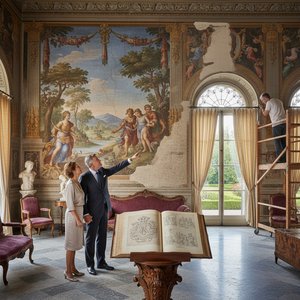
The Florentine Legacy of Sebastiano Mainardi
In the golden era of the Italian Renaissance, where the light of humanism began to illuminate the shadows of the Middle Ages, Sebastiano Mainardi emerged as a vital, though often understated, voice within the Florentine school. Born in the picturesque hilltop town of San Gimignano around 1460, Mainardi’s artistic journey was deeply rooted in the fertile soil of Tuscany. While history frequently shines its brightest spotlight on the titans of the era, it is through the meticulous work of artists like Mainardi that we truly grasp the cohesive texture of the Florentine Renaissance. His life and career were inextricably linked to the great masters of his time, most notably Domenico Ghirlandaio, whose influence acted as the foundational pillar for Mainardi’s developing style.
The apprenticeship of Mainardi under Ghirlandaio was more than a mere period of training; it was an immersion into a sophisticated visual language characterized by clarity, anatomical precision, and a profound sense of narrative grace. Through this lineage, Mainardi inherited a mastery of fresco technique and a penchant for harmonious color palettes that would define much of his oeuvre. This connection is perhaps most poignantly captured in the historical records of the Tornabuoni Chapel, where glimpses of Mainardi working alongside his master suggest a collaborative spirit that helped shape some of the most significant religious decorations in Florence. His ability to navigate the complexities of large-scale monumental painting allowed him to contribute to the very fabric of Florentine sacred spaces.
Devotion and Grace in Portraiture
While his contributions to fresco cycles demonstrate a command over grand, architectural narratives, Mainardi found a unique and enduring resonance in the intimate realm of devotional portraiture. He became particularly renowned for his depictions of the Madonna and Child, works that serve as windows into the spiritual tenderness of the period. In these paintings, one observes a delicate balance between the idealized beauty of the divine and a palpable, human warmth. His Madonnas are rarely distant or cold; instead, they possess a serene, tranquil expression that invites the viewer into a moment of quiet contemplation.
The technical execution of these portraits reveals a sophisticated understanding of light and drapery. Mainardi utilized subtle gradations of tone to give form to the soft features of the Virgin, while the heavy, rhythmic folds of her garments reflect the Ghirlandaio tradition of tactile realism. His compositions often include various saints, creating a celestial hierarchy that is both structurally balanced and emotionally accessible. Through these works, Mainardi achieved a specific type of artistic triumph:
- Mastery of Perspective: Integrating sacred figures into believable, three-dimensional spaces.
- Emotional Depth: Capturing the profound, maternal tenderness essential to Renaissance piety.
- Stylistic Refinement: Utilizing a palette that emphasizes clarity and luminous skin tones.
A Lasting Impression on Florentine Art
As the 15th century transitioned into the 16th, Mainardi’s involvement in significant projects, such as the decoration of the Abbey of Passignano, solidified his reputation as a reliable and skilled hand within the Tuscan artistic community. Though the specific details of his later years remain somewhat obscured by the passage of time, his historical significance is undeniable. He represents the essential bridge between the rigorous, observational style of the early Florentine masters and the more fluid, emotive developments that would follow in the High Renaissance.
Today, when we look upon the surviving fragments of his work—whether it be a detailed scene within a larger fresco or a solitary, hauntingly beautiful portrait of a saint—we see the enduring legacy of a man who helped define the visual identity of Florence. Sebastiano Mainardi remains a testament to the power of tradition and the beauty of devotion, reminding us that the greatness of an era is built not only by its most famous icons but by the dedicated masters who breathed life into its most sacred visions.
الأسئلة والأجوبة
هل يوجد عرض شامل لجميع الموضوعات التي رسمها Sebastiano Mainardi؟
يمكن استكشاف أعمال Sebastiano Mainardi حسب الموضوع عبر صفحة أطلس المواضيع الخاصة بالفنان.
كيف يمكنني العثور على أعمال Sebastiano Mainardi ضمن موضوع معين؟
للعثور على أعمال Sebastiano Mainardi حول موضوع معين، يمكنك زيارة صفحة حسب الكلمات المفتاحية الخاصة بالفنان، والتي تجمع الأعمال الفنية حسب الكلمات المفتاحية.
أين يمكنني مشاهدة أعمال Sebastiano Mainardi الفنية في معرض ثلاثي الأبعاد؟
تُعد متحف ثلاثي الأبعاد الخاصة بـ Sebastiano Mainardi صفحة تعرض أعمال الفنان في معرض افتراضي ثلاثي الأبعاد.