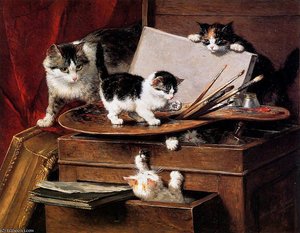
Henriëtte Ronner-Knip - A Life Immersed in Fur and Feeling
Henriëtte Ronner-Knip, born in Amsterdam in 1821, wasn’t simply a painter of animals; she was a chronicler of domestic intimacy, a keen observer of the quiet dramas unfolding within bourgeois homes. Her name became synonymous with cats – playful kittens tumbling amongst cushions, regal felines surveying their domains – but to define her solely by this subject matter would be to diminish the breadth of her talent and the fascinating complexity of her life. Born into a lineage steeped in artistic tradition, Ronner-Knip’s journey was one shaped by both familial legacy and personal resilience. Her father, Josephus Augustus Knip, himself an accomplished artist, provided her earliest instruction, fostering a dedication to observation and technique that would remain central to her work throughout her career. The family's nomadic existence, necessitated by his teaching engagements and later, his declining eyesight, instilled in young Henriëtte a sensitivity to the nuances of light and atmosphere, qualities that would become hallmarks of her paintings. Even amidst financial hardship and familial upheaval – including questions surrounding her parentage – she persevered, exhibiting at a remarkably young age and steadily honing her skills.Early Artistic Beginnings and Familial Influence
Henriëtte’s artistic education commenced at the tender age of five under the watchful eye of her father, Josephus Augustus Knip—a man who himself possessed considerable artistic talent. He instilled in her a profound appreciation for nature and a meticulous approach to drawing, emphasizing the importance of capturing accurate details and conveying emotion through color and composition. Recognizing her innate aptitude, he diligently trained her, mirroring his own dedication to craftmanship. Her father’s influence extended beyond mere instruction; he championed her artistic independence and encouraged her to pursue her passions with unwavering determination. Nicolaas Knip, Henriëtte's grandfather, was also a respected artist—a painter of landscapes—and instilled in his daughter the same reverence for visual representation as a means of conveying profound truths about the human condition. This familial heritage profoundly shaped Henriëtte’s artistic worldview and fueled her lifelong commitment to capturing beauty and emotion on canvas. Her aunt, Henriëtte Geertruida Knip, Josephus' youngest sister, also received instruction from him—further cementing the family’s tradition of artistic excellence.From Landscapes to Domestic Scenes: The Evolution of Style
Initially, Ronner-Knip explored landscapes with watercolor and oil paints, developing foundational skills in composition, color harmony, and textural rendering. These early works demonstrate her mastery of capturing atmospheric effects – mist-laden hillsides, dappled sunlight filtering through forest foliage—reflecting the Romantic sensibility prevalent during her formative years. However, it was her relocation to Brussels in 1850, following her marriage to Feico Ronner who became her manager due to his ill health, that marked a pivotal moment in her artistic trajectory. Recognizing the burgeoning demand for art depicting domestic life and animal companionship within the Victorian era, she decisively shifted her focus toward portraying cats and dogs—subjects she would pursue with unwavering passion throughout her career. This decision wasn’t merely pragmatic; it represented a deeper conviction that true beauty resided in capturing intimate moments of human-animal interaction.The Quintessence of Romanticism: Cats in Bourgeois Interiors
Ronner-Knip's artistic vision crystallized during the 1870s, producing her most celebrated masterpieces—scenes featuring longhaired cats nestled comfortably within elegantly furnished bourgeois homes. These paintings exemplify the Romantic aesthetic—characterized by vibrant colors, dramatic lighting, and an emphasis on emotional expression—and stand apart from other artists of her time. She achieved this remarkable feat through painstaking observation and meticulous technique. Like many Romantic painters, Ronner-Knip employed a method known as *papier-mâché modeling*, creating miniature sculptures of her subjects before applying paint—a practice that allowed her to achieve unparalleled anatomical accuracy and capture subtle nuances of posture and expression. Her palette is rich and luminous, infused with hues reminiscent of Impressionism but tempered by Romantic sensibilities—creating an atmosphere of warmth, serenity, and profound tenderness. She skillfully rendered the soft glow of candlelight illuminating plush cushions and intricately patterned fabrics—transforming ordinary domestic spaces into canvases brimming with beauty and emotion.Recognition and Legacy: A Pioneer Among Women Artists
Henriëtte Ronner-Knip’s talent garnered considerable acclaim during her lifetime. She was admitted as an “active member” to Arti et Amicitiae in Amsterdam—a groundbreaking achievement for a woman artist at the time—demonstrating her unwavering determination and securing her place among the leading figures of Dutch art history. Her work was showcased at prestigious exhibitions, including the Palace of Fine Arts at the 1893 World’s Columbian Exposition in Chicago—where it captivated audiences worldwide. Furthermore, she received honors from the Royal Family—affirming her artistic stature and cementing her legacy as a trailblazer for future generations of female artists who sought to challenge societal conventions and pursue their creative ambitions with courage and conviction. Her enduring influence can be seen in the continuing fascination with animal paintings—particularly depictions of domestic cats—and in the celebration of quiet beauty and emotional resonance within art.Въпроси и отговори
Къде могат да бъдат намерени произведенията на Henriette Ronner Knip, групирани по техника?
Страницата Всички техники групира произведенията на Henriette Ronner Knip според техниката им.
Колко популярни са произведенията на Henriette Ronner Knip?
Съществува страница Статистика за Henriette Ronner Knip, която представя статистика за произведенията на творца в този уебсайт.
Мога ли да разглеждам творбите на Henriette Ronner Knip по цветова палитра?
Работите на Henriette Ronner Knip могат да бъдат разгледани по цветова палитра на страницата за Според палитрата на художника.