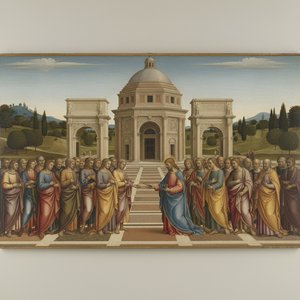
Raphael I Sadeler: The Harmonious Echo of Florentine Genius
Raphael I Sadeler (b. ca. 1560, Antwerp, d. ca. 1628, Venezia) stands as a testament to the enduring power of artistic collaboration and the reverberations of Renaissance ideals across Europe. Born into a prominent Flemish family steeped in artistic tradition – his father, Jan Sadeler I., was himself a celebrated sculptor and architect – Raphael’s early life foreshadowed a destiny inextricably linked with the glories of Florence and Venice. He honed his skills alongside his brother, Jan Sadeler II., establishing a workshop that quickly became synonymous with excellence in printmaking and fresco painting, cementing their family's reputation as leading artists of their time.
Early Training & Florentine Influence: Raphael’s formative years were spent studying under Pietro Perugino in Perugia, absorbing the serene beauty and compositional mastery characteristic of Umbrian Renaissance art. Perugino instilled in him a profound appreciation for balance, clarity, and idealized forms – principles that would profoundly shape Raphael's artistic vision.
The Workshop & Artistic Partnerships: Returning to Antwerp, Raphael established a prolific workshop where he collaborated extensively with Giovanni Battista Pinturicchio and Federico Bartolomeo Amerighi. These partnerships fostered innovation and broadened their stylistic horizons, resulting in stunning frescoes for churches and palaces across Europe – notably the Palazzo Vecchio in Florence and St Mary’s Church in Antwerp.
Technical Virtuosity & Printmaking Mastery: Sadeler's reputation as a printmaker was unparalleled. He possessed an extraordinary ability to reproduce paintings with breathtaking accuracy, elevating engraving to new heights of artistic sophistication. His prints served not only as decorative objects but also as crucial conduits for disseminating Renaissance ideas and imagery throughout the continent.
Notable Works & Artistic Legacy: Raphael’s oeuvre encompasses a remarkable range of subjects – biblical narratives, mythological scenes, portraits, and landscapes – all executed with meticulous detail and imbued with humanist ideals. His frescoes in St Mary's Church in Antwerp exemplify his mastery of perspective and color theory, establishing him as one of the foremost artists of the High Renaissance.
The Ionian School & Venetian Patronage
Raphael’s artistic trajectory intersected decisively with the burgeoning Ionian school of painting, centered on Corfu Island during the Habsburg reign. This distinctive style emerged from the ashes of Cretan Byzantine art following Ottoman conquest and blended Venetian influences with traditional Byzantine techniques. Sadeler's involvement in this movement resulted in captivating depictions of religious subjects – notably “The Liberation of Saint Peter”—that showcased his ability to adapt to evolving artistic tastes while upholding the highest standards of craftsmanship. Venetian patronage provided crucial support for Sadeler’s creative endeavors, fostering a vibrant artistic environment and propelling him to international acclaim.
Exploring Raphael's Artistic Vision
At its core, Raphael’s art embodies the humanist spirit of the Renaissance – an unwavering belief in human reason, beauty, and moral virtue. He sought to capture idealized representations of humanity, reflecting philosophical concepts prevalent during his era. His meticulous attention to detail, combined with masterful use of color and perspective, created images that captivated audiences and continue to inspire admiration centuries later. Raphael’s influence extended far beyond his own lifetime, shaping the artistic sensibilities of subsequent generations and securing his place as one of history's most revered painters.
Concluding Reflections: A Lasting Impression
Raphael I Sadeler’s legacy transcends mere technical skill; it resides in his profound contribution to the dissemination of Renaissance ideals and his unwavering commitment to artistic excellence. His workshop produced masterpieces that adorn churches and palaces across Europe, ensuring that his vision—a harmonious blend of Florentine grace and Venetian dynamism—would endure for centuries to come. As a symbol of artistic collaboration and innovation, Raphael Sadeler remains an enduring emblem of the High Renaissance’s transformative power.
Jan van Eyck used translucent glazes in his 1434 Portrait of Giovanni Arnolfini and his Wife to capture light. Compare his technique with Rogier van der Weyden.
Explore the life & art of Pietro Perugino, a pivotal Renaissance master and Raphael’s influential teacher. Discover his serene compositions, Sistine Chapel frescoes, and lasting legacy with AllPaintingsStore.
Мога ли да посетя виртуален музей с творбите на Raphael I Sadeler?
Възможно е виртуално посещение: страницата 3D галерия на Raphael I Sadeler представя творбите на художника в триизмерна галерия.
Има ли хронологическа история на Raphael I Sadeler?
Хронологичен преглед на творчеството на Raphael I Sadeler може да бъде открит на страницата Хронология, където произведенията са подредени по ред на създаване им, разделени на периоди.
Къде мога да видя творбите на Raphael I Sadeler, подредени според настроението?
Пространство по настроение на Raphael I Sadeler е страница, която подрежда произведенията на художника според настроението им.
Къде и през коя година е роден/а Raphael I Sadeler?
Raphael I Sadeler е роден в Antwerp през 1560 г.
Мога ли да разгледам творбите на Raphael I Sadeler чрез ключови думи?
Страницата По ключови думи на Raphael I Sadeler групира произведенията на художника по ключови думи.
В кои художествени направления е работил/а Raphael I Sadeler?
Страницата Всички художествени направления групира произведенията на Raphael I Sadeler според тяхното художествено направление.
Къде могат да бъдат намерени произведенията на Raphael I Sadeler, групирани по палитра?
Работите на Raphael I Sadeler могат да бъдат разгледани по цветова палитра на страницата за По палитра на художника.
Има ли пълен списък с всички произведения на Raphael I Sadeler?
Всички произведения на Raphael I Sadeler в ето този уебсайт могат да бъдат разгледани на неговата страница с всички творби: Всички произведения на изкуството.
Мога ли да проуча използването на цветове от Raphael I Sadeler в цялата му/ѝ творческа дейност?
Палитра на генома на Raphael I Sadeler е страница, която представя цветния профил от творчеството на художника.
AАтелие КонсиержНа линия · отговаря в рамките на минута
Здравейте! Мога да ви помогна с избора на произведение на изкуството, проследяването на поръчка или отговори на въпроси относно гаранцията. С какво мога да ви бъда полезен?