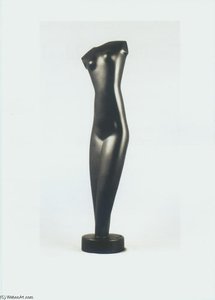
Бърз отговор
Най-известната картина на Александър Архипенко е The Boxers (La Lutte) (1914). Mask (1911) и Woman combing her hair (1914) са числата два и три. От 43 произведения на Александър Архипенко в нашия каталог, тези са 43-те най-известни, подредени по ранг, всяко с неговата година и музей, за да можете да изберете картината за поръчка.
Топ 10 картини на Александър Архипенко, подредени по популярност
Картини на Александър Архипенко, подредени от 11 до 43
Картини на Александър Архипенко по тема
Четирите най-често срещани сюжета в това класиране, с най-добрата картина за всеки от тях.
Women 11 произведения
Nudes 7 произведения
Royalty 3 произведения
Abstract form 2 произведения
Музеи, притежаващи оригинали на Александър Архипенко
3 музея, които притежават най-голям брой от картините на тази страница.
| Музеи | Град | Творения на Александър Архипенко | Картини от този списък |
|---|---|---|---|
| Вашингтон, окръг Колумбия | 1 | Standing Woman | |
| Хамилтън | 1 | Woman with Fan | |
| Oldenburg | 1 | Geometry |
Александър Архипенко по десетилетия: най-добрите картини за всяко от тях
Произведения по десетилетия
Изберете десетилетие, за да видите най-известната му картина.
Картини на Александър Архипенко: често задавани въпроси
Коя е най-известната картина на Александър Архипенко?Покажи отговора
The Boxers (La Lutte) (1914) заема първо място, последван от Mask (1911) и Woman combing her hair (1914).
На каква възраст е бил Александър Архипенко, когато е нарисувана The Boxers (La Lutte)?Покажи отговора
Александър Архипенко е бил на 27 години: The Boxers (La Lutte) е датирана 1914, а Александър Архипенко е роден в 1887.
Кои са 10-те най-добри картини на Александър Архипенко?Покажи отговора
The Boxers (La Lutte), Mask, Woman combing her hair, Standing Woman, Carafe, The Past, Nude, Seated Female Nude (Black Torso), Sorrow и The Gondolier. Годината и музеят за всяка са посочени в ранжирането по-горе.
Колко произведения на Александър Архипенко са изброени?Покажи отговора
В нашия каталог са включени 43 произведения на Александър Архипенко, датирани от 1909 до 1963.
Къде се съхраняват оригиналните картини на Александър Архипенко?Покажи отговора
Предимно в The Phillips Collection (Вашингтон, окръг Колумбия), Art Gallery of Hamilton (Хамилтън) и Oldenburg State Museum for Art and Cultural History (Oldenburg). Вижте таблицата с музеи по-горе за пълния списък.
Коя е епохата, в която са създадени най-известните картини на Александър Архипенко?Покажи отговора
В 1910s: 12 от 43 картините, класирани тук, са от това време, включително The Boxers (La Lutte).
Кои са най-ранните и най-късните известни картини на Александър Архипенко?Покажи отговора
Най-стара на тази страница: Sorrow (1909). Най-нова: King Solomon (1963).
Какви са основните сюжети в картините на Александър Архипенко?Покажи отговора
Сред 43 картини, класирани тук: Women (11), Nudes (7) и Royalty (3).
С кое художествено направление е свързан(а) Александър Архипенко?Покажи отговора
Cubism, въз основа на картините, класирани на тази страница.
За художника: Александър Архипенко
A Pioneer of Cubist Sculpture: The Life and Art of Alexander Archipenko
Alexander Porfyrovych Archipenko, born in Kyiv, Ukraine, on May 30, 1887, stands as a monumental figure in the evolution of modern sculpture. His journey, marked by a restless spirit and an unwavering pursuit of artistic innovation, fundamentally reshaped our understanding of three-dimensional form and space. From his early training in Kyiv to his eventual embrace of American art, Archipenko’s life was a testament to his dedication to pushing the boundaries of creative expression. He passed away on February 25, 1964, leaving behind a legacy that continues to inspire artists and scholars alike.- Early Years and Artistic Foundations: Archipenko's formative years in Kyiv instilled within him a deep appreciation for both Western artistic traditions and the rich visual heritage of his native Ukraine. He initially studied painting and sculpture, absorbing influences from classical forms and Byzantine iconography. This early exposure laid the groundwork for his later experimentation with abstraction and geometric principles.
- Parisian Awakening: A pivotal moment in Archipenko’s career arrived in 1908 when he relocated to Paris, a city teeming with artistic ferment. He quickly immersed himself in the avant-garde circles of La Ruche, encountering artists like Fernand Léger and Vladimir Baranoff-Rossiné – figures who shared his desire to challenge conventional artistic norms. This environment proved crucial in shaping his Cubist sensibilities.
Deconstructing Form: The Birth of a New Sculptural Language
Archipenko’s artistic vision was profoundly shaped by the burgeoning Cubist movement, yet he wasn't content merely to translate painting’s fractured perspectives into three dimensions. He sought to fundamentally redefine sculpture itself. Where traditional sculptors focused on solid mass and volume, Archipenko began exploring the power of *negative space* – voids that became integral components of his compositions. This daring approach challenged the very definition of form, suggesting that a sculpture could be defined as much by what wasn’t there as by what was. He masterfully manipulated convex and concave surfaces, creating dynamic interplay of light and shadow, imbuing his works with an unprecedented sense of movement and energy. This innovative spirit led to the creation of “sculpto-paintings,” where he boldly incorporated painted color onto intersecting planes, blurring the lines between sculpture and painting. Inspired by Cubist collage techniques, Archipenko further expanded his material palette, incorporating glass, wood, and metal into his sculptures – most notably in his captivating “Medrano” series depicting circus performers. These works weren’t simply representations of figures; they were investigations into the very essence of sculptural possibility. Key Innovations:- Negative Space: Archipenko's radical use of voids redefined sculpture, shifting the focus from solid mass to the interplay of positive and negative forms.
- Sculpto-Paintings: The integration of painted color onto intersecting planes blurred the boundaries between sculpture and painting, creating a dynamic visual experience.
- Geometric Abstraction: Archipenko’s work embraced geometric abstraction, reflecting the principles of Cubism while forging its own unique aesthetic language.