Olive Rogers (born circa 1897, Milford Haven, Wales; died 1986) stands as a singular figure in the landscape of early 20th-century American painting. Largely unrecognized during her lifetime, Rogers’s work—characterized by its bold color palettes and emotionally charged depictions of rural Welsh life—has garnered considerable acclaim posthumously, cementing her place within the canon of Regionalist art and demonstrating an enduring fascination with capturing the essence of human experience against a backdrop of natural beauty. Her artistic vision transcended mere representation; it sought to distill the soul of a place and its inhabitants into luminous canvases that spoke volumes about the human condition.
Rogers’s formative years were steeped in Celtic folklore and landscape painting traditions, nurtured within the vibrant cultural milieu of Milford Haven. These influences profoundly shaped her artistic sensibilities, prompting her to explore innovative approaches to color and form—a deliberate departure from the prevailing stylistic conventions of the time. Notably, she drew inspiration from artists like Roger Fry and Roger de la Fresnaye, whose groundbreaking experiments with Cubism challenged established notions of visual perception and encouraged a more subjective engagement with art. This intellectual curiosity fueled Rogers’s artistic evolution, propelling her toward a distinctive style that prioritized intuitive harmonies over meticulous detail.
Her artistic output spanned several decades, resulting in approximately 150 paintings and drawings primarily focused on Welsh landscapes and portraits. Rogers meticulously documented scenes from daily life—farmers tending their fields, children playing outdoors—transforming commonplace moments into meditations on time, memory, and identity. Her technique involved layering thin washes of color onto textured surfaces – often prepared with gesso or sand – creating luminous effects that captured the subtle nuances of light and atmosphere. This meticulous attention to textural detail served as a crucial element in conveying Rogers’s profound emotional resonance; it allowed her to imbue each canvas with an unparalleled sense of immediacy and psychological depth.
A pivotal juncture in Rogers's artistic trajectory occurred with her relocation to New York City in 1923, where she embraced the burgeoning avant-garde movement. Although initially experimenting with Surrealist techniques—influenced by André Breton—Rogers swiftly recognized that her artistic core lay elsewhere. She resolutely returned to her foundational aesthetic principles, prioritizing emotional expression and vibrant color palettes over intellectual abstraction. Her paintings from this period – “Warship, Milford Haven” and “Abstract (Fantasy Cliffs & Sea View)” – exemplify her masterful command of tonal modulation and textural variation, conveying an unparalleled sense of psychological depth and capturing the ethereal beauty of Welsh coastal vistas.
Rogers’s enduring legacy extends beyond her artistic accomplishments; she established Musée d'Art Roger-Quilliot in Clermont-Ferrand, France, dedicating herself to fostering artistic dialogue and promoting the appreciation of regionalist art. Today, Olive Rogers’s paintings are housed in prestigious institutions across the United States and Europe—a testament to her unwavering commitment to artistic excellence and a beacon of inspiration for generations of artists—solidifying her place as one of America's most significant Regionalist painters and ensuring that her evocative vision continues to captivate audiences worldwide.
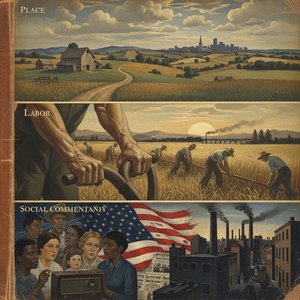
Explore American Regionalism's powerful depiction of the American heartland during the Great Depression. Discover Grant Wood, Thomas Hart Benton & more. Expert analysis & high-quality art reproductions at AllPaintingsStore.
Explore the profound history of American Regionalism. Discover how Grant Wood captured the heart of the Midwest through masterpieces like American Gothic. An expert guide to the movement, its cultural impact, and the enduring beauty of American Realism.
Discover Julian Alden Weir, a leading American Impressionist painter celebrated for his serene landscapes & depictions of rural life. Explore his artistic evolution, influence on 'The Ten', and legacy at Weir Farm.
AАтелие КонсиержНа линия · отговаря в рамките на минута
Здравейте! Мога да ви помогна с избора на произведение на изкуството, проследяването на поръчка или отговори на въпроси относно гаранцията. С какво мога да ви бъда полезен?