The Life and Training of Adrian Lamb
Adrian Lamb enters the scene in New York City, born on March 22, 1901. The mid-1920s find him immersed in the rigorous discipline of the Art Students League. Here, the foundations of his technique take shape under the direct instruction of Frank Vincent DuMond and George Bridgman. He moves through these formative years with a focus on the mechanics of form and the nuances of light.
The trajectory shifts in 1929. Lamb travels to Paris to attend the Académie Julien, a move that places him at the heart of European artistic tradition. This period marks a departure from his American roots. Following his time in Paris, he moves through England and France, working and traveling across the continent. This movement through different landscapes and cultures informs the breadth of his perspective before he establishes himself as a fixture in American portraiture.
His life concludes in 1989. Throughout his decades of practice, the transition from landscape painting to the study of human character remains the central arc of his career.
Artistic Style and Technical Approach
The brushwork begins with the landscape. Before turning his attention to the human face, Lamb spent his formative years observing the natural world, a period that established his foundational command of light and space. This early focus on scenery eventually gave way to portraiture, yet the influence of European traditions remained. He draws from the sensibilities of Claude Monet and Vincent van Gogh, integrating their approaches to light and texture into a more structured, realistic framework. His technique relies on meticulous detail and subtle tonal gradations to build form, moving away from the broad strokes of pure Impressionism toward a more controlled, precise execution.
He approaches a sitter not as a static object, but as a psychological landscape. His realism aims for more than a mere physical likeness; he seeks the essence of the individual, attempting to capture the internal life behind the eyes. This focus on character often results in a sense of dignity and gravitas, particularly when depicting figures of significant social or historical standing. The weight of a subject's presence is rendered through careful attention to the texture of fabric and the nuanced shifts in facial expression, ensuring the sitter's personality is as palpable as their physical features.
Notable Portraits and Key Works
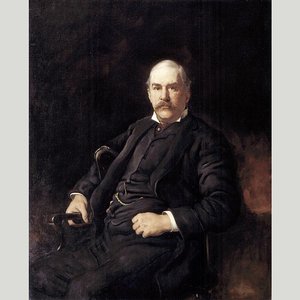
The canvas often serves as a meeting point between Lamb and the architects of American history. His early work includes a depiction of Theodore Roosevelt about 1908. Later, his brush captured the weight of leadership in his depictions of Franklin Delano Roosevelt and J.P. Morgan III. These portraits focus on the dignity and gravitas inherent in their subjects, moving beyond simple likeness to reach the core of their character.
The mid-20th century saw Lamb engaging with the titans of industry and civic life. In 1962, he painted R. L. Bowen, the chairman of the board of Community Public Service. This period also produced significant studies of immense wealth and influence, including John Pierpont Morgan, Sr. in 1966 and John D. Rockefeller, Sr. in 1967. These works function as visual meditations on the figures who shaped the economic landscape of the era.
In his later years, Lamb turned toward more symbolic and neoclassical themes. His 1971 portrait of Joseph Smith utilizes a neoclassical approach, emphasizing authority and contemplation through dramatic detail. This late-career precision remains a hallmark of his technical ability to render human presence with profound psychological depth.
- Theodore Roosevelt, about 1908
- John Pierpont Morgan, Sr., 1966
- John D. Rockefeller, Sr., 1967
- Joseph Smith, 1971
Legacy and Artistic Impact
The influence of Adrian Lamb persists in the work of subsequent generations of portrait artists. These painters look toward his commitment to realism and his capacity to convey psychological depth. His paintings do more than record a face; they possess a specific ability to evoke empathy in viewers. This connection stems from his focus on the inner life of the subject, a quality that ensures his work continues to resonate with audiences today.
His legacy rests on a foundation of technical achievement and a steadfast belief in the transformative potential of painting. He remains a pivotal figure in American artistic history. By bridging the gap between mere representation and the complexities of human emotion, he helped define a specific standard for 20th-century American portraiture.
Otázky a odpovědi
Kolik děl umělce Adrian Lamb je možné si prohlédnout?
Na stránce Všechná umělecká díla si můžete prohlédnout 5 uměleckých děl děl autora Adrian Lamb.
Pod jakými dalšími jmény nebo pseudony je Adrian Lamb známý/á?
Adrian Lamb se vystupuje även pod alternativními jmény Adrian Stymetz Lamb, Adrian S. Lamb.
Odkud pochází Adrian Lamb?
Adrian Lamb se narodil(a) v United States.
Mohu si prohlédnout díla umělce Adrian Lamb podle uměleckých směrů?
Stránka Všechna umělecká hnutí seskupuje díla umělce Adrian Lamb podle jednotlivých uměleckých směrů.