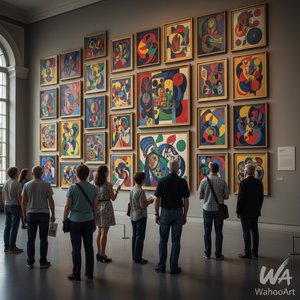
Albert Contreras: A Second Act of Color and Form
Born in Santa Monica, California, in 1933, Albert Contreras’s artistic journey was a testament to the enduring power of delayed expression and a profound connection to the tactile nature of paint. His life, marked by periods of intense creative output followed by decades of quiet contemplation, offers a compelling narrative within the broader context of mid-20th century American art – particularly the evolving landscape of abstract expressionism and minimalism. Contreras’s work isn't easily categorized; it exists in a space between these movements, imbued with a unique sensibility shaped by his experiences as a sanitation engineer, a period of deliberate detachment from the artistic world that ultimately fueled an extraordinary resurgence of creativity.
Contreras initially began painting in the early 1960s, deeply influenced by the burgeoning currents of abstract expressionism and the nascent explorations of minimalism. His early canvases, exhibited at Peter Mendenhall Gallery during this pivotal decade, demonstrated a bold engagement with color and form – vibrant hues layered over stark geometric shapes, reflecting the dynamism and experimentation characteristic of the era. These works, often characterized by their energetic brushwork and a sense of raw emotion, established him as a promising voice within the American art scene. However, around 1972, at the height of his early success, Contreras abruptly ceased painting, a decision he attributed to having achieved everything he’d set out to do. This wasn't a simple retirement; it was a conscious severing of ties with an artistic identity that had become, in his view, fully realized.
For the next 25 years, Contreras led a remarkably ordinary life, working as a sanitation engineer for the City of Santa Monica – a job he described as profoundly grounding and deeply satisfying. He found fulfillment in the physicality of his work, the tangible results of his labor, and the camaraderie of his colleagues. This period of deliberate inactivity was not one of artistic stagnation but rather a crucial period of personal reflection and re-evaluation. As Peter Mendenhall, his long-time gallerist and friend, noted, Contreras’s psychotherapy sessions provided him with the mental space to reconnect with his creative core. It was during this time that he began to quietly contemplate the nature of art itself, questioning its purpose and seeking a new direction.
The Resurgence: 1997 and Beyond
In 1997, after years of introspection, Contreras returned to painting with an intensity and urgency that belied his decades-long absence. This wasn’t simply a resumption of a previous career; it was the birth of a new artistic voice, informed by both his past experiences and his subsequent period of detachment. His later works represent a significant departure from his earlier geometric abstractions, embracing a more gestural and layered approach. Contreras began to experiment with unconventional materials – acrylic lacquer paint, glitter, sand, and pebbles – creating surfaces that were richly tactile and visually complex.
A defining characteristic of this second phase of his career was the use of black wood panels as a backdrop for his vibrant compositions. This stark contrast heightened the impact of the colors, emphasizing their luminosity and depth. Contreras’s palette became increasingly bold and expressive, moving beyond subtle gradations to encompass saturated hues and unexpected combinations. He frequently employed techniques that blurred the boundaries between painting and sculpture, building up thick impasto layers that created a sense of three-dimensionality. The incorporation of glitter, often applied in delicate, shimmering patterns, added an ethereal quality to his work, transforming them into mesmerizing kaleidoscopes of color and light.
A Unique Style: Abstract Expressionism Meets Minimalism
Contreras’s artistic style is remarkably difficult to pin down, existing as a compelling synthesis of abstract expressionism and minimalism. While he shared with the abstract expressionists a commitment to emotional intensity and spontaneous gesture, his later work moved away from the sprawling, gestural brushstrokes of artists like Jackson Pollock towards the more controlled and reductive forms of minimalist painters such as Donald Judd or Sol LeWitt. His canvases are often characterized by bold colors, distorted forms, and exaggerated expressions – yet these elements are deployed with a deliberate precision that reflects his minimalist sensibilities.
His work frequently features large-scale compositions, often employing circular motifs—sometimes simple circles, sometimes complex arrangements of concentric shapes—that evoke both spiritual and geometric associations. The use of unconventional materials, such as acrylic lacquer paint and glitter, further distinguishes his style, adding a tactile dimension to his paintings and creating surfaces that are richly textured and visually stimulating. The influence of Jay DeFeo’s monumental “Rose” is often noted in discussions of Contreras' work, particularly in the layering of paint and the creation of relief-like textures.
Legacy and Recognition
Albert Contreras left an indelible mark on the American art world, not only through his distinctive artistic style but also through his unwavering commitment to his craft. His works have been exhibited at numerous museums and galleries across the United States and Sweden, including the Museum of Modern Art in Stockholm and the Gothenburg Art Museum, ensuring that his art is accessible to a wide audience. He generously donated many of his paintings to university galleries and private collections, contributing significantly to the preservation and appreciation of his work for future generations.
Contreras’s story—a career punctuated by periods of intense creative activity followed by deliberate withdrawal—offers a poignant reflection on the nature of artistic identity and the importance of self-reflection. His legacy extends beyond his individual works, serving as an inspiration to artists who seek to challenge conventional notions of creativity and embrace the unexpected turns of life’s journey. He died in 2017 at the age of 84, leaving behind a body of work that continues to captivate and inspire viewers with its bold colors, dynamic forms, and profound sense of emotional depth.
Otázky a odpovědi
V jakém historickém období působil/a Albert Contreras (American, 1933 - 2017)?
Albert Contreras (American, 1933 - 2017) působil v období Modern. Toto období historicky vymezuje uměleckou činnost tohoto autora.
Existuje časová osa děl umělce Albert Contreras (American, 1933 - 2017)?
Prohlédněte si časovou osu děl umělce Albert Contreras (American, 1933 - 2017): na stránce Chronologie děl jsou díla seřazena podle data jejich vzniku.
Kolik děl umělce Albert Contreras (American, 1933 - 2017) je možné si prohlédnout?
Na stránce Všechná umělecká díla si můžete prohlédnout 4 uměleckých děl děl autora Albert Contreras (American, 1933 - 2017).