A Renaissance Woman of the Dutch Golden Age
In the vibrant, intellectually charged atmosphere of the seventeenth-century Netherlands, few figures shone with as much multifaceted brilliance as Anna Maria van Schurman. Born in Cologne in 1607 to a wealthy and noble Protestant family, her life was a testament to the power of intellect over the restrictive boundaries of gender. While many women of her era were confined to the domestic sphere, Schurman’s early years were defined by an insatiable hunger for knowledge. Under the tutelage of her father, Frederik van Schurman, she mastered Latin and various other classical languages by the tender age of four, setting the stage for a life that would bridge the gap between the delicate arts and the rigorous world of philosophy.
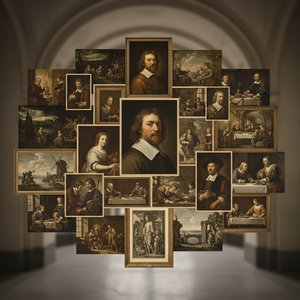
As her family moved to Utrecht in 1623, Schurman became a central figure in the city's burgeoning intellectual scene. She was not merely a student but a polymath whose talents spanned the spectrum of human creativity. Her hands were as skilled at the delicate art of embroidery and intricate paper cuttings as they were capable of wielding the tools of more permanent media. This versatility allowed her to navigate both the social expectations of a lady of distinction and the demanding technical requirements of a professional artist, earning her an honorary membership in the prestigious Guild of Saint Luke in Utrecht in 1643—a rare and profound recognition for a woman of her time.
The Intersection of Artistry and Scholarship
Schurman’s artistic development was deeply intertwined with her scholarly pursuits. While she maintained that much of her learning was self-directed, the influence of established masters provided a vital foundation for her technical mastery. In the 1630s, she sought instruction in drawing and engraving from Magdalena van de Passe, a pioneering female engraver whose work helped pave the way for women in the graphic arts. Through this training, Schurman developed a command over various mediums, producing small-scale portraits, self-portraits, and sculptures crafted from wax or boxwood. Her work often possessed a refined elegance, mirroring the precision found in her celebrated calligraphy.
Her artistry was never an isolated endeavor; it served as a visual extension of her profound linguistic and philosophical capabilities. To observe her calligraphy was to witness a symphony of script, as she could transcribe complex texts in over a dozen ancient and modern languages. This ability to marry the aesthetic beauty of the written word with deep intellectual content made her a sensation across Europe. She became known as the "Utrecht Minerva," a title that bestowed upon her the mantle of the goddess of wisdom, reflecting her status as a scholar who could navigate the complexities of science, literature, and theology with equal grace.
A Legacy of Intellectual Defiance
Beyond the physical beauty of her engravings and portraits lies a legacy of profound social significance. Schurman was a vocal advocate for the education of women, publishing dissertations and treatises that challenged the prevailing notion that women were unfit for the rigors of academic study. Her correspondence network was a who's who of the seventeenth-century intellectual elite, including luminaries such as René Descartes and Constantijn Huygens. Through these letters, she engaged in the most pressing debates of her day, asserting the right of the female mind to participate in the advancement of human knowledge.
However, her life also underwent a dramatic spiritual transformation. In her later years, her devotion to the Labadist community—a Protestant sectarian group—led her to retreat from the secular pursuits of science and classical literature. While this shift moved her away from the public intellectual stage, it did not diminish the impact of her earlier contributions. Anna Maria van Schurman remains a singular icon of the Dutch Golden Age: a woman who refused to be contained by a single frame, much like the very art she created, leaving behind a trail of inspiration for every artist and scholar who dares to transcend the limits of their era.