Early Life and Florentine Training
Lodovico Cardi, known universally as Cigoli, emerged in the vibrant artistic landscape of late 16th-century Florence on September 21st, 1559. Born at Villa Castelvecchio near his namesake town, Cigoli’s initial artistic formation took place under Alessandro Allori, a fervent proponent of Mannerism—a style characterized by elongated forms, stylized poses, and often complex compositions. This early training steeped him in the traditions of Florentine painting, but it was not merely imitation that defined his path. He diligently studied the masters who preceded him: Michelangelo’s powerful figures, Correggio’s graceful dynamism, Andrea del Sarto's refined technique, and Pontormo’s emotive intensity all left their mark on the young artist. However, Cigoli wouldn’t remain confined by the strictures of Mannerism; a shift was brewing within his artistic sensibility, one that would ultimately lead him to embrace a more expressive and emotionally resonant style. The influence of Santi di Tito, a key figure in the “Counter-Maniera” movement, proved pivotal, encouraging him to move beyond stylistic artifice towards greater naturalism and emotional depth.The Roman Period and Artistic Maturity
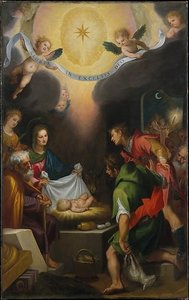
Around 1608, Cigoli relocated to Rome, marking a turning point in his career. He quickly gained recognition within the city’s competitive artistic circles, securing commissions from prominent patrons like Massimo Massimi. A particularly noteworthy early work for Massimi was an *Ecce Homo*, originally intended for Palazzo Pitti. This painting became emblematic of the evolving artistic climate—Massimi had also commissioned works on the same subject from Passignano and Caravaggio, creating a fascinating comparison point between three distinct approaches to religious imagery. The *Ecce Homo* itself eventually found its way to the Louvre during the Napoleonic era before being returned to Florence in 1815. During his time in Rome, Cigoli’s style underwent a significant transformation. He moved away from the cool elegance of his earlier Florentine works, embracing a more dramatic use of light and shadow, richer color palettes, and an increased focus on emotional intensity—characteristics that would come to define his mature Baroque style. Paintings like *St. Peter Healing the Lame Man* in St. Peter’s Basilica showcased this newfound power, earning him accolades from contemporaries such as Andrea Sacchi, who hailed it as one of the three most beautiful paintings in Rome alongside Raphael's *Transfiguration* and Domenichino’s *The Last Communion of St. Jerome*.Innovation and Influence: A “Divine” Painter
Cigoli’s reputation soared during his Roman period, solidifying his position as a leading artist of his time. He was not merely a skilled technician; he possessed an exceptional ability to convey emotion and spiritual depth through his work. Baldanucci, in his *Notizie or lives of the artists*, uniquely bestowed upon Cigoli the title of “Divine,” alongside Michelangelo—a testament to the profound impact he had on his contemporaries. His influence extended beyond the realm of painting; he fostered a thriving workshop, attracting numerous pupils including Cristofano Allori (1577–1621), Giovanni Biliverti (1576–1644), Domenico Fetti, Giovanni Antonio Lelli, Aurelio Lomi, Pietro Medici, Gregorio Pagani, and Andrea Comodi (1560–1638). But perhaps his most significant contribution lay in his willingness to embrace new scientific discoveries and integrate them into his art.Galileo’s Moon and the Dawn of a New Visual Language
Cigoli enjoyed a close personal friendship with Galileo Galilei, whom he considered the greatest painter of the age—a remarkable statement from an artist about a scientist. This connection culminated in a groundbreaking fresco for the dome of the Pauline chapel in Santa Maria Maggiore in Rome. The image depicted the Madonna standing upon a lunar orb, but it was not just any depiction of the moon. It was a representation based on Galileo’s own observations and drawings published in his 1610 treatise *Sidereus Nuncius*. Prior to this, depictions of the moon in religious art were invariably mythical and smooth, adhering to Platonic and Ptolemaic cosmological models. Cigoli's fresco, however, presented a pockmarked, physically textured lunar surface—the first extant example of Galileo’s discoveries penetrating the visual arts practice of his day. This innovative depiction signaled a shift towards scientific accuracy in art, bridging the gap between observation, knowledge, and artistic representation.Legacy and Major Works
Lodovico Cardi died on June 8th, 1613, leaving behind a rich legacy of paintings that continue to captivate audiences today. Beyond the works already mentioned, other significant achievements include *Cain Slaying Abel*, *Venus and Satyr*, *Sacrifice of Isaac* (all for the Pitti Palace), and his unfinished *Burial of St. Paul* in San Paolo fuori le Mura. His *Story of Psyche* fresco within Villa Borghese remains a testament to his skill as a decorative painter, while his *Martyrdom of Stephen* at Florence further cemented his reputation as a master of emotional expression. Cigoli’s work represents a crucial transition between the late Mannerist and early Baroque periods, blending stylistic elegance with dramatic intensity and a newfound commitment to realism—a legacy that continues to inspire artists and scholars alike. His willingness to embrace scientific advancements, particularly through his collaboration with Galileo, marks him as a truly innovative figure in the history of art, one who helped usher in a new era of visual representation.Otázky a odpovědi
V jakém městě a z jaké země pochází Cigoli?
Cigoli se narodil(a) ve městě Cigoli v zemi Itálie.
Mohu si prohlédnout díla umělce Cigoli podle použité techniky?
Stránka Podle techniky seskupuje díla umělce Cigoli podle použité techniky.
Kde mohu vidět díla umělce Cigoli v 3D galerii?
Možná je i virtuální prohlídka: na stránce 3D galerie umělce Cigoli můžete obdivovat jeho díla v trojrozměrné galerii.
Kde najdu díla umělce Cigoli uspořádaná podle tématu?
Stránka Atlas témat umělce Cigoli umožňuje prohlížet jeho díla podle jejich témat.