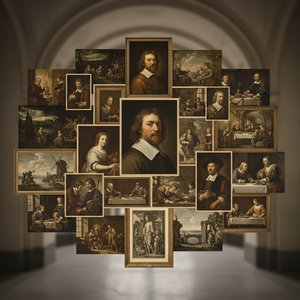
A Renaissance Polymath Bridging Art and History
Caspar Barlaeus, born as Caspar van Baerle in 1584, stands as a remarkable figure of the Dutch Renaissance, embodying an extraordinary blend of artistic talent and scholarly pursuits. Born in Antwerp, Belgium, he navigated the turbulent waters of his era—marked by religious upheaval and burgeoning exploration—leaving behind a legacy that continues to fascinate historians and art connoisseurs alike. His multifaceted intellect extended far beyond the canvas, reaching into the realms of theology, poetry, and meticulous historical research, cementing his place as one of the most erudite minds of his time.
His early life was shaped by the profound humanist ideals that permeated Europe during the sixteenth century. As a child of Antwerp, a vibrant hub for Flemish art and commerce, Barlaeus was immersed in an environment ripe for intellectual and creative development. However, the shadows of conflict followed his family; as Spanish troops occupied his birthplace, his parents fled to Zaltbommel in the Dutch Republic. This displacement perhaps contributed to the restless, searching nature of his later work, as he moved through various disciplines including theology, philosophy, and even medicine.
The Intersection of Scholarship and Aesthetic Mastery
While history often remembers Barlaeus primarily as a theologian, poet, and professor at the Athenaeum Illustre in Amsterdam, his artistic output offers compelling glimpses into a deeply refined aesthetic sensibility. His paintings, though relatively modest in number compared to the prolific masters of the Dutch Golden Age, reveal a masterful command of color and composition. These works reflect the lingering influence of Mannerism, a stylistic movement characterized by dramatic contrasts and expressive, often elongated, figures that convey profound emotional depth.
In examining his notable paintings, such as Friburgum and Olinda, one observes a fascinating tension between the meticulous realism of the Renaissance and the more stylized distortions of the Mannerist tradition. His dedication to detail speaks to a scientific precision—likely honed during his medical studies in Caen—yet this is always tempered by an expressive quality that seeks to capture the soul of the subject. Through these canvases, Barlaeus bridged the gap between the analytical mind of the scholar and the emotive heart of the artist.
A Legacy of Intellectual and Artistic Synthesis
The historical significance of Caspar Barlaeus lies in his ability to synthesize disparate fields of knowledge into a cohesive worldview. He was not merely an observer of history but a participant in the shaping of Dutch intellectual life. His scholarly writings, including works like Rerum per Oct, alongside his poetic endeavors, demonstrate a man deeply engaged with the complexities of his age—from the theological debates of the Remonstrants to the burgeoning global expansion of the Netherlands.
Ultimately, Barlaeus represents the quintessential Renaissance man. His life was a testament to the idea that art and intellect are not separate endeavors but are deeply intertwined threads in the tapestry of human experience. Whether through the stroke of a brush or the careful composition of a historical text, he sought to illuminate the truths of his era, leaving behind a profound imprint on the cultural landscape of the seventeenth century.