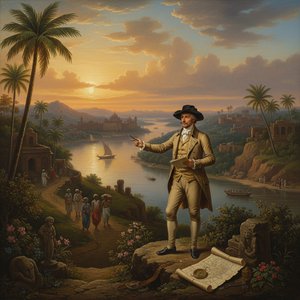
A Renaissance Man of the Orient
James Atkinson (1780–1852) was a figure of extraordinary breadth, a true polymath whose life story reads like an epic of the nineteenth century. Born in Darlington, England, to a family of humble origins, Atkinson’s journey from the industrial landscapes of Northern England to the vibrant, complex heart of colonial India is nothing short of remarkable. While history often remembers him as a distinguished surgeon and a profound Persian scholar, his artistic legacy provides a window into the soul of an era defined by exploration, discovery, and the romanticized gaze of the East. His life was a seamless tapestry woven from threads of medical precision, linguistic mastery, and a deeply evocative painterly vision.
His intellectual foundation was forged through rigorous academic discipline, having studied medicine in London and Edinburgh. This scientific training instilled in him an eye for meticulous detail—a quality that would later define his approach to both his scholarly translations and his canvases. Upon arriving in India in 1802 as a surgeon's mate, Atkinson did not merely observe the landscape; he immersed himself in its cultural and linguistic depths. His fascination with Persian culture led him to become a vital bridge between East and West, translating complex texts that brought the nuances of Middle Eastern thought to an English-speaking audience.
The Canvas of Colonial India
As an artist, Atkinson belonged to the burgeoning tradition of Orientalist painting, yet his work possessed a unique intimacy born of lived experience. Unlike many travelers who painted from hearsay or brief excursions, Atkinson’s art was rooted in his deep integration into Indian society. Influenced heavily by the renowned painter George Chinnery, Atkinson developed a style that captured the atmospheric splendor and the poignant realities of life in the subcontinent. His brushwork often reflected the influence of European Romanticism, utilizing light and shadow to imbue scenes of Indian landscapes and village life with a sense of spiritual depth and dramatic tension.
His paintings frequently moved beyond mere documentation, seeking instead to capture the emotional resonance of his surroundings. Whether depicting the ritualistic intensity of A Sati or Widow Burning or the rhythmic energy of festivals like Charakpuja, Atkinson’s work is characterized by a masterful command of color and a profound respect for his subjects. His ability to render the textures of draped fabrics, the heat of the tropical sun, and the solemnity of religious ceremonies allowed him to create works that were both visually stunning and culturally significant.
Legacy of a Scholar-Artist
The significance of James Atkinson lies in his refusal to be confined by a single discipline. He was a man who could navigate the delicate complexities of the Calcutta Mint, edit the Calcutta Gazette, and yet find profound peace in the depiction of an Afghan mountain pass or a Persian garden. His contributions were multifaceted:
- Linguistic Bridge: Through his scholarly translations, he facilitated a deeper understanding of Persian literature and culture within the British Empire.
- Visual Record: His illustrated books and paintings serve as invaluable historical documents, capturing the social fabric of 19th-century India and Afghanistan before the sweeping changes of late Victorian colonialism.
- Artistic Influence: As a pupil of George Chinnery, he helped propagate a specific style of Indian landscape painting that blended European technique with Eastern subject matter.
Ultimately, Atkinson remains a captivating figure of the Romantic age—a man whose life was defined by an insatiable curiosity and an enduring passion for the beauty found in the unknown. His legacy survives not only in the archives of medical history or linguistic studies but in the vibrant, enduring colors of his paintings, which continue to invite us into the vanished worlds he so lovingly documented.
Otázky a odpovědi
Mohu navštívit virtuální muzeum děl umělce James Atkinson?
Možná je i virtuální prohlídka: na stránce 3D galerie umělce James Atkinson můžete obdivovat jeho díla v trojrozměrné galerii.
Mohu si prohlédnout díla umělce James Atkinson podle uměleckých směrů?
Stránka Všechna umělecká hnutí seskupuje díla umělce James Atkinson podle jednotlivých uměleckých směrů.
Mohu si prohlédnout díla umělce James Atkinson podle nálady?
Díla umělce James Atkinson si můžete prohlédnout podle nálady na jeho stránce Galerie nálad, kde jsou umělecká díla uspořádána podle jejich vyvolané nálady.