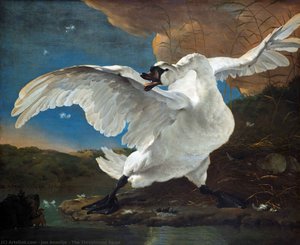
A Life Forged in Landscape: The World of Jan Asselijn
Jan Asselin, born around 1610 in Dieppe, France, embarked on an artistic journey marked by profound shifts in religious belief and a fervent dedication to capturing the splendor of the natural world. His family, Huguenots fleeing persecution, sought refuge in Amsterdam in 1621 – a vibrant metropolis brimming with commercial dynamism and burgeoning artistic innovation during the Dutch Golden Age. This relocation proved instrumental, immersing young Jean into an environment where landscape painting was undergoing a transformative metamorphosis, moving beyond traditional representations toward scenes imbued with palpable atmosphere and emotional resonance. Initially apprenticed to Jan Martszen the Younger, Asselijn honed his skills in battle paintings before discovering his true passion: portraying the breathtaking beauty and dramatic intensity of both landscapes and animal life. The distinctive Dutch light – expansive skies and subtle tonal variations – would become a cornerstone of his artistic style, profoundly shaped by his formative years.The Italianate Embrace & The Bentvueghels
Like many ambitious Northern European painters of his era, Asselijn recognized the importance of refinement in Italy, likely arriving sometime after 1635. He wholeheartedly embraced the *Italianate* aesthetic – a genre characterized by sun-drenched vistas, classical ruins, and pastoral landscapes brimming with romanticism. He joined the ranks of the *Bentvueghels*, a spirited society comprised of Dutch and Flemish artists residing in Rome. These “Birds of a Feather” defied convention, adopting outlandish nicknames and prioritizing direct observation – rejecting the constraints imposed by studio practice. Within this lively community, Asselijn earned the moniker "Krabbetje" (little crab) due to a physical disability affecting his hand—a detail that subtly acknowledged his personal challenge yet fueled his creative spirit. He absorbed inspiration from artists such as Pieter van Laer (Bamboccio), whose depictions of Roman peasant life and landscapes resonated deeply with Asselijn’s evolving vision. This period solidified his ability to convey mood, light, and narrative within his canvases—a skill that would define his artistic legacy.Mastering Light & Symbolism: Key Works
Upon returning to Amsterdam, Asselijn possessed a refined technique and a distinctive artistic voice. His paintings are distinguished by exceptional clarity of execution and masterful control over illumination – qualities that swiftly garnered admiration from contemporaries like Rembrandt, who even created etchings depicting Asselijn at work—a gesture perhaps sensitive to the artist’s physical impairment. While he produced historical and battle scenes, it was his landscapes and animal depictions that truly elevated him among his peers. The Threatened Swan, completed around 1640, stands as his most celebrated masterpiece. More than merely a visual representation of avian defense, this painting transcended its immediate subject matter to become a potent emblem of Dutch national resilience against external adversaries—a theme powerfully conveyed through the depiction of a swan fiercely protecting its eggs from encroaching dangers. The image resonated deeply with anxieties prevalent during Asselijn’s time and was interpreted as an allegory for Johan de Witt, a prominent Dutch statesman. Intriguingly, subsequent owners added symbolic inscriptions to the canvas – “Holland” on one of the eggs and “Enemy of the state” positioned beside the menacing dog—further cementing its political significance. Other noteworthy compositions include Cavalry Attack at Sunset, showcasing his initial training in battle painting with dramatic flair, and depictions of rural life like Drovers with Cattle Under an Arch of the Colosseum – a piece that seamlessly blends Italianate landscapes with meticulous animal studies. This artwork exemplifies Asselijn’s capacity to capture fleeting moments of grandeur and convey nuanced emotional depth.Influence & Legacy: A Lasting Impression
Jan Asselijn's influence extended far beyond his prolific output. He was revered by artists such as Rembrandt, who produced etchings documenting Asselijn’s artistic process—a gesture indicative of mutual respect for the artist’s physical condition. Furthermore, he served as a mentor to Frederik de Moucheron, another influential Dutch landscape painter who championed the Italianate style and disseminated its aesthetic principles throughout Europe. Asselijn's innovative approach to light and atmosphere profoundly impacted subsequent generations of painters—laying the groundwork for greater naturalism and emotional resonance in landscape art. His enduring works are housed in prestigious institutions like the Rijksmuseum in Amsterdam, ensuring his artistic legacy persists as a cornerstone of Dutch Golden Age artistry. He passed away peacefully in 1652, leaving behind an oeuvre that continues to captivate viewers with its beauty, dramatic intensity, and subtle layers of symbolic meaning—a testament to his enduring contribution to European art history.Otázky a odpovědi
Odkud pochází Jan Asselijn?
Jan Asselijn se narodil(a) v Francie.
Jaké nálady vyjadřují umělecká díla umělce Jan Asselijn?
Stránka Galerie nálad umělce Jan Asselijn nabízí prohlížení jeho děl rozřazených podle nálady.
Jaké barvy používal/a Jan Asselijn nejčastěji?
Barevný profil děl umělce Jan Asselijn naleznete na jeho stránce Genom palety.