A life in Bern and Stuttgart
Joseph Plepp lived through the early decades of the seventeenth century, moving between the familiar streets of Bern and the workshops of Stuttgart. Born in 1595 to Hans Jakob Plepp, a glass painter, and Salome Heintz, his hands were trained in the traditions of craftsmanship from a young age. His time in Germany brought him into contact with different styles, yet by 1622, he had returned to his home in Switzerland. In Bern, he took on roles that required both an eye for detail and a sense of structure, working as a painter, architect, and even a city planner.
His work often touched the very fabric of the city itself. He contributed to the facade paintings of the Bernese bailiff's castle and worked on the appearance of the Käfigturm. There was a practical side to his artistry, seen in how he updated the Herrengassbrunnen system and connected it to the local drinking water pipeline. His life was tied to the physical growth and maintenance of the places he inhabited.
The precision of the map and the etching
Beyond the walls of buildings, Plepp looked outward at the landscape through the lenses of cartography and engraving. He possessed a way of capturing territory that relied on accuracy rather than flourish. His maps, such as the 1623 oil painted view of Bern and the Bremgarten Forest, show a focus on the specific placement of landmarks and the flow of the Aare loops. In 1638, he produced a copper engraved map of the Old Bernese national territory, a work that remained faithful to earlier records while updating the names and details of the land.
His etchings and engravings documented specific Swiss locations with a quiet clarity:
- The town of Nyon, captured in 1637.
- Views of Lenzburg and Aarburg, which later served as models for other topographical works.
- A depiction of the Grindelwald Glacier from 1642.
- Bird's eye views of Lenzburg that recorded the town's layout in 1628.
Still life and portraiture
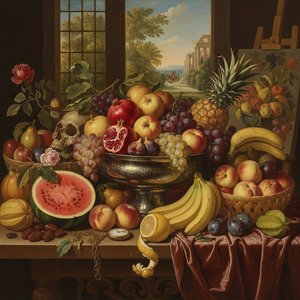
When he was not mapping borders or planning streets, Plepp turned his attention to smaller, more intimate subjects. His still life paintings often featured the simple textures of food and fruit. One can see the weight of a plate of apples or the specific arrangement of cherries, blueberries, strawberries, apricots, and gooseberries. These works, like his 1632 piece held in the State Hermitage, focus on the physical presence of the objects on the table.
He also recorded the faces of his era. His oil on panel portrait of Gustav Adolf, King of Sweden, shows a different side of his technical skill, moving from the topographical to the human. Through these varied tasks—from the large-scale planning of a city to the fine lines of an etching or the soft skin of a fruit—he left behind a record of the Swiss Baroque era as it was lived and seen.
Otázky a odpovědi
Kde najdu díla umělce Joseph Plepp uspořádaná podle barvy?
Díla umělce Joseph Plepp si můžete prohlédnout podle barev na jeho stránce Sestavení podle barev.
Mohu si prohlédnout díla umělce Joseph Plepp podle tématu?
Díla umělce Joseph Plepp si můžete prohlédnout podle tématu na stránce Atlas témat.
Kde mohu najít statistiky o dílech umělce Joseph Plepp?
Statistiky o dílech umělce Joseph Plepp naleznete na jeho profilové stránce Statistiky.
Odkud pochází Joseph Plepp?
Joseph Plepp se narodil(a) v Switzerland.