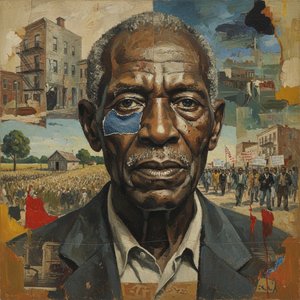
The Resonance of Presence: The Art of Lhola Amira Mbongwa
Born in 1984 amidst the complex, transformative landscape of Guguletu, South Africa, lhola amira mbongwa has emerged as a profound voice in contemporary interdisciplinary art. Her practice is not merely an aesthetic pursuit but a spiritual and political inquiry that transcends the boundaries of photography, video installation, and sculpture. At the heart of her creative universe lies the concept of ubuciko—a Xhosa principle signifying arrival or presence. For Amira, art is an act of appearing, a deliberate manifestation of identity that refuses to remain invisible. Her work serves as a bridge between the tangible world and the ancestral realms, navigating the heavy shadows of colonial history while illuminating paths toward healing and reclamation.
Amira’s artistic evolution is deeply intertwined with the socio-political currents of post-apartheid South Africa. Growing up in a context shaped by systemic injustice, she developed an acute sensitivity to the ways in which power structures attempt to erase or flatten cultural identities. This awareness led her to embrace a rhizomatic approach to storytelling, heavily influenced by the philosophical frameworks of Deleuze and Guattari. By rejecting linear, colonial narratives in favor of multiplicity and interconnectedness, she challenges established hierarchies. Her engagement with queer theory further enriches this complexity, allowing her to explore the fluidity of existence and the importance of acknowledging difference within a landscape that often demands conformity.
Ancestral Echoes and the Architecture of Healing
The work of Lhola Amira Mbongwa is characterized by an intense, sensory engagement with memory. She views objects not as static representations but as active triggers for remembrance—vessels that carry purpose and signal the presence of what has been lost or suppressed. This philosophy is most vibrantly realized in her monumental installations, such as Philisa: Ditaola. In this work, she creates immersive portals where the boundaries between the viewer and the ancestral spirit begin to blur. Through the use of meticulously crafted beaded curtains, sea salt, and the haunting echoes of recorded song, she constructs a ceremonial space designed for rejuvenation.
In these installations, Amira invites the audience into a state of deep listening. Her practice demands an attentiveness to the subtle rhythms of the earth: the movement of water, the texture of soil, and the silent histories embedded in bone and blood. This process is deeply rooted in African Nguni spiritualism, particularly the Zulu notion of Ukuvela, which situates an individual’s existence within a vast continuum of collective historical and future narratives. By focusing on these currents of energy, known as umlibo womoya, she transforms the act of viewing art into a ritual of self-care and ancestral reconnection.
Legacy and Contemporary Significance
Amira’s contribution to the global contemporary art dialogue lies in her ability to confront the trauma of colonization without becoming trapped by it. While her work unflinchingly addresses the wounds left by colonial imposition, it is fundamentally an art of resilience and reconstruction. She creates much-needed sanctuaries where the reclamation of Black identity and the celebration of queer existence can occur through a lens of spiritual reverence. Her ability to weave together disparate elements—the physical weight of salt, the translucency of glass, and the ephemeral nature of sound—positions her as a master of atmosphere and meaning.
As her practice continues to expand onto international stages, such as the Biennale of Sydney, Lhola Amira Mbongwa remains a vital figure in the movement to decolonize the gaze. Her work stands as a testament to the power of memory to act as medicine, proving that by listening to the silences and finding the wounds, we may ultimately find the strength to heal both ourselves and our ancestors.