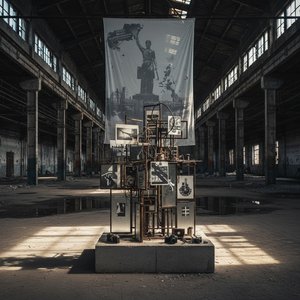
A Spatial Disorientation: The World of Monika Sosnowska-Królak
Monika Sosnowska-Królak, born in 1972 in the Polish town of Ryki, is an artist who fundamentally alters our perception of space. Her large-scale installations aren’t merely sculptures *in* a space; they are interventions that redefine it, twisting familiar architectural elements into disorienting and thought-provoking configurations. Sosnowska doesn't build new worlds so much as she deconstructs ours, revealing the inherent instability and subjectivity of our surroundings. Her work is a compelling exploration of how we navigate—both physically and mentally—the structures around us, challenging the very foundations of order and stability.
From Canvas to Construction: An Evolving Practice
Sosnowska’s artistic journey began with painting at the University of Fine Arts in Poznań. However, she soon found herself constrained by the two-dimensional plane. A pivotal shift occurred during her studies; as she described it, “the painting started to escape her canvas.” This realization propelled her towards a more immersive and expansive medium—space itself. She continued her education at the Rijksakademie van beeldende kunsten in Amsterdam, further refining her approach to spatial manipulation. Early works involved playing with the boundaries between painting and three-dimensional form, but she ultimately abandoned the canvas altogether, embracing architecture as her primary material. This wasn’t simply a change of medium; it was a conceptual leap—a move from representing space to *being* in space, actively shaping it. Her initial explorations focused on altering existing structures, transforming them into mental landscapes that playfully distorted viewers' perceptions.
The Language of Concrete and Steel
Sosnowska’s signature aesthetic is defined by her use of construction materials—concrete, steel beams, rods, and pipes—often sourced from demolition sites or fabricated specifically for her installations. These are not pristine elements; they bear the marks of their previous lives, adding a layer of history and materiality to her work. She expertly manipulates these robust forms, bending, twisting, and reassembling them into impossible geometries. Staircases lead nowhere, hallways abruptly terminate, and ceilings buckle under unseen pressures. The resulting structures are simultaneously familiar and alienating, evoking a sense of unease and wonder. Her process is meticulously planned, always tailored to the specific site, creating works that exist for a limited time before being dismantled—a deliberate impermanence that underscores their conceptual nature. She isn’t interested in permanence but rather in the fleeting experience of spatial disruption.
Recognition and Influence
Sosnowska's talent quickly garnered critical acclaim. In 2003, she received both the prestigious Bâloise Prize at Art Basel and the Polityka's Passport award—a testament to her innovative approach and growing reputation within the art world. These accolades propelled her onto an international stage, leading to solo exhibitions in major museums and galleries worldwide, including EMMA – Espoo Museum of Modern Art (Finland), Zentrum Paul Klee (Berlin), and the Museum of Contemporary Art (New York). Her work has been featured in numerous group shows at institutions like Tate Modern (London) and Centre Pompidou (Paris), solidifying her position as a leading figure in contemporary sculpture. Sosnowska’s influence extends beyond the realm of visual art, inspiring architects and designers to reconsider the relationship between form, function, and perception. She represented Poland at the 52nd Venice Biennial in 2007, further cementing her international recognition.
Deconstructing Modernism: A Historical Dialogue
While seemingly abstract, Sosnowska’s work engages with a deeper historical context—specifically, the legacy of modernism and its utopian ideals. The clean lines, geometric forms, and emphasis on functionality that characterized modernist architecture are subtly subverted in her installations. By distorting and reassembling these elements, she challenges the rational paradigm of modernism, exposing its inherent limitations and contradictions. Her work often references the architectural landscape of Eastern Europe, reflecting the region’s complex relationship with the promises and failures of socialist urban planning. Sosnowska's sculptures are not merely aesthetic objects; they are critical commentaries on the built environment, prompting viewers to question the structures that shape their lives—both literally and figuratively. She creates beautiful visual puzzles and optical illusions, inviting us to reconsider our assumptions about space, order, and reality itself.