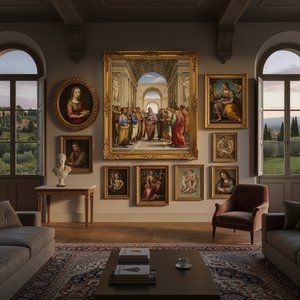
A Quiet Master of the Italian Renaissance: Pastorino de’ Pastorini
Pastorino de’ Pastorini, born in Castelnuovo dell'Ordine around 1508 and passing away in 1592, remains a somewhat enigmatic figure within the vast landscape of the Italian Renaissance. While not enjoying the widespread renown of contemporaries like Raphael or Michelangelo, Pastorino carved out a significant niche for himself as a portraitist and painter of religious scenes, particularly esteemed for his meticulous detail and graceful compositions. His work offers a fascinating glimpse into the artistic currents flowing beyond the major centers of Rome and Florence, reflecting both the influence of established masters and a distinctly personal style. The relative scarcity of documented information surrounding his life contributes to the allure of his paintings; each canvas becomes a precious clue in reconstructing the career of this dedicated artist.
Early Life and Formation
Born into a family likely involved in local craftsmanship, Pastorino’s early artistic training remains largely unknown. Castelnuovo dell'Ordine, nestled in the hills southeast of Rome, was a modest town but one connected to broader artistic networks through patronage and religious institutions. It is probable that he received his initial instruction from regional artists, absorbing the techniques prevalent in the area – a blend of Umbrian sweetness and Roman classicism. The influence of Perugino, whose style permeated central Italy, is often detected in Pastorino’s early works, particularly in the soft modeling of faces and the harmonious color palettes. He would have been exposed to the artistic fervor emanating from Rome, though likely not through direct apprenticeship with leading figures but rather via commissioned works circulating within the region. This formative period instilled in him a reverence for anatomical accuracy and a commitment to depicting religious narratives with clarity and emotional resonance.
A Career Defined by Portraiture and Devotion
Pastorino de’ Pastorini's artistic output centered primarily on two key areas: portraiture and religious painting. His portraits, though not numerous, are remarkable for their psychological insight and refined execution. He possessed a keen ability to capture the individual character of his sitters, moving beyond mere physical likeness to convey personality and social standing. His patrons were often members of the local nobility and clergy, reflecting his strong ties to the community surrounding Castelnuovo dell'Ordine.
Alongside portraiture, Pastorino dedicated considerable effort to religious subjects. These paintings frequently depict scenes from the life of Christ, the Virgin Mary, and various saints. He demonstrated a particular skill in rendering drapery, creating textures that appear both realistic and imbued with symbolic weight. His compositions are generally balanced and harmonious, prioritizing clarity and devotional feeling over dramatic flourishes.
The emphasis on serene beauty and pious expression became hallmarks of his style.
Influences and Artistic Style
Identifying Pastorino’s precise artistic lineage is a complex undertaking. While the early influence of Perugino is evident, he also absorbed elements from other Renaissance masters. The works of Raphael, though likely encountered through reproductions or secondary sources, seem to have informed his compositional arrangements and idealized forms.
However, Pastorino never simply imitated these artists. He synthesized these influences into a unique style characterized by:
- Meticulous attention to detail in facial features and clothing
- A soft, harmonious color palette dominated by blues, reds, and golds
- Balanced compositions that prioritize clarity and devotional feeling
- An emphasis on psychological realism in portraiture
- Graceful figures with a sense of quiet dignity
His paintings often feature a subtle sfumato technique, creating soft transitions between light and shadow. This contributes to the overall atmospheric quality of his work, enhancing its emotional impact.
Historical Significance and Legacy
Pastorino de’ Pastorini's historical significance lies not in revolutionary innovation but rather in his consistent dedication to artistic excellence within a specific regional context. He represents a generation of artists who skillfully blended established Renaissance principles with local traditions, creating works that resonated deeply with their communities. While he may not be a household name, Pastorino’s paintings offer valuable insights into the artistic landscape of 16th-century Italy beyond the major centers of power. His work serves as a reminder that the Renaissance was not solely defined by its most famous figures but also by countless dedicated artists who contributed to the richness and diversity of this transformative period.
His legacy endures through the captivating portraits and religious scenes that continue to inspire admiration for their detail, grace, and quiet beauty.