Záruka vrácení peněz · 100 dní Doprava po celém světě zdarma
646 446umělecká díla 53 409umělci 5 406muzea 32jazyky
Portrét Gino Severini

Obrazy umělce Gino Severini: 68 nejznámějších podle pořadí

Aktualizováno říjen 2026 · seřazeno podle našeho skóre popularity (vyhledávání, návštěvy a objednávky u každého díla) · 68 děl umělce Gino Severini v našem katalogu

Rychlá odpověď

Nejslavnější obrazem autora Gino Severini je The Pan Pan at the Monico (1959). Armored Train in Action (1915) a Waltz jsou čísla dvě a tři. Z 68 děl umělce Gino Severini v našem katalogu je zde 68 nejznámějších, seřazených podle popularity, s uvedením roku vzniku a muzea, abyste si mohli vybrat obraz k objednání.

1883 – 1966, Cortona Futurism Nejvíce děl: Art Institute of Chicago

Top 10 obrazů umělce Gino Severini, seřazeno

1
The Pan Pan at the Monico (1959) od Gino Severini

The Pan Pan at the Monico

1959 · Oil On Canvas

The scene unfolds within The Pan Pan at the Monico, a work that pulses with the energy of the Futurism style. Created in 1959 by the artist Gino Severini, this oil on canvas captures a moment of intense social motion. The painting exists as a replica, executed in Rome, following an earlier version that vanished decades ago. It brings the spirit of the early twentieth century into a new light…

2
Armored Train in Action (1915) od Gino Severini

Armored Train in Action

1915 · Oil On Canvas

The composition is dominated by a large, steel armored train that occupies the majority of the frame. This machine moves through an urban landscape, cutting through the environment with a sense of momentum. The train is rendered with sharp, angular lines and a palette of contrasting colors. Puffs of caustic smoke and steam rise from the engine, obscuring parts of the background and the sky. Within the scene, several figures…

3
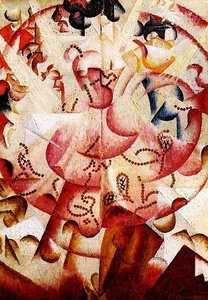
Waltz od Gino Severini

Waltz

Oil On Canvas

To gaze upon Gino Severini’s "Waltz" is not merely to observe a dance; it is to be swept into its very current. This painting captures the exhilarating, almost breathless energy of a Parisian nightclub in the early 20th century. The scene pulses with life—a dizzying confluence of bodies caught in the rhythmic embrace of the waltz. Severini has masterfully translated the ephemeral nature of movement into solid pigment, creating a…

5
Sea = Dancer (1914) od Gino Severini

Sea = Dancer

1914 · Oil On Canvas

Gino Severini's Sea=Dancer, created in 1914, is a quintessential example of Futurist art. This oil on canvas painting, currently housed at the Solomon R. Guggenheim Museum in New York, captures the essence of motion and dance with vibrant colors and dynamic brushstrokes. Inspiration and Technique Severini's inspiration for Sea=Dancer came from his vacation in Anzio, Italy, where he was captivated by the movement of the sea. The painting reflects this…

Obrazy umělce Gino Severini se řadí od 11 do 68

11Synthèse plastique de l’idée: Guerre (1915) od Gino SeveriniSynthèse plastique de l’idée: Guerre1915 · Bavarské státní sbírky malby 12Composition: The Dove (1930) od Gino SeveriniComposition: The Dove1930 13Harlequins (1954) od Gino SeveriniHarlequins1954 14Dancer = Propeller = Sea (1915) od Gino SeveriniDancer = Propeller = Sea1915 · Metropolitan Museum of Art 15Mosaic at the Church of St. Mark, Cortona, Italy od Gino SeveriniMosaic at the Church of St. Mark, Cortona, Italy 16Self-portrait od Gino SeveriniSelf-portrait 17Dancer + Sea + Equals Sailing Deck od Gino SeveriniDancer + Sea + Equals Sailing Deck 18Two Harlequins od Gino SeveriniTwo Harlequins 19The Boulevard (1911) od Gino SeveriniThe Boulevard1911 20Dancers at Monicos (1910) od Gino SeveriniDancers at Monicos1910 21Memories of Travel (1911) od Gino SeveriniMemories of Travel1911 22Portrait of Madame M-S (1912) od Gino SeveriniPortrait of Madame M-S1912 · Izraelské muzeum 23Dancer (1912) od Gino SeveriniDancer1912 24Dancer in Pigalle (1912) od Gino SeveriniDancer in Pigalle1912 25Maternity (1916) od Gino SeveriniMaternity1916 26Visual Synthesis of the Idea: ''War'' (1914) od Gino SeveriniVisual Synthesis of the Idea: ''War''1914 27Still Life (1916) od Gino SeveriniStill Life1916 28Suburban Train Arriving in Paris (1915) od Gino SeveriniSuburban Train Arriving in Paris1915 29Train of the Wounded (1913) od Gino SeveriniTrain of the Wounded1913 30Still Life with Marsala Bottle (1917) od Gino SeveriniStill Life with Marsala Bottle1917 31Plastic Rhythm of the 14th of July (1913) od Gino SeveriniPlastic Rhythm of the 14th of July1913 32Ballerina in Blue (1912) od Gino SeveriniBallerina in Blue1912 33Red Cross Train Passing a Village (1915) od Gino SeveriniRed Cross Train Passing a Village1915 34The Accordion Player (1919) od Gino SeveriniThe Accordion Player1919 35Maternity (1927) od Gino SeveriniMaternity1927 36Flowers and masks (1930) od Gino SeveriniFlowers and masks1930 37Window with Doves (1931) od Gino SeveriniWindow with Doves1931 38La Marchesa Maria De Seta (1937) od Gino SeveriniLa Marchesa Maria De Seta1937 39Odalisque with Mirrors (1942) od Gino SeveriniOdalisque with Mirrors1942 40Still Life with the Dome of St. Peter's (1943) od Gino SeveriniStill Life with the Dome of St. Peter's1943 41On the Beach (1948) od Gino SeveriniOn the Beach1948 42A dancer (1950) od Gino SeveriniA dancer1950 43A spring (1952) od Gino SeveriniA spring1952 44Still life (1949) od Gino SeveriniStill life1949 45Still Life (1955) od Gino SeveriniStill Life1955 46The Cyclist (1956) od Gino SeveriniThe Cyclist1956 47The musicians (1955) od Gino SeveriniThe musicians1955 48Ballerina (1954) od Gino SeveriniBallerina1954 49Commedia dell'Arte (1958) od Gino SeveriniCommedia dell'Arte1958 50Still Life: Barbera (1918) od Gino SeveriniStill Life: Barbera1918 · Art Institute of Chicago 51Harlequin (1965) od Gino SeveriniHarlequin1965 52Still Life with Violin (1964) od Gino SeveriniStill Life with Violin1964 53Self-portrait (1908) od Gino SeveriniSelf-portrait1908 54North-South od Gino SeveriniNorth-SouthGalleria Civica di Arte Moderna e Contemporanea Torino 55The Black Cat od Gino SeveriniThe Black CatNárodní galerie Kanady 56Untitled od Gino SeveriniUntitled 57Arrival od Gino SeveriniArrival 58Festival in Montmartre od Gino SeveriniFestival in MontmartreArt Institute of Chicago 59Dancers od Gino SeveriniDancers 60A dancer od Gino SeveriniA dancer 61The north-south od Gino SeveriniThe north-south 62Sea = Dancer od Gino SeveriniSea = Dancer 63Dancer + Sailing + Sea = Bouquet od Gino SeveriniDancer + Sailing + Sea = Bouquet 64Dynamism of a dancer od Gino SeveriniDynamism of a dancer 65Portrait of Madame M.S. od Gino SeveriniPortrait of Madame M.S. 66Ballerina - Bow - Sea od Gino SeveriniBallerina - Bow - Sea 67Still Life. Centrifugal Expansion of Colors. (1916) od Gino SeveriniStill Life. Centrifugal Expansion of Colors.1916 · Art Institute of Chicago 68Stations of the Cross (1947) od Gino SeveriniStations of the Cross1947

obrazy autora Gino Severini podle tématu

Čtyři nejčastější témata v tomto žebříčku, včetně nejvýraznějšího díla pro každé z nich.

Muzea, ve kterých jsou vystavena originálna umělce Gino Severini

6 muzea, v nichž je umístěno nejvíce obrazů z této stránky.

Muzea Město Díla autora Gino Severini Obrazy z tohoto seznamu
Art Institute of Chicago, ChicagoArt Institute of Chicago Chicago 3 Still Life: Barbera, Festival in Montmartre, Still Life. Centrifugal Expansion of Colors.
Bavarské státní sbírky malby, MnichovBavarské státní sbírky malby Mnichov 1 Synthèse plastique de l’idée: Guerre
Metropolitan Museum of Art, New YorkMetropolitan Museum of Art New York 1 Dancer = Propeller = Sea
Izraelské muzeum, JeruzalémIzraelské muzeum Jeruzalém 1 Portrait of Madame M-S
Galleria Civica di Arte Moderna e Contemporanea Torino, TurínGalleria Civica di Arte Moderna e Contemporanea Torino Turín 1 North-South
Národní galerie Kanady, OttawaNárodní galerie Kanady Ottawa 1 The Black Cat

Gino Severini podle desetiletí: nejlepší dílo každého

Díla podle dekád

Vyberte dekádu, abyste si prohlédli její nejvýznamnějšíjší obraz.

Obrazy autora Gino Severini: nejčastější dotazy

Který obraz od Gino Severini je nejznámější?Zobrazit odpověď

Na prvním místě je The Pan Pan at the Monico (1959), následuje Armored Train in Action (1915) a Waltz.

Kolik bylo Gino Severini let, když byl obraz The Pan Pan at the Monico namalován?Zobrazit odpověď

Gino Severini byl ve věku 76: dílo The Pan Pan at the Monico pochází z roku 1959 a Gino Severini se narodil v 1883.

Kterých 10 nejlepších obrazů má Gino Severini?Zobrazit odpověď

The Pan Pan at the Monico, Armored Train in Action, Waltz, Lancers, Sea = Dancer, Woman with Green Plant, The bear dance at the Moulin Rouge, Memories of Travel, The Haunting Dancer a The Concert. Rok a muzeum pro každé dílo jsou uvedeny v hodnocení výše.

Kolik děl umělce Gino Severini máte v nabídce?Zobrazit odpověď

V našem katalogu je 68 děl umělce Gino Severini, datovaných od 1908 do 1965.

Kde jsou uloženy originální obrazy autora Gino Severini?Zobrazit odpověď

Primárně v Art Institute of Chicago (Chicago), Bavarské státní sbírky malby (Mnichov) a Metropolitan Museum of Art (New York). Pro úplný seznam se podívejte do tabulky muzeí výše.

Které období se narodily nejznámější obrazy umělce Gino Severini?Zobrazit odpověď

V období 1910s: 25 z 68 obrazů zařazených zde pochází z této doby, včetně Armored Train in Action.

Která jsou nejstarší a nejnovější slavná díla umělce Gino Severini?Zobrazit odpověď

Nejstarší na této stránce: Self-portrait (1908). Nejnovější: Harlequin (1965).

Jakými hlavními motivy jsou obrazy Gino Severini?Zobrazit odpověď

Mezi 68 obrazy zařazenými v tomto žebříčku: Music (18), Roads (7) a Life (7).

V jaké technice je většina originálů od Gino Severini?Zobrazit odpověď

Oil On Canvas, u 4 z 68 obrazů zařazených v tomto žEBŘÍČKU.

S jakým směrem je spojen(a) Gino Severini?Zobrazit odpověď

Futurism a Cubism, na základě obrazů zařazených na této stránce.

Která originál díla Gino Severini se nachází v Art Institute of Chicago?Zobrazit odpověď

V muzeu Art Institute of Chicago, Chicago se nachází 3 z obrazů zařazených v tomto žebříčku, včetně Still Life: Barbera, Festival in Montmartre a Still Life. Centrifugal Expansion of Colors..

O umělci: Gino Severini

Early Life and the Seeds of Artistic Rebellion

Gino Severini emerged into the world on April 7, 1883, in the picturesque Tuscan town of Cortona, Italy. His beginnings were humble; his father a junior court official, his mother a dressmaker – a background that instilled in him both a sensitivity to form and an awareness of societal structures. Formal education proved ill-fitting for the young Severini’s restless spirit. Expelled at fifteen alongside classmates for a youthful indiscretion involving stolen exam papers, he found himself cast adrift from conventional schooling. This expulsion, however, wasn't a derailment but rather a catalyst, freeing him to pursue his burgeoning artistic inclinations independently while working as a shipping clerk. The move to Rome in 1899 marked a turning point; it was there, amidst the ancient ruins and vibrant street life, that he began formal art classes, quickly becoming captivated by the shimmering effects of Divisionism – a technique championed by artists like Giacomo Balla and Umberto Boccioni, who would soon become pivotal figures in his artistic journey. These formative years laid the essential groundwork for Severini’s eventual embrace of Futurism, igniting within him a desire to capture the dynamism of modern life.

Embracing the Velocity of Futurism

The invitation to join Filippo Tommaso Marinetti and Umberto Boccioni in the burgeoning Futurist movement proved transformative for Severini. He became a signatory of the *Manifesto of the Futurist Painters* in 1910, aligning himself with a revolutionary ideology that celebrated speed, technology, and the intoxicating energy of modernity. This wasn’t merely an artistic choice; it was a philosophical commitment to shattering tradition and forging a new aesthetic language for a rapidly changing world. Severini played a crucial role in disseminating Futurist ideas internationally, notably organizing the movement's first exhibition outside Italy at Galerie Bernheim-Jeune in Paris in 1912. His work during this period, exemplified by paintings like *North-South* (1915), embodies the Futurist obsession with capturing motion and energy through fragmented forms and a vibrant, almost explosive palette. Unlike some of his colleagues who focused on machines, Severini often turned to urban scenes and dancers as subjects, reflecting his fascination with portraying the rhythms and sensations of modern life – the swirling skirts, the flashing lights, the pulsating crowds. He helped organize the first Futurist exhibition outside Italy at Galerie Bernheim-Jeune in Paris in 1912. His work during this period, exemplified by paintings like *North-South* (1915), embodies the Futurist obsession with capturing motion and energy through fragmented forms and a vibrant, almost explosive palette. Unlike some of his colleagues who focused on machines, Severini often turned to urban scenes and dancers as subjects, reflecting his fascination with portraying the rhythms and sensations of modern life – the swirling skirts, the flashing lights, the pulsating crowds.

A Synthesis of Styles: Cubism and Beyond

Severini’s artistic style was never confined by rigid dogma; it was a constantly evolving synthesis of influences. While deeply rooted in the Futurist aesthetic, his work also demonstrated a profound engagement with Cubism, particularly after his pivotal visit to Paris in 1911. He absorbed elements of geometric abstraction and fragmented perspectives, incorporating them into his compositions to create dynamic arrangements that conveyed a sense of simultaneity and movement. Artists like Umberto Boccioni, Carlo Carrà, and Giovanni Francesco Romanelli were significant influences, but Severini’s unique vision allowed him to forge his own path. *Waltz*, for instance, showcases this masterful fusion of styles – the swirling energy of dance rendered through a Cubist lens, resulting in a painting that feels both chaotic and harmonious. He was adept at capturing lively urban scenes, for example in *Dynamic Hieroglyph of the Bal Tabarin* (1912) and *The Boulevard* (1913). ##Later Years and Enduring Legacy Severini continued to experiment with diverse artistic media, including mosaic and fresco, expanding his creative horizons beyond the canvas. He divided his time between Paris and Rome, producing works that reflected both his Italian heritage and his immersion in Parisian culture. Beyond his painting, he became a prolific writer on art theory, contributing significantly to the intellectual discourse surrounding modernism. Gino Severini passed away in Paris on February 26, 1966, at the age of 83, leaving behind a rich and multifaceted body of work. His legacy as a key figure in the Futurist movement – and a significant contributor to 20th-century Italian art – endures. Today, his paintings are held in prominent museums worldwide, including the Galleria Civica di Arte Moderna in Venice, serving as testaments to his lasting impact on the development of modern art and continuing to inspire generations of artists and viewers alike. He remains a vital link between the past and present, reminding us of the power of art to capture the energy and complexity of the human experience.

Všechna díla od Gino Severini: 68 →