Záruka vrácení peněz · 100 dní Doprava po celém světě zdarma
612 262umělecká díla 52 888umělci 5 406muzea 32jazyky
Portrét Walther Eberbach

Obrazy umělce Walther Eberbach: 10 nejznámějších podle pořadí

Aktualizováno listopad 2026 · seřazeno podle našeho skóre popularity (vyhledávání, návštěvy a objednávky u každého díla) · 10 děl umělce Walther Eberbach v našem katalogu

Rychlá odpověď

Nejslavnější obrazem autora Walther Eberbach je Totentanz Series: The Sinking of RMS Lusitania Obverse (1916); originál se nachází v American Numismatic Society, New York City. Totentanz Series: Strategic Bombing Obverse (1916) a Totentanz Series: For the Duke of Aosta Obverse (1917) jsou čísla dvě a tři. Z 10 děl umělce Walther Eberbach v našem katalogu je zde 10 nejznámějších, seřazených podle popularity, s uvedením roku vzniku a muzea, abyste si mohli vybrat obraz k objednání.

1866 – 1944, Heidelberg Nejvíce děl: American Numismatic Society

Top 10 obrazů umělce Walther Eberbach, seřazeno

1
Totentanz Series: The Sinking of RMS Lusitania Obverse (1916) od Walther Eberbach

Totentanz Series: The Sinking of RMS Lusitania Obverse

1916 · Metalwork · American Numismatic Society, New York City

In the hauntingly beautiful Totentanz Series: The Sinking of RMS Lusitania Obverse, we encounter a profound meditation on death, memory, and the relentless passage of time. Created in 1916 by the master German engraver and medallist Walther Eberbach, this piece serves as more than just a commemorative object; it is a visceral window into an era defined by global upheaval. The artwork presents a striking, embossed metal medallion that captures…

2
Totentanz Series: Strategic Bombing Obverse (1916) od Walther Eberbach

Totentanz Series: Strategic Bombing Obverse

1916 · Metal · American Numismatic Society, New York City

The piece before us is titled Totentanz Series: Strategic Bombing Obverse, a work created by the artist Walther Eberbach. Produced in 1916, this object belongs to the broader Totentanz series, a collection of satirical and morbid medallions designed during the First World War. Eberbach, a German medalist, utilized this specific series to engage with the political and military realities of the era through highly symbolic imagery.

3
Totentanz Series: For the Duke of Aosta Obverse (1917) od Walther Eberbach

Totentanz Series: For the Duke of Aosta Obverse

1917 · Metal · American Numismatic Society, New York City

A skeletal figure glides across a frozen landscape, its movement as steady as the turning of the seasons. This is not a peaceful descent. The figure, clad in a field cap, aims a rifle with chilling intent, supported by the slender lines of ski poles. Beneath the skis, the terrain rolls in waves or perhaps represents the jagged peaks of a mountain range, rendered in a dark, aged patina that…

4
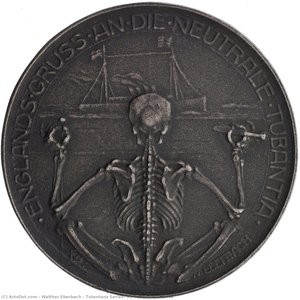
Totentanz Series: SS Tubantia Obverse (1916) od Walther Eberbach

Totentanz Series: SS Tubantia Obverse

1916 · Metal · American Numismatic Society, New York City

The work before us is Totentanz Series: SS Tubantia Obverse, a piece created by the artist Walther Eberbach. It belongs to his Totentanz Series, a collection that explores the heavy themes of mortality and the historical tragedies of the early twentieth century. This specific medallion was produced in 1916, a period of intense global conflict that deeply informed the artist's focus on the intersection of human loss and political upheaval.

5
Totentanz Series: Death Mowing down Russian Refugees Obverse (1916) od Walther Eberbach

Totentanz Series: Death Mowing down Russian Refugees Obverse

1916 · Metalwork · American Numismatic Society, New York City

The scene unfolds upon a circular metal surface, where the heavy patina of age lends a somber, brownish hue to a moment of absolute desperation. A skeletal figure, draped in a Russian fur cap, dominates the composition. This personification of death does not merely exist; it acts, wielding a sharp scythe that sweeps through a frantic crowd. Beneath the blade, human figures are caught in mid-flight, their bodies contorted in…

6
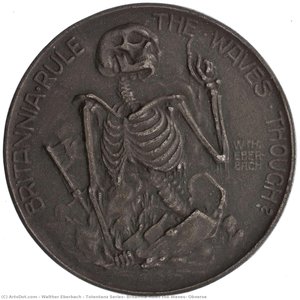
Totentanz Series: Britannia Rules the Waves? Obverse (1916) od Walther Eberbach

Totentanz Series: Britannia Rules the Waves? Obverse

1916 · Metalwork · American Numismatic Society, New York City

The artwork Totentanz Series: Britannia Rules the Waves? Obverse is a creation by the artist Walther Eberbach. It emerged in 1916 from a collection of at least twelve satiric medals produced during the First World War. This specific piece belongs to the Totentanz series, a group of works that utilize morbid themes to reflect the political and military realities of the era.

7
Totentanz Series: Death Pumping Blood over Verdun Obverse (1916) od Walther Eberbach

Totentanz Series: Death Pumping Blood over Verdun Obverse

1916 · Engraving · American Numismatic Society, New York City

Totentanz Series: Death Pumping Blood over Verdun Obverse is a work by the German medalist Walther Eberbach. Created in 1916, this piece belongs to the Totentanz (Dance of Death) series. This collection consists of at least twelve satiric medals produced during the First World War.

Ručně malovaná olejná reprodukce od $170 32 × 32 cm
Vyberte si velikost Zobrazit detaily
8
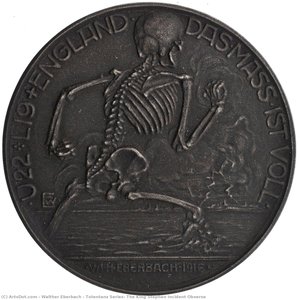
Totentanz Series: The King Stephen Incident Obverse (1916) od Walther Eberbach

Totentanz Series: The King Stephen Incident Obverse

1916 · American Numismatic Society, New York City

L19 was a German Zeppelin taking part in a bombing raid over England on February 1, 1916. On the return trip home, the airship was blown off course over Holland where it attracted anti-aircraft fire and was damaged. The airship went down in the North Sea with the crew alive but clinging to the wreckage. A nearby British fishing trawler, King Stephen, refused to aid the airship’s crew despite their…

Ručně malovaná olejná reprodukce od $170 32 × 32 cm
Objednat ručně malovanou kopii O malbě
9
Totentanz Series: Irish Easter Rising Obverse (1916) od Walther Eberbach

Totentanz Series: Irish Easter Rising Obverse

1916 · American Numismatic Society, New York City

The Irish bid for Home Rule was supported both morally and with arms by the Germans since both shared the British as an enemy. This medal refers to the Easter Rising in Dublin on April 24–30, 1916, an armed insurrection against British rule that was ruthlessly put down by the British under the command of General Sir John Maxwell, who subsequently ordered the execution of the rebellion’s leaders, fifteen of…

Ručně malovaná olejná reprodukce od $170 32 × 32 cm
Vyberte si velikost Zobrazit detaily
10
Totentanz Series: Death Chokes Italy Obverse (1916) od Walther Eberbach

Totentanz Series: Death Chokes Italy Obverse

1916 · American Numismatic Society, New York City

The Italian Minister of Foreign Affairs during the war, Sidney Sonnino, played a role in concluding the secret Treaty of London in April 1915, which was seen as a major betrayal to the Central Powers, whose cause he had initially supported. The Treaty not only brought Italy into the war on the side of the Entente, but also included plans to dismantle and partition Austria-Hungary for Italy’s benefit in the…

Ručně malovaná olejná reprodukce od $170 32 × 32 cm
Objednat tento obraz Detaily obrazu

obrazy autora Walther Eberbach podle tématu

Čtyři nejčastější témata v tomto žebříčku, včetně nejvýraznějšího díla pro každé z nich.

Muzea, ve kterých jsou vystavena originálna umělce Walther Eberbach

Muzeum s největším počtem obrazů na této stránce.

Muzeum Město Díla autora Walther Eberbach Obrazy z tohoto seznamu
American Numismatic Society, New York CityAmerican Numismatic Society New York City 10 Totentanz Series: The Sinking of RMS Lusitania Obverse, Totentanz Series: Strategic Bombing Obverse, Totentanz Series: For the Duke of Aosta Obverse

Díla Walther Eberbach podle roku: nejlepší obrazy

Obrazy umělce Walther Eberbach na této stránce pokrývají období 2 let, od 1916 do 1917, seřazené rok po roce.

Díla podle roku

Vyberte rok a prohlédněte si jeho obrazy.

Obrazy autora Walther Eberbach: nejčastější dotazy

Který obraz od Walther Eberbach je nejznámější?Zobrazit odpověď

Totentanz Series: The Sinking of RMS Lusitania Obverse (1916), American Numismatic Society, New York City, zaužívá první místo, za nímž následují Totentanz Series: Strategic Bombing Obverse (1916) a Totentanz Series: For the Duke of Aosta Obverse (1917).

Kolik bylo Walther Eberbach let, když byl obraz Totentanz Series: The Sinking of RMS Lusitania Obverse namalován?Zobrazit odpověď

Walther Eberbach byl ve věku 50: dílo Totentanz Series: The Sinking of RMS Lusitania Obverse pochází z roku 1916 a Walther Eberbach se narodil v 1866.

Kterých 10 nejlepších obrazů má Walther Eberbach?Zobrazit odpověď

Totentanz Series: The Sinking of RMS Lusitania Obverse, Totentanz Series: Strategic Bombing Obverse, Totentanz Series: For the Duke of Aosta Obverse, Totentanz Series: SS Tubantia Obverse, Totentanz Series: Death Mowing down Russian Refugees Obverse, Totentanz Series: Britannia Rules the Waves? Obverse, Totentanz Series: Death Pumping Blood over Verdun Obverse, Totentanz Series: The King Stephen Incident Obverse, Totentanz Series: Irish Easter Rising Obverse a Totentanz Series: Death Chokes Italy Obverse. Rok a muzeum pro každé dílo jsou uvedeny v hodnocení výše.

Kolik děl umělce Walther Eberbach máte v nabídce?Zobrazit odpověď

V našem katalogu je 10 děl umělce Walther Eberbach, datovaných od 1916 do 1917.

Kde jsou uloženy originální obrazy autora Walther Eberbach?Zobrazit odpověď

Primárně v American Numismatic Society (New York City). Pro úplný seznam se podívejte do tabulky muzeí výše.

Které období se narodily nejznámější obrazy umělce Walther Eberbach?Zobrazit odpověď

V období 1916: 9 z 10 obrazů zařazených zde pochází z této doby, včetně Totentanz Series: The Sinking of RMS Lusitania Obverse.

Která jsou nejstarší a nejnovější slavná díla umělce Walther Eberbach?Zobrazit odpověď

Nejstarší na této stránce: Totentanz Series: The Sinking of RMS Lusitania Obverse (1916). Nejnovější: Totentanz Series: For the Duke of Aosta Obverse (1917).

Jakými hlavními motivy jsou obrazy Walther Eberbach?Zobrazit odpověď

Mezi 10 obrazy zařazenými v tomto žebříčku: Skeleton (7), Medallion (4) a Death (2).

V jaké technice je většina originálů od Walther Eberbach?Zobrazit odpověď

Metalwork, u 3 z 10 obrazů zařazených v tomto žEBŘÍČKU.

Která originál díla Walther Eberbach se nachází v American Numismatic Society?Zobrazit odpověď

V muzeu American Numismatic Society, New York City se nachází 10 z obrazů zařazených v tomto žebříčku, včetně Totentanz Series: The Sinking of RMS Lusitania Obverse, Totentanz Series: Strategic Bombing Obverse a Totentanz Series: For the Duke of Aosta Obverse.

Mohu si objednat reprodukci Walther Eberbach?Zobrazit odpověď

Ano. Každý obraz na této stránce lze objednat jako ručně malovanou olejovou reprodukci nebo jako tisk. Otevřete obraz, zvolte velikost a dokončete objednávku.

O umělci: Walther Eberbach

The Master of Metal and Memory: The Life of Walther Eberbach

In the annals of German art history, few names evoke the somber elegance and technical precision of Walther Eberbach. Born in 1866 in Besigheim, Eberbach emerged from a lineage of craftsmanship that would define his entire creative existence. His journey began not merely with a brush or a chisel, but with the disciplined hands of a draftsman and metal sculptor. Through his formative studies in Schwäbisch Gmünd and later at the Kunstgewerbeschule Stuttgart, he mastered the intricate language of metalwork, a skill that would allow him to breathe life into bronze, silver, and steel. His career was a nomadic tapestry of European culture, spanning the industrial energy of Cologne, the historical weight of Strasbourg, and the cosmopolitan atmosphere of London and Berlin.

Eberbach was far more than a mere craftsman; he was a storyteller of the profound. As an educator in Strasbourg and later in Heilbronn, he passed on the delicate arts of ziselieren (chasing) and goldsmithing to new generations, ensuring that the meticulous traditions of the past survived into a modernizing world. His work often sat at the intersection of Victorian allegory and a hauntingly realistic portrayal of human mortality. This duality allowed him to capture the zeitgeist of an era caught between the grandeur of imperial pride and the devastating reality of industrial warfare.

Symbolism in Bronze: The Totentanz Series

The true emotional depth of Eberbach’s legacy is perhaps most poignantly realized in his Totentanz (Dance of Death) series. In these works, the artist moved beyond simple ornamentation to engage with the most harrowing themes of his time. His medallions and reliefs serve as historical witnesses, utilizing skeletal figures and symbolic landscapes to process the collective trauma of the early 20th century. Each piece is a masterclass in embossed metalwork, where every line serves a narrative purpose.

His explorations of historical tragedy are both beautiful and unsettling:

  • The Sinking of the RMS Lusitania: In this somber embossed medallion, Eberbach depicts a skeletal figure rowing through turbulent waves, a hauntingly beautiful commemoration of one of the era's most tragic maritime disasters.
  • Death Pumping Blood over Verdun: A powerful and visceral relief print from 1916, this work captures the sheer devastation of the Battle of Verdun, using symbolic imagery to reflect the horrors of World War I.
  • Britannia Rules the Waves?: Through this bronze relief, Eberbach poses a provocative question regarding naval supremacy and mortality, blending maritime history with a chilling Victorian allegory.

A Legacy of Craftsmanship and Historical Reflection

The significance of Walther Eberbach lies in his ability to transform cold, hard materials into vessels of deep historical reflection. While many artists of his era focused on the purely aesthetic or the purely political, Eberbach found a middle ground where meticulous realism met symbolic depth. His membership in organizations such as the Künstlerbunds Heilbronn and his frequent exhibitions with the Kunstverein Heilbronn solidified his role as a pillar of the German artistic community.

As we look back on his life, which concluded in 1944, we see an artist who refused to look away from the shadows of history. Whether through the delicate precision of an engraving or the heavy, textured presence of a bronze relief, Eberbach’s work remains a vital connection to a period of immense transition. He remains a master of the permanent—an artist who used the most enduring mediums to capture the most fleeting and tragic moments of human existence.