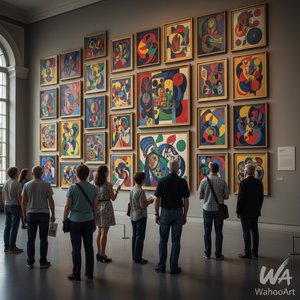
The Architect of Perception: The Life and Vision of Augusto Garau
Augusto Orazio Vittorio Garau (1923–2010) was far more than a painter; he was a profound explorer of the mechanics of sight, an artist who sought to bridge the gap between the tangible canvas and the intangible psychology of human vision. Born in the serene landscape of Bolzano, Italy, Garau’s journey began with a rigorous academic foundation at the prestigious Brera Academy in Milan. Graduating in 1946, he entered a world still reeling from the tremors of World War II, a period that demanded a new visual language—one stripped of old allegories and rebuilt upon the essential truths of form and color. His early years were marked by a transformative encounter with his mentor, Atanasion Soldati, whose influence steered Garau toward the radical frontiers of abstraction. As a co-founder of the Concrete Art Movement (MAC) in 1948, Garau stood alongside luminaries such as Lucio Fontana and Piero Dorazio. This movement was not merely an aesthetic choice but a philosophical stance, prioritizing geometric purity and industrial clarity over traditional representation. In these early works, one can sense the pulse of post-war reconstruction: a desire for order, simplicity, and a commitment to the fundamental elements of art. Yet, Garau’s spirit was too restless to remain confined to pure geometry alone. Following the passing of Soldati in 1953, he embarked on a period of intense experimentation, drifting through figurative styles, visual poetry, and even pottery, searching for a way to marry the structural rigor of abstraction with the fluid complexity of human experience.A Symphony of Science and Color
The true metamorphosis of Garau’s oeuvre occurred in the mid-1960s, as his artistic practice began to coalesce with scientific inquiry. He became deeply enamored with the psychology of perception, drawing inspiration from the Gestalt theory and engaging in intellectual dialogues with thinkers like Rudolph Arnheim. This era saw him transition from a creator of shapes to an architect of optical experiences. His work became a laboratory where color theory and perceptual psychology intersected, challenging the viewer to recognize that what we see is not merely a reflection of reality, but a construction of the mind. In this mature phase, Garau’s canvases became sophisticated explorations of how light, edge, and hue interact to create depth and movement. He utilized color not as a decorative element, but as a structural force capable of triggering physiological responses. His mastery lay in his ability to manipulate the viewer's gaze, using carefully calibrated contrasts to evoke a sense of spatial ambiguity. To look at a Garau painting is to participate in an active cognitive process; the eye must navigate the tension between competing forms, making the act of viewing an essential component of the artwork itself.Legacy and Historical Significance
The legacy of Augusto Garau resides in his unique ability to synthesize the disparate worlds of art, science, and philosophy. He remains a pivotal figure in 20th-century Italian art, serving as a vital link between the structured discipline of Concrete Art and the more fluid, psychologically driven explorations of later modernism. His contributions extend beyond the gallery walls, as his theoretical writings on color and vision have left an indelible mark on the study of visual communication. Today, Garau is remembered as a pioneer who dared to look beneath the surface of the image to understand the very essence of sight. His life’s work stands as a testament to the power of interdisciplinary thinking, proving that when the precision of science meets the passion of art, the result is a profound expansion of human perception.- Key Influences: Atanasio Soldati, Gestalt Psychology, and the Concrete Art Movement.
- Artistic Milestones: Co-founding the MAC in 1948; graduation from Brera Academy in 1946.
- Core Themes: The psychology of perception, color theory, geometric abstraction, and visual communication.