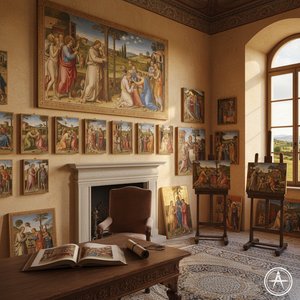
The Enigmatic Master of 1518: A Renaissance Visionary
The “Master of 1518,” a name shrouded in mystery and speculation, remains one of the most compelling enigmas of early Renaissance art. Little is definitively known about this artist’s life – his true identity has never been conclusively established – yet his remarkably sophisticated paintings, primarily altarpieces and devotional scenes, offer a profound glimpse into the artistic currents flowing through Northern Italy during a pivotal period. Born around 1518 in Venice, likely as Jacopo Robusti (a name sometimes linked to his father’s profession of cloth dyer, “tintore”), he emerged from a milieu steeped in tradition yet possessed an innovative spirit that would profoundly influence generations of artists. His career unfolded largely within the Veneto region, particularly in the service of wealthy patrons and religious institutions, leaving behind a legacy of breathtaking beauty and technical mastery.
Early Influences and Artistic Development
The Master’s artistic development is believed to have been shaped by a complex interplay of influences. While he undoubtedly benefited from the tutelage of Titian, a dominant figure in Venetian painting at the time, the relationship was reportedly fraught with tension – accounts suggest a youthful rebellion against the master's demanding style. Contemporary sources hint at a strong connection to the Tuscan school, particularly the dramatic and emotionally charged works of Michelangelo, as well as the more restrained elegance of Giovanni Francesco Caroto. This synthesis—a blend of dynamism, emotional intensity, and classical restraint—is strikingly evident in his paintings. The “retardataire” style he employed, characterized by a deliberate delay in adopting the latest trends, allowed him to retain a unique voice within the evolving artistic landscape.
- Titian’s Shadow: While Titian undoubtedly provided an early foundation, the Master quickly surpassed his mentor in terms of expressive power and compositional innovation.
- The Tuscan Impulse: The influence of Michelangelo's dramatic figures and powerful narratives is palpable in the Master’s depictions of religious subjects.
- Caroto’s Restraint: A subtle elegance and a focus on refined detail, reminiscent of Giovanni Francesco Caroto, temper the more overtly emotional aspects of his work.
Key Works and Artistic Techniques
The Master's output is relatively modest – perhaps only around thirty paintings survive – yet each piece reveals a remarkable command of technique and a deep understanding of human psychology. His most celebrated works include the altarpiece for Santi Nazaro e Celso in Verona, showcasing his ability to create complex narratives within a limited space; the *Resurrection of Lazarus* for the chapel of Santa Croce in Lübeck (now lost), demonstrating his mastery of light and shadow; and the emotionally charged *Assumption of the Virgin* at Santa Maria Gloriosa dei Frari in Venice. A particularly significant achievement is the *Last Supper* in Venice, a monumental work that exemplifies his innovative approach to composition and his ability to convey profound spiritual meaning.
- Dramatic Lighting: The Master’s use of light—often described as “luminous” – is central to his artistic vision. He employed chiaroscuro (the contrast between light and dark) not merely for technical effect, but to heighten the emotional impact of his scenes and create a sense of drama and mystery.
- Dynamic Composition: His compositions are rarely static; figures are often caught in moments of intense action or profound emotion, creating a sense of movement and vitality.
- Psychological Depth: The Master’s portraits, particularly those of Paulus de Nigro, reveal an extraordinary sensitivity to the individual character of his subjects.
Historical Context and Lasting Significance
The Master of 1518 operated during a period of immense artistic ferment in Italy – a time when Renaissance ideals were being reinterpreted and redefined. His work reflects the ongoing dialogue between classical antiquity, Byzantine tradition, and contemporary Italian art. He stands as a crucial link between the early Renaissance masters and the subsequent development of Mannerism and the High Renaissance. His innovative use of light, his dramatic compositions, and his profound understanding of human emotion have had a lasting impact on generations of artists. Despite the enduring mystery surrounding his identity, the “Master of 1518” remains an essential figure in the history of art – a testament to the power of artistic vision and technical skill.
Further Research
For more information on this fascinating artist, consult the following resources:
- Wikipedia: Master of 1518
- Britannica: Tintoretto (While focused on Tintoretto, this biography provides valuable context about the Venetian art scene of the period.)