Nicolaas Samuel Cruquius: Dutch Golden Age Painter and Hydraulic Engineer
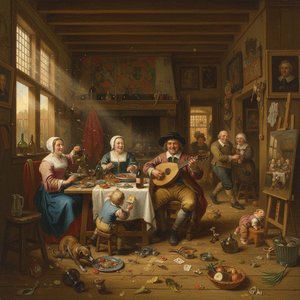
Nicolaas Samuel Cruquius (Kruikius) (West-Vlieland, 2 December 1678 – Spaarndam, 5 February 1754) was a Dutch land surveyor, cartographer, astronomer, and hydraulic engineer who is celebrated for his serene landscapes and genre scenes depicting the elite of Antwerp. His artistic legacy extends beyond mere visual beauty; it embodies the spirit of scientific inquiry and civic responsibility that defined the Dutch Golden Age.
Early Life and Education
Born in Vlieland, a small island off the coast of Friesland, Cruquius’s formative years were marked by intellectual curiosity and engagement with humanist ideals prevalent during his time. He received an education focused on mathematics and surveying—skills crucial for his future profession—laying the groundwork for his meticulous observation of nature and his dedication to accurate representation. Notably influenced by Herman Boerhaave, a pioneer in experimental medicine and pharmacology at Leiden University, Cruquius pursued advanced studies there, immersing himself in scientific discourse and fostering connections with fellow scholars who championed empirical research methods. This intellectual environment profoundly shaped his worldview and fueled his lifelong fascination with understanding the natural world.
Career as Surveyor and Cartographer
Cruquius swiftly established himself as a respected surveyor at Delft’s Royal Guild of St Luke, undertaking commissions for mapping projects across Holland and Flanders. His meticulous attention to detail—evident in his detailed topographical drawings—became synonymous with Dutch cartography during the 18th century. He skillfully combined artistic sensibility with scientific precision, producing maps that not only accurately depicted landscapes but also incorporated innovative techniques like isobaths (contour lines representing depths of water), a groundbreaking approach for visualizing underwater topography and informing hydraulic engineering projects. His work on the Merwede canal project exemplifies this fusion of art and science, demonstrating his commitment to improving infrastructure while upholding aesthetic standards.
Meteorological Observations and Hydraulic Engineering
Beyond his artistic pursuits, Cruquius possessed an unwavering passion for unraveling the mysteries of weather phenomena—a fascination that propelled him to become one of Europe’s foremost meteorologists. Collaborating closely with Jan Noppen, he initiated the earliest continuous meteorological station in Zwanenburg, diligently recording temperature, air pressure, humidity, and rainfall data over several decades. Cruquius's pioneering efforts revolutionized atmospheric science by establishing a systematic framework for monitoring climatic conditions and predicting weather patterns—a legacy that continues to inspire scientific research today. His meticulous measurements underpinned his advocacy for reclaiming the Haarlemmermeer lake, securing funding for ambitious engineering projects aimed at bolstering the region’s defenses against flooding.
Notable Paintings and Artistic Style
Cruquius's artistic output consisted primarily of idyllic landscapes—often bathed in soft light—and genre scenes portraying aristocratic gatherings in Antwerp. His paintings are characterized by a serene aesthetic imbued with classical influences, reflecting his admiration for Greco-Roman art and philosophy. He skillfully employed atmospheric perspective—a technique pioneered by Rembrandt—to convey depth and realism, capturing the subtle nuances of natural illumination and creating compositions that evoke tranquility and contemplation. Recurring motifs included gardens, fountains, and architectural elements—symbols of refinement and harmony—underscoring Cruquius’s artistic vision as one rooted in humanist ideals and informed by scientific observation.
Legacy and Recognition
Nicolaas Samuel Cruquius died in Spaarndam in 1754, leaving behind a remarkable body of work that cemented his place among the most influential artists and scientists of the Dutch Golden Age. His contributions to cartography and meteorology profoundly impacted European intellectual life, establishing precedents for empirical research and fostering advancements in hydraulic engineering—a field he championed with unwavering dedication. Today, Cruquius’s paintings are housed in prominent museums across Europe, serving as enduring reminders of his artistic genius and his commitment to elevating human understanding through the pursuit of knowledge. His legacy continues to inspire artists and scientists alike, demonstrating the transformative power of combining aesthetic sensibility with intellectual rigor.