The Alpine Echoes of Lech Twardowski
Born in the quiet Polish town of Brodnica in 1952, Lech Twardowski has cultivated a visual language that transcends mere landscape painting, venturing instead into the profound architecture of memory. His artistic journey is one of movement and metamorphosis, stretching from his formative academic years in Wrocław to the serene, high-altitude landscapes of Tannberg am Lech, Austria. It is within this alpine environment that Twardowski’s soul found its true resonance, allowing the rugged textures of mountains and glaciers to seep into his conceptual framework. His work does not simply depict nature; it seeks to capture the fleeting, ephemeral moments where light meets stone, distilling them into enduring symbols that speak to the very essence of existence.
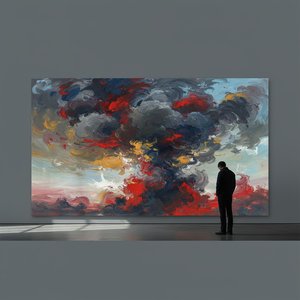
The evolution of Twardowski’s style is deeply intertwined with the heavyweights of contemporary art history. Drawing inspiration from the monumental and often visceral approaches of Anselm Kiefer and Gerhard Richter, he learned to navigate the delicate tension between historical weight and modern abstraction. Like his predecessors, Twardowski grapples with themes of trauma, time, and the relationship between reality and representation. However, he distinguishes himself through a unique commitment to aesthetic luminosity, finding beauty within the struggle of creation. His canvases often serve as geological records, where layers of paint act as strata of time, reflecting cycles of destruction and inevitable regeneration.
Technique and the Texture of Time
To witness a Twardowski painting is to engage with a physical, tactile experience. The artist employs a meticulous, almost ritualistic method of layering, frequently marrying the translucency of oil paints with the dense, sculptural qualities of encaustic wax. This painstaking process creates an unparalleled depth, allowing light to penetrate the surface and bounce through various strata of pigment. Such technique is essential to his ability to mirror the atmospheric shifts of the Alps—the way a mist might cling to a rock face or how sunlight pierently pierces a glacier. The result is a palpable sense of atmosphere that invites the viewer to lose themselves in the textural richness of the work.
This mastery of medium allows him to explore several recurring motifs that define his oeuvre:
- Geological Formations: Mountains, rock strata, and glaciers serve as metaphors for the permanence of nature against the transience of human life.
- Temporal Dimensions: The use of heavy textures creates a sense of deep time, suggesting that each painting is an archaeological site of memory.
- Abstract Installations: Through his acclaimed “PURO.” series, he expands his painterly language into the realm of abstract installation, using dynamic blues and reds to explore tracks of memory.
A Legacy of Memory and Motion
Twardowski’s career is marked by a restless creativity that extends far beyond the traditional canvas. A true multidisciplinary force, he has ventured into performance art and complex installations, often collaborating with musicians to create immersive theatrical spaces. His work has been honored in some of Europe's most prestigious institutions, including the National Museum in Warsaw, the Musée National d’Art Moderne in Paris, and the National Museum in Wrocław. These exhibitions highlight his significance not just as a Polish contemporary master, but as an international voice capable of communicating universal truths through the language of abstraction.
Ultimately, the historical significance of Lech Twardowski lies in his ability to bridge the gap between the physical world and the internal landscape of the mind. His paintings are more than mere objects; they are conduits for meditation. Whether he is exploring the ruggedness of a mountain range or the abstract traces of a memory, Twardowski remains a painter of the profound, reminding us that art possesses the singular capacity to transcend time and capture the eternal echoes of our shared existence.