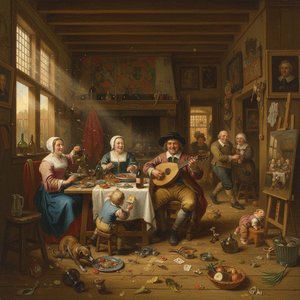
Franz Christoph Janneck: A Viennese Baroque Visionary
Franz Christoph Janneck (1703-1761) stands as a prominent figure in Austrian Baroque art, celebrated for his evocative genre scenes, ambitious mythological compositions and dignified portraits. Born in Graz, Austria, Janneck’s artistic journey unfolded against the backdrop of Vienna’s burgeoning cultural landscape—a city undergoing significant transformation during the reign of Empress Maria Theresa. His oeuvre reflects not only stylistic trends prevalent at the time but also a deep engagement with Viennese history and aristocratic patronage.
- Early Life & Training:
- Vienna’s Artistic Circle & Patronage:
- Style & Technique: Dutch & French Influences
- Notable Works: Genre Scenes & Mythological Narratives
- Legacy & Historical Significance:
Vienna’s Artistic Circle & Patronage
Janneck's formative years were spent honing his skills in Graz, where he received instruction from Johann Baptist Zimmerman, a respected Baroque painter. This exposure to Zimmermann’s artistic sensibilities undoubtedly shaped Janneck’s stylistic preferences and instilled a commitment to meticulous observation—a characteristic that would permeate throughout his subsequent works. Crucially, Janneck found considerable support within Vienna's aristocratic circles, securing commissions from influential families who recognized the artist’s talent for capturing human emotion and grandeur. This patronage allowed him to pursue ambitious projects and contribute significantly to the city’s artistic heritage.
Style & Technique: Dutch & French Influences
Janneck's artistic style is undeniably indebted to the stylistic currents circulating across Europe during his lifetime—particularly those originating in Holland and France. Like many Austrian Baroque artists, Janneck embraced chiaroscuro – dramatic contrasts between light and dark – as a cornerstone of his technique. This masterful manipulation of tonal values lends depth and emotional intensity to his paintings, creating an immersive experience for the viewer. Furthermore, Janneck’s compositions often incorporate elements characteristic of Dutch landscape painting, emphasizing atmospheric perspective and meticulous detail. Simultaneously, he absorbed influences from French portraiture, prioritizing elegance and refined aesthetic sensibilities.
Notable Works: Genre Scenes & Mythological Narratives
Janneck's artistic output encompassed a diverse range of subjects—primarily genre scenes depicting everyday life in Vienna and mythological narratives inspired by classical mythology. His ‘Crucifixion’ (1730), for instance, exemplifies his ability to convey profound spiritual emotion through dramatic staging and expressive brushwork. Similarly, ‘Jupiter & Juno v2,’ showcases Janneck's command of composition and color palettes—capturing the majesty of Roman deities with remarkable accuracy. These works stand as testament to Janneck’s artistic versatility and his dedication to exploring both human experience and timeless themes.
Legacy & Historical Significance
Franz Christoph Janneck’s contribution to Viennese Baroque art is undeniable. His paintings continue to resonate today, offering insights into the cultural values and artistic sensibilities of 18th-century Austria. More broadly, Janneck's work exemplifies the broader European Baroque movement—a period characterized by fervent religious fervor, opulent artistic expression, and a fascination with grandeur and spectacle. He remains an important figure in Austrian art history, remembered as a skilled painter who skillfully blended Dutch and French influences to create emotionally charged narratives that captured the spirit of his time.