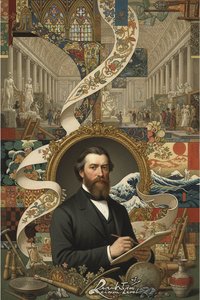
Jean-Louis Ernest Meissonier: The Architect of Detail
Jean-Louis Ernest Meissonier (Γιάννης Λουΐς Έρνεστ Μεσονιέρας), born Lyon, France in 1815, stands as a singular figure within the landscape of French Romantic painting—a master craftsman whose unwavering dedication to meticulous observation and painstaking execution cemented his place among the most celebrated artists of his era. Unlike many contemporaries preoccupied with capturing fleeting impressions or exploring emotional landscapes, Meissonier pursued an entirely different path: reconstructing historical scenes with astonishing accuracy, transforming canvases into immersive dioramas that transported viewers back in time. His legacy resides not merely in the beauty of his compositions but in the revolutionary technique he pioneered—a method that continues to inspire artists today.
- Early Influences and Training:
- The Pursuit of Precision: Meissonier's Technique
- Genre Scenes and Historical Narratives
- Napoleon and the Siege of Paris
- A Lasting Impression: Meissonier’s Influence on Subsequent Artists
Early Influences and Training
Meissonier's artistic journey began modestly, nurtured by a familial inclination toward commerce—his father was the proprietor of a dye factory—that initially steered him towards a career in business. However, from his formative years, he possessed an undeniable passion for painting, evidenced by early sketches that foreshadowed his future mastery. Recognizing this innate talent, Meissonier sought guidance from Jules Potier and subsequently enrolled in Léon Cogniet’s studio, absorbing the principles of academic art—a tradition deeply rooted in classical ideals of beauty and proportion. Crucially, he turned to the Dutch masters at the Louvre as his primary inspiration, immersing himself in the works of Gabriel Metsu and Gerard Dou. These painters championed a style characterized by subdued palettes, soft lighting, and an unparalleled attention to detail—a stylistic ethos that profoundly shaped Meissonier’s developing artistic vision. The meticulous study of these artists instilled within him a conviction that true art demanded not merely aesthetic appeal but also exhaustive research into subject matter and historical context.
The Pursuit of Precision: Meissonier's Technique
What truly distinguished Meissonier from his peers was his revolutionary technique—a method that would become synonymous with “manual dexterity” and “eye for fascinating minutiae,” as lauded by John Ruskin. Rejecting the Impressionist preoccupation with capturing fleeting sensations, Meissonier embarked on an arduous process of reconstructing historical scenes with breathtaking realism. He undertook exhaustive research into costumes, weaponry, architectural details, and even atmospheric conditions—transforming his studio into a microcosm of the past. This dedication extended beyond mere visual observation; he painstakingly analyzed human anatomy and movement to depict figures convincingly in battle scenes. Furthermore, Meissonier employed a layering technique that involved applying numerous thin glazes over underdrawings—a practice unheard of at the time—to achieve an astonishing level of tonal gradation and textural complexity. The result was canvases imbued with an unparalleled sense of depth and atmosphere—works that captivated audiences and established Meissonier’s reputation as a titan among painters.
Genre Scenes and Historical Narratives
Meissonier's artistic breakthrough arrived in 1834 with *Les Bourgeois Flamands*, exhibited at the Salon, where he immediately demonstrated his singular talent—a capacity for recreating scenes of everyday life or historical vignettes with astonishing precision. Unlike many artists of his time who favored grand narratives and heroic figures, Meissonier focused on portraying intimate moments of bourgeois existence—domestic interiors populated by meticulously rendered characters—capturing subtle expressions of emotion and social interaction. Simultaneously, he embraced monumental historical subjects—particularly Napoleonic battles—transforming canvases into immersive dioramas that transported viewers back to pivotal moments in European history. His meticulous attention to detail extended beyond mere visual representation; he recreated entire environments with painstaking accuracy, capturing textures, light, and atmosphere with breathtaking fidelity.
Napoleon and the Siege of Paris
Meissonier’s artistic ambition culminated in *Napoleon III at Solferino* (1863) and *Campaign of France, 1814*(1864)—two canvases that cemented his legacy as one of France's greatest painters. These monumental works exemplify Meissonier’s mastery of composition and narrative—a feat achieved through exhaustive research into military history and a relentless pursuit of visual realism. He meticulously recreated the battlefield environment, capturing the heat, dust, and chaos of combat with astonishing accuracy. Moreover, he employed innovative techniques to convey the psychological impact of warfare—depicting soldiers' expressions of fear, determination, and camaraderie with profound empathy. *Le Siège de Paris 1870–1871*, completed shortly before his death in 1891, represents Meissonier’s final artistic statement—a harrowing depiction of the siege of Paris during the Franco-Prussian War that underscored his unwavering commitment to portraying historical events with unflinching honesty.
A Lasting Impression: Meissonier’s Influence on Subsequent Artists
Jean-Louis Ernest Meissonier's technique—characterized by painstaking detail, meticulous observation, and a layering approach—became an indelible mark on the artistic landscape of the late nineteenth century. His influence extended beyond his immediate contemporaries, inspiring generations of painters who sought to emulate his mastery of fine art. Museums worldwide proudly display his works—a testament to the enduring power of patience, precision, and artistic vision—ensuring that Meissonier’s legacy continues as a beacon for artists striving to achieve unparalleled realism and emotional depth.