The Chromatic Soul of Peter Krasnow
In the vast tapestry of twentieth-century modernism, few threads are as vibrantly colored or as spiritually resonant as those woven by Peter Krasnow. Born Feivish Reisberg in 1886 within the Russian Empire, Krasnow’s journey was one of profound migration—not only across continents but across artistic disciplines. His early years in Novohrad-Volynskyi were shaped by a quiet apprenticeship under his father, an interior decorator whose influence instilled in the young artist a lifelong sensitivity to spatial harmony and the structural elegance of composition. When he emigrated to the United States in 1907, Krasnow carried with him a burgeoning aesthetic that would eventually find its formal voice at the Art Institute of Chicago, where he graduated in 1916, refining the technical prowess that would later allow him to bridge the gap between the physical and the metaphysical.
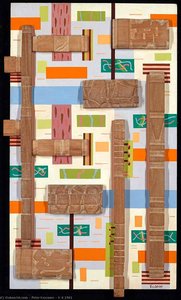
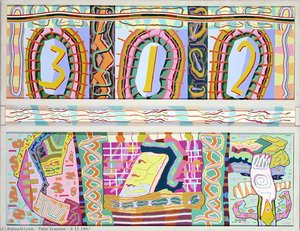
Krasnow’s artistic evolution is a captivating study in the pursuit of purity. As he moved through the early decades of the twentieth century, he became a pioneer of geometric abstraction, a movement that sought to strip away the distractions of representational imagery to reveal the underlying architecture of reality. Influenced by the radical visions of Piet Mondrian and Kazimierz Malevich, Krasnow embraced the power of orthogonal lines and primary hues. Yet, unlike the stark austerity of some of his contemporaries, Krasnow’s work possessed a unique warmth and a rhythmic vitality. He was a true colorist, utilizing color not merely as a decorative element but as an emotional and spiritual language capable of conveying balance, tension, and unity.
A Fusion of Heritage and Form
What truly distinguishes Krasnow from the broader canon of abstract expressionists is his profound engagement with his Jewish heritage. He possessed a rare ability to synthesize the rigid structures of hard-edge painting with the fluid, ancient beauty of Hebrew calligraphy. In his hands, the sacred characters of his culture were transformed into architectonic elements, where the stroke of a letter became a structural component of a larger geometric whole. This fusion created a body of work that was simultaneously avant-garde and deeply traditional, offering a meditative space where modern abstraction met ancestral memory. His paintings and drawings often functioned as visual prayers, utilizing the rhythm of script to explore themes of identity and spiritual continuity.
This mastery of form extended beyond the two-dimensional plane into his groundbreaking sculptural practice. Krasnow’s sculptures, often carved from wood, demonstrated a masterful manipulation of medium. He treated the organic grain of the wood as a partner in his geometric explorations, creating monumental pieces that felt both grounded in the earth and reaching toward the celestial. These wooden abstractions were not merely objects to be viewed but presences to be experienced, embodying the same tension between chaos and harmony that defined his painted works.
Legacy of the Los Angeles Avant-Garde
For much of his life, Krasnow was a cornerstone of the burgeoning Los Angeles art scene. Settling in the Atwater Village neighborhood in 1922, he lived and worked on land purchased from his friend, the legendary photographer Edward Weston. This connection placed him at the very heart of the early West Coast avant-garde, a community that would eventually redefine American modernism. His career was marked by an impressive series of solo exhibitions across the globe—from the Whitney Studio Club in New York to prestigious galleries in Paris and San Francisco—ensuring that his unique vision reached the most influential stages of the art world.
The historical significance of Peter Krasnow lies in his refusal to separate the aesthetic from the spiritual. His achievements, including a National Endowment for the Arts fellowship in 1977, serve as a testament to a lifetime of uncompromising dedication to his craft. He remains a vital figure for scholars and lovers of art alike, representing a bridge between the structured logic of abstraction and the soulful depth of cultural symbolism. To look upon a Krasnow piece is to witness a masterwork of balance, where every line and every hue serves the ultimate purpose of illuminating the profound beauty of existence.
Ερωτήσεις και Απαντήσεις
Υπάρχει χρονολόγιο με τα έργα του/της Peter Krasnow;
Η σελίδα Χρονολόγιο Έργων του καλλιτέχνη παρουσιάζει τα έργα του Peter Krasnow ταξινομημένα ανά ημερομηνία, έτος προς έτος.
Μπορώ να περιηγηθώ στα έργα του/της Peter Krasnow ανά τεχνική;
Η σελίδα Κατά Τεχνική ομαδοποιεί τα έργα του/της Peter Krasnow ανά τεχνική.
Πού μπορεί να ανακαλυφθούν τα έργα του Peter Krasnow ταξινομημένα ανά θέμα;
Το Ατλάς Θεμάτων του Peter Krasnow είναι μια σελίδα που ομαδοποιεί τα έργα του καλλιτέχνη ανάλογα με τα θέματά τους.