Simon Mazière (1649 - 1722): A Baroque Sculptor’s Journey from Italian Influence to French Classicism
Simon Mazière (b. 1649, Pontoise, d. after 1721) was a French sculptor whose career spanned the turbulent years of the Baroque era and witnessed the burgeoning influence of classical ideals in France. Though biographical details remain scarce—primarily gleaned from archival records and contemporary accounts—his artistic legacy endures through monumental sculptures adorning Versailles and significant contributions to ecclesiastical art, cementing his place as a pivotal figure in shaping French sculpture during a transformative period.
## Early Life and Training
Little is known about Mazière’s formative years. Born in Pontoise, France, he emerged onto the artistic scene around 1679, establishing himself primarily at Versailles under the patronage of Louis XIV. His training likely commenced in Paris, where he studied under François Girardon, a leading sculptor of his time who championed innovative techniques and embraced humanist principles.Girardon’s influence profoundly shaped Mazière's approach to sculpture, emphasizing naturalism and striving for emotional resonance—characteristics that would define his artistic style.
## Major Works: Versailles and Beyond
Mazière’s most celebrated achievements reside in his sculptures commissioned for the Palace of Versailles, a testament to Louis XIV’s ambition to elevate French art to unparalleled heights.
The Raising of the Cross (1689): This monumental sculpture, depicting Christ being lifted into heaven by angelic figures, exemplifies Mazière's masterful command of marble and his ability to convey spiritual grandeur. It stands as a cornerstone of Baroque sculpture in France
Pan (1685): Based on a wax figurine created by Girardon, Pan embodies the mythological deity’s playful spirit and connection to nature. Mazière skillfully captured Pan's dynamism and expressive gestures—a feat that showcased his technical prowess
Other Sculptures at Versailles: Mazière contributed several other sculptures to Versailles’s decorative program, including Syrinx (1689), Junon, and depictions of mythological figures like Zeus and Neptune. These works demonstrate Mazière's versatility and his commitment to portraying classical themes with meticulous detail
Beyond Versailles, Mazière undertook commissions for churches throughout France, notably the cathedral of Notre Dame de Chartres and Saint Alippe’s chapel.
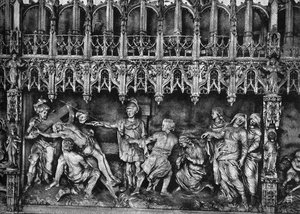
Notre Dame Cathedral Sculptures (1712): Mazière created seven sculptures for the cathedral's cloisters—a poignant reflection of religious devotion and artistic innovation. These figures capture the solemn beauty of Gothic art, demonstrating Mazière’s ability to adapt stylistic conventions to specific contexts
Saint Alippe Chapel Sculptures (1715): Mazière sculpted two monumental sculptures for Saint Alippe's chapel—a testament to his skill in conveying emotion and capturing human form. These works stand as enduring symbols of faith and artistic excellence
## Artistic Style and Legacy
Mazière’s sculptural style is characterized by a harmonious blend of Baroque exuberance and classical restraint.He skillfully combined expressive dynamism with meticulous anatomical accuracy, mirroring the stylistic trends prevalent during his time. Mazière's works are notable for their refined surfaces, subtle drapery folds, and masterful use of light and shadow—techniques that imbue his sculptures with a palpable sense of realism and emotional depth.
Mazière’s contribution to French sculpture is undeniable.His influence extended beyond his immediate commissions, shaping the artistic sensibilities of subsequent generations. Today, Mazière's sculptures continue to inspire admiration for their beauty, craftsmanship, and profound spiritual significance—a lasting testament to his enduring legacy as a Baroque master who bridged the gap between Italian idealism and French classicism.
Από την επιβλεπόμενη ομάδα της AllPaintingsStore.com
Explore the life & art of Simon Vouet, a pivotal French Baroque painter who introduced Italian styles to France. Discover his masterpieces and lasting influence on 17th-century art.
Πώς μπορώ να βρω όλα τα έργα του/της Simon Mazière ανά είδος μέσου;
Η σελίδα Κατά Τεχνική ομαδοποιεί τα έργα του/της Simon Mazière ανά τεχνική.
Πού μπορεί να ανακαλυφθούν τα έργα του Simon Mazière ταξινομημένα ανά θέμα;
Εξερευνήστε τα έργα του/της Simon Mazière ανά θέμα στη σελίδα Ατλάς Θεμάτων του καλλιτέχνη/της.
Υπάρχει χρονολόγιο με τα έργα του/της Simon Mazière;
Τα έργα του καλλιτέχνη Simon Mazière μπορούν να περιηγηθούν χρονολογικά στη σελίδα Χρονολόγιο Έργων.
Πόσα έργα του/της Simon Mazière είναι διαθέσιμα για περιήγηση;
Μπορείτε να περιηγηθείτε σε 1 έργα τέχνης έργα του Simon Mazière στη σελίδα Όλα τα έργα.
Υπάρχει 3D εικονική περιήγηση στα έργα του Simon Mazière;
Τα έργα τέχνης του/της Simon Mazière μπορούν να περιηγηθούν σε μια 3D γκαλερί στη σελίδα 3D Μουσείο του καλλιτέχνη/της.
Μπορώ να ταξινομήσω τα έργα του/της Simon Mazière ανά χρώμα;
Τα έργα του Simon Mazière μπορούν να εξερευνηθούν ανά χρώμα στη σελίδα Δείκτης Χρώματος του καλλιτέχνη.
Πού μπορώ να βρω τα έργα του καλλιτέχνη Simon Mazière ομαδοποιημένα ανά καλλιτεχνικό ρεύμα;
Τα καλλιτεχνικά κινήματα στα οποία συμμετείχε ο/η Simon Mazière μπορείτε να τα δείτε στη σελίδα των καμπανών του/της Όλα τα Ρευmatά, η οποία ομαδοποιεί τα έργα ανά καλλιτεχνικό κίνημα.
Από πού προέρχεται ο/η Simon Mazière;
Ο/Η Simon Mazière γεννήθηκε στην/στη France.
Σε ποια ιστορική περίοδο δραστηριοποιήθηκε ο/η Simon Mazière;
Ο/Η Simon Mazière δραστηριοποιήθηκε κατά την περίοδο του/της Early Modern. Η συγκεκριμένη εποχή τοποθετεί τη δραστηριότητα του/της καλλιτέχνη/στη στην ιστορία.
AConcierge του AtelierΣυνδεδεμένος · απαντά σε λεπτό
Γεια σας! Μπορώ να σας βοηθήσω στην επιλογή ενός έργου τέχνης, στην παρακολούθηση μιας παραγγελίας ή στην απάντηση ερωτήσεων σχετικά με την εγγύηση. Πώς μπορώ να σας φανώ χρήσιμος;