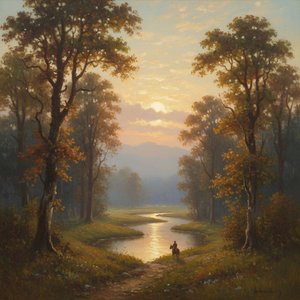
Theodore Gerard: A Belgian Master of Atmospheric Landscapes and Intimate Portraits
Born in Ghent, Belgium, on December 9, 1829, Theodore Gerard emerged as a significant figure within the Belgian artistic landscape during the late 19th century. His career spanned several decades, marked by a dedication to capturing the subtle nuances of light, atmosphere, and human experience—particularly within the familiar settings of rural Flanders and the bustling courts of Europe. Gerard’s work represents a fascinating intersection of academic training, Dutch Golden Age influences, and a distinctly modern sensibility, solidifying his place as a key representative of Belgian artistic identity.
Gerard's early artistic education took place at the Ghent Academy of Fine Arts, where he honed his technical skills and developed a foundational understanding of composition and technique. However, recognizing the opportunities for growth in Brussels, the burgeoning capital of Belgium, he relocated there in 1863. It was within this vibrant artistic hub that Gerard truly began to establish himself, initially drawing inspiration from the established traditions of Dutch genre painting—particularly the works of Gerrit Dou and Jan van de Hecke. These masters’ ability to depict everyday scenes with remarkable realism and psychological depth profoundly influenced Gerard's early style.
The Development of a Distinctive Style
While initially echoing the techniques of his predecessors, Gerard quickly evolved beyond mere imitation. He began to infuse his paintings with a heightened sense of atmosphere—a characteristic that would become synonymous with his oeuvre. This was achieved through meticulous attention to light and shadow, often employing a soft, diffused illumination reminiscent of Rembrandt’s chiaroscuro. His landscapes weren't simply representations of scenery; they were imbued with a palpable mood, conveying the quiet dignity of rural life or the subtle drama of inclement weather.
A pivotal shift in Gerard’s artistic trajectory occurred during his travels throughout Germany and Austria in the 1870s. These journeys exposed him to the rich tapestry of European history and costume, sparking a renewed interest in depicting historical scenes—often featuring figures dressed in elaborate period attire. These works, while retaining his signature atmospheric style, demonstrated a growing command of composition and an increasingly sophisticated understanding of human psychology. He skillfully blended elements of academic realism with a subtle romanticism, creating paintings that were both meticulously detailed and emotionally resonant.
Subjects and Themes
Gerard’s subject matter was remarkably diverse, encompassing a wide range of scenes—from intimate domestic interiors to lively market squares, from serene landscapes to grand courtly gatherings. He frequently depicted rural Flemish life, portraying farmers tending their fields, families sharing meals, or children engaged in playful activities. These scenes were rendered with an affectionate warmth and a keen eye for detail, capturing the essence of everyday existence. Conversely, his portraits—particularly those commissioned by European nobility—were characterized by their understated elegance and psychological insight. He possessed a remarkable ability to capture the character of his subjects, revealing their inner lives through subtle gestures and expressions.
Recognition and Legacy
Gerard’s artistic talents were quickly recognized throughout Europe. He received numerous awards and accolades, including medals at international exhibitions in Philadelphia (1870), London (1871), Vienna (1873), and Brussels (1875). His work gained considerable popularity among collectors and patrons, establishing him as one of Belgium’s most celebrated artists. He was appointed a professor at the Brussels Academy of Fine Arts in 1886, further cementing his position as a leading figure in Belgian art education.
Theodore Gerard passed away in Laeken (Laken) on November 27, 1895. His legacy endures through a substantial body of work—approximately 38 paintings—that continues to be exhibited and admired for its atmospheric beauty, psychological depth, and skillful execution. Gerard’s paintings offer a valuable glimpse into the social and cultural landscape of 19th-century Belgium, reflecting both the traditions of the past and the aspirations of a modernizing nation. His influence can still be felt in contemporary artists who continue to explore the evocative power of light, atmosphere, and human emotion.