A Life Shaped by the Lakes
William Wordsworth was not a painter, but an English Romantic poet whose words captured the very essence of the natural world. Born in 1770 in Cockermouth, Cumberland, his early years were deeply rooted in the landscape of the Lake District. The mountains and waters of this region provided the primary imagery for his later work. His childhood was marked by significant loss, as he lost his mother at age seven and his father when he was only thirteen. These early hardships left him reliant on the care of guardians and uncles, yet the rugged beauty of the fells and lakes remained a constant presence in his mind.
His education took him from local schools in Cockermouth and Penrith to Hawkshead Grammar School. During these formative years, he developed a deep connection to the outdoors, often wandering through the mountains. A significant period of growth occurred during a walking tour of Europe in 1790, where his travels through the Alps and France shaped his political views and his sensitivity to nature. He was deeply moved by the revolutionary spirit he encountered in France, an experience that would later influence the themes of his poetry.
The Birth of a New Poetic Voice
In 1798, Wordsworth changed the course of English literature through the publication of Lyrical Ballads. Created alongside Samuel Taylor Coleridge, this collection introduced a way of writing that moved away from complex, artificial language. He sought to use the vocabulary and speech patterns of common people, focusing on everyday situations and the simple beauty of rural life. This approach helped launch the Romantic Age in English literature.
His work often explored the relationship between the human mind and the natural environment. One of his most significant long poems, The Prelude, serves as a semi-autobiographical account of the growth of his own mind. Through his verses, he expressed a profound belief in the spiritual power of nature. He believed that the landscape could act as a teacher, offering insights into the human condition through quiet observation and memory.
Legacy and Later Years
Throughout his life, Wordsworth remained closely tied to the Lake District, living in places like Dove Cottage in Grasmere and later at Rydal Mount. His family life was also deeply intertwined with the literary circles of his time; his sister, Dorothy Wordsworth, was a significant figure whose own writings provided insight into their shared life and observations of nature. In 1843, he was appointed Poet Laureate of England, a position he held until his death in 1850.
The impact of his work can be seen in several key areas:
- The introduction of common, everyday language into high poetry.
- The focus on the spiritual and emotional connection between humans and the natural landscape.
- The establishment of the Lake Poets as a central group in the Romantic movement.
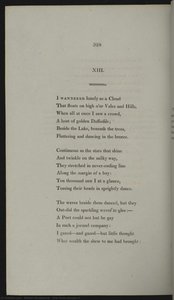
Even after his death, his influence persisted through the preservation of his memory in places like Grasmere. His poems continue to be recognized for their ability to find meaning in the simplest elements of the earth, from a field of daffodils to the quiet banks of a river.
Ερωτήσεις και Απαντήσεις
Πόσα έργα του/της William Wordsworth είναι διαθέσιμα για περιήγηση;
Μπορείτε να περιηγηθείτε σε 4 έργα τέχνης έργα του William Wordsworth στη σελίδα Όλα τα έργα.
Πού μπορώ να δω τα έργα του/της William Wordsworth ταξινομημένα ανά ατμόσφαιρα;
Μπορείτε να περιηγηθείτε στα έργα του/της William Wordsworth ανάλογα με τη διάθεση στη σελίδα Κόρνερ Αίσθησης, όπου τα œuvres έχουν ταξινομηθεί σύμφωνα με την ατμόσφαιρα που αποπንέουν.
Υπάρχει χρονολόγιο με τα έργα του/της William Wordsworth;
Τα έργα του καλλιτέχνη William Wordsworth μπορούν να περιηγηθούν χρονολογικά στη σελίδα Χρονολόγιο Έργων.