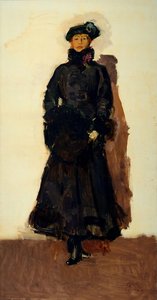
Isaac Israëls: A Pioneer of Amsterdam Impressionism
- Early Life and Artistic Heritage
- The Amsterdam Impressionist Movement
- Travels and Artistic Evolution
- Notable Works and Recognition
- Legacy and Influence
Early Life and Artistic Heritage
Isaac Lazarus Israëls was born in Amsterdam, Netherlands, on February 3rd, 1865, into a family deeply rooted in the Dutch art world. His father, Jozef Israëls—a towering figure of the Hague School—was renowned for his monumental depictions of maritime life and peasant scenes, establishing a tradition of realism infused with lyrical beauty. Aleida Schaap, Isaac’s mother, was herself an accomplished artist and instilled within him a profound appreciation for visual expression from childhood. This familial artistic lineage profoundly shaped Isaac's formative years, fostering an innate talent that would blossom into extraordinary creativity. From the tender age of sixteen, he demonstrated remarkable skill when he secured a sale of “Bugle Practice” to Hendrik Willem Mesdag—a visionary collector and artist—even before its completion, showcasing his prodigious ability to capture fleeting moments and convey emotion with masterful technique. Two portraits created in the same year of his grandmother and family friend Nannette Enthoven attest to this early aptitude for portraying human subjects with sensitivity and precision.
The Amsterdam Impressionist Movement
Israëls’ artistic trajectory was decisively influenced by the intellectual currents swirling around him, particularly the “Tachtigers”—a group of writers and artists who championed stylistic innovation as a reflection of content. Rejecting academic conventions, they advocated for portraying subjects with intense emotion and capturing the immediacy of experience—principles that resonated deeply within Israëls’ artistic sensibilities. He honed his craft at the Royal Academy of Art in The Hague alongside George Hendrik Breitner, forging a lifelong friendship that would propel them both toward groundbreaking achievements. Together, they embraced the ethos of the Tachtigers, rejecting traditional artistic formulas and striving to convey psychological depth through vibrant color palettes and loose brushwork. Israëls’ fascination with capturing the dynamism of urban life—particularly the bustling streets and cafes of Amsterdam—became a defining characteristic of his oeuvre.
Travels and Artistic Evolution
Driven by an insatiable curiosity and artistic ambition, Israëls embarked on extensive journeys throughout Europe and Asia in 1904, establishing a studio in Paris. He immersed himself in the city’s vibrant cultural landscape, studying at Paquin and Drecoll fashion houses—a pursuit that honed his observational skills and broadened his understanding of visual aesthetics. The outbreak of World War I prompted him to return to Holland, where he focused primarily on portraiture—capturing the faces of prominent figures from Dutch society with unwavering dedication. However, Israëls’ artistic explorations didn't cease there; he undertook expeditions to India and the Dutch East Indies, immersing himself in exotic landscapes and cultures. These experiences infused his work with new perspectives and techniques, enriching his artistic vocabulary and cementing his reputation as a cosmopolitan artist.
Notable Works and Recognition
Israëls’ legacy rests upon a substantial body of paintings celebrated for their luminous colors, expressive brushstrokes, and astute portrayals of everyday life. Among his most iconic creations are “Transport of Colonial Soldiers”—a monumental canvas depicting the arduous journey of African soldiers—and “The Coffee Sorters”—a captivating depiction of labor amidst tropical foliage. His portrait of Mata Hari—a controversial figure shrouded in intrigue—became a symbol of artistic daring and psychological insight. Israëls’ work garnered international acclaim, culminating in a Gold Medal at the 1928 Olympic Games for his painting "Red Rider"—a testament to his artistic prowess and enduring influence.
Legacy and Influence
Isaac Lazarus Israëls left an indelible mark on Dutch art history. His paintings—now housed in prestigious museums worldwide, including the Van Gogh Museum and Mauritshuis—continue to inspire artists and captivate audiences alike. He championed Impressionism’s expressive power, elevating it beyond mere visual representation to convey profound emotional resonance. Israëls' unwavering commitment to capturing the spirit of his time solidified his place as one of the most significant Dutch painters of the early 20th century—a true innovator who reshaped artistic conventions and bequeathed a timeless vision of beauty and human experience.