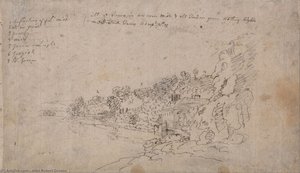
The Poetic Vision of John Robert Cozens
In the annals of English art, few names evoke such a profound sense of atmospheric wonder as John Robert Cozens. Often described as perhaps the most poetic of English painters, Cozens occupied a singular space in the transition toward Romanticism. Though his career was relatively brief and his output modest, the impact he left upon the landscape tradition was monumental. He did not merely seek to record the topography of the world; rather, he sought to capture the very soul of the atmosphere, translating the ephemeral qualities of light, mist, and shadow into a delicate language of watercolor.
Born in London, United Kingdom, Cozens was shaped by a deep-seated connection to the landscape, nurtured by his father, the distinguished artistic theorist Alexander Cozens. Under his father's guidance, the young artist developed an intimate appreciation for Continental scenery. His travels through the Alps and Italy were not merely excursions but essential pilgrimages that provided the raw material for his most evocative works. In these vast, rugged terrains, Cozen found the perfect stage to explore the Sublime—that breathtaking intersection of awe and overwhelming magnitude where the scale of nature dwarfs human presence.
A Revolution in Watercolor Technique
The technical mastery of Cozens lay in his ability to achieve immense depth and grandeur through an incredibly restrained means. Eschewing vibrant or distracting colors, he frequently employed a limited palette consisting primarily of blues, greys, and greens. This monochromatic or near-monochromatic approach allowed him to focus entirely on the nuances of light and the weight of the atmosphere. By utilizing subtle washes and precise linear contours, he could create a sense of receding distance, where mountains seemed to dissolve into misty heights and valleys were swallowed by soft, diffused light.
His method represented a significant departure from the purely topographical records common in his era. Cozens was a pioneer who used watercolor as a purely expressional medium, capable of representing vast expanses of land and sky without the need for heavy bodycolor or additives. This innovation allowed for a luminous, ethereal glow to emerge directly from the paper itself, giving his landscapes an almost spiritual quality. His work moved beyond the mere depiction of a location to capture the essence of a moment—a fleeting impression of stillness within a wild, untamed world.
Legacy and Influence on the Romantic Era
The historical significance of John Robert Cozens cannot be overstated, as he served as a vital progenitor for the revolution in British watercolor during the late eighteenth century. His influence acted as a bridge between the classical traditions of the past and the burgeoning Romantic movement. The giants of English landscape painting, most notably Thomas Girtin and J. M. W. Turner, looked to his work with profound reverence. It is well-documented that these masters made copies of his watercolours during their formative years, absorbing his ability to manipulate light and atmosphere.
Even the great John Constable spoke of him with unparalleled admiration, describing Cozens as "all poetry" and "the greatest genius that ever touched landscape." Through his ability to find beauty in the monochrome and grandeur in the simple composition, Cozens redefined what the medium of watercolor could achieve. He transformed the landscape from a subject of documentation into a vessel for emotion, leaving behind a legacy of atmospheric brilliance that continues to resonate with anyone who seeks the sublime in the natural world.
Questions & Answers
Is there a timeline of John Robert Cozens's works?
A timeline of John Robert Cozens's works exists: the artist's Artwork Timeline page orders the artworks by creation date.
Where are John Robert Cozens's artworks grouped by keywords?
The By Keywords page of John Robert Cozens groups the artist's artworks by their keywords.
How popular are John Robert Cozens's artworks?
Statistics about John Robert Cozens's works are available on the artist's Stats page.