A Life Between Stone and Canvas
Born in Basel, Switzerland, to a stonemason named Rudolf Birmann, the life of Peter Birmann was shaped by a unique intersection of structural precision and artistic vision. His early years were spent under the tutelage of his father, where he gained an intimate understanding of the weight, texture, and permanence of stone—a foundation that would later manifest in his masterful depictions of architectural marvels and rugged landscapes. This technical grounding provided him with a rare perspective when he transitioned from the physical craft of masonry to the delicate nuances of fine art, studying under the guidance of Johann Ludwig Aberli.
The trajectory of Birmramn's career was profoundly altered by his time in Rome during the 1780s. This period of intense immersion in Italian culture allowed him to work within the studio of Louis Ducros and manage the engraving workshop of Giovanni Volpato. It was amidst the classical grandeur of Italy that his artistic identity truly flourished. He became a keen observer of the landscape, finding deep inspiration in the dramatic waterfalls of Tivoli and Terni. His ability to capture these scenes through watercolours and wash drawings earned him significant acclaim among international travellers from England, Germany, and Russia, eventually allowing him to achieve professional independence.
The Mastery of Landscape and Light
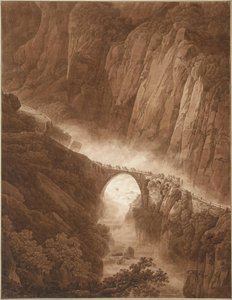
Birmann’s oeuvre is a testament to his ability to weave together the classical tradition with a burgeoning romantic sensibility. His work often serves as a bridge between the organized world of human architecture and the untamed majesty of nature. In masterpieces such as The Devil, one can witness his extraordinary technical brilliance; he renders the meticulous stonework of bridges and the purposeful movement of figures with such clarity that the viewer feels the spray of a rushing river or the weight of a mountain peak. His style was deeply influenced by the seventeenth-century master Claude Lorrain, a connection evident in his sophisticated handling of light and shadow, which imbues his compositions with an almost palpable depth.
Upon returning to Basel, Birmann did not merely replicate his Italian vistas but expanded his repertoire to include the sweeping landscapes of the Jura region. His artistic output was remarkably diverse, encompassing:
- Architectural Views: Detailed renderings of ruins, gardens, and cityscapes that capture the enduring spirit of historical structures.
- Italian Landscapes: Evocative depictions of the Roman countryside, focusing on the interplay between water and stone.
- Classical Landscapes: Works that applied a refined, classical style to the rugged terrains of Switzerland.
Legacy and Artistic Contribution
Beyond his individual canvases, Birmann was a pivotal figure in the cultural fabric of Basel. He was not only a painter but also an accomplished art dealer and publisher, establishing a workshop that contributed to the region's artistic vitality. His commitment to the local arts community was solidified when he became a founding member of the Basel Artists' Society in 1812. His influence extended into the realms of civic duty as well, serving on both the Grand Council and the Small Council of Basel for several decades.
The Birmann name would continue to resonate within the art world through his sons, Wilhelm and Samuel Birmann, both of whom followed in his footsteps as artists. Through his meticulous technique and his ability to capture the sublime tension between civilization and the wild, Peter Birmann left an indelible mark on the tradition of landscape painting, ensuring that his vision of the natural and constructed world would endure long after his passing.
Questions & Answers
Is there a complete list of Peter Birmann's artworks?
Every work by Peter Birmann on this website can be browsed from the artist's All Artworks page.
Can I browse Peter Birmann's works by medium?
To find all works by Peter Birmann in a given medium, use the artist's All Medium page.
In which movements did Peter Birmann work?
The movements Peter Birmann worked in can be seen on the artist's All Movements page, which groups the artworks by movement.