

The Painting Process, Step by Step
Watch how a commissioned oil painting comes to life — from a blank linen canvas to the finished portrait hanging on your wall.
Stretching the Canvas and the First Drawing
When one of our artists receives your commission — say, a family portrait — this is what happens in the studio. If you chose the premium linen canvas we recommend, it is cut to size and stretched onto its frame, ready for the first charcoal or pencil drawing. If you could look over the artist's shoulder, these are the steps you would see unfold over the following days:

The First Strokes of Oil Paint
Next come the first strokes of fine-quality oil paint. For amateur painters this is often a nerve-racking moment — permanent oil paint meeting a good drawing on a good canvas. For our experienced artists, it is simply where the painting begins.

Blocking In the Face and Hair
In a portrait, the face is the first thing every viewer looks at, so it is naturally the first thing the painter works on. Here, a light undercoat is brushed onto the face and hair to establish the tones.

Building Up the Paint Layers
The artist knows that many layers of paint will be built up before the picture is finished, and works accordingly — always mindful of how the semi-transparent layers will interact with one another, especially on the faces.

Bringing In the Background
As the faces begin to come alive on the canvas, it is time to fill in the background colors, chosen to make the figures stand out with a convincing sense of depth.

Deepening Color and Detail
Rich browns and greys are worked into the background while the faces are modelled further — notice the free, confident brushstrokes, the mark of a painter who enjoys the craft, as painters always have. Each layer of oil paint needs time to dry, so the complete process can stretch over several days.
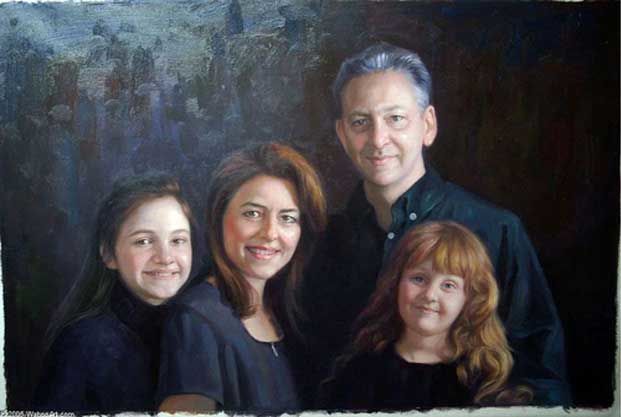
Light, Shadow and Expression
Dark clothes against a dark background draw all the attention to the heads and faces, turning the portrait into a study of individual expression and personality. It is an age-old technique, perfected by masters such as Rembrandt in his revealing portrait studies.

The Finished Painting
Voilà — the finished painting, ready to hang on your wall. Up close you can still catch the scent of the oil paint as you enjoy its painterly quality: nuances of complementary colors glowing through transparent layers, something only a true oil painting can offer.
