


The Great Rebellion: Moving Beyond the Visible Surface of Realism
 Symbolism vs. Impressionism: Painting the Unseen Human Psyche
The Visible World: Impressionism and the Ephemeral Capture of Light 19th Century Masterpieces: 10 Paintings That Defined an Era | AllPaintingsStore Introduction The 19th century—a period defined by sweeping transformations, from the Industrial Revolution’s re...
At the close of the nineteenth century, a profound rebellion began to stir against the rigid dictates of Realism and the scientific observation of Naturalism. While artists like Courbet sought to depict the world exactly as it appeared, a new generation of thinkers felt that such literal representation was insufficient. They yearned for an art that could capture the intangible—the emotions, the anxieties, and the spiritual longings that lie beneath the surface of our daily lives. This was the birth of Symbolism, a movement that moved away from the objective, quasi-scientific gaze of its predecessors to embrace the power of pure subjectivity. It was a shift from painting what the eye sees to painting what the heart feels, turning the canvas into a window for the unseen.
Gustave Moreau: Weaving Myths and Ethereal Visions into Canvas
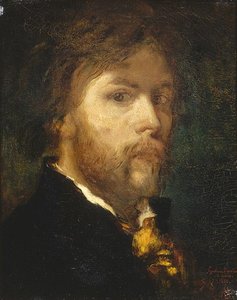 Gustave Moreau
A Dream Weaver of Symbolism: The Life and Art of Gustave Moreau Gustave Moreau, a name synonymous with the ethereal beauty and enigmatic depths of Symbolist painting, emerged from 19th-century Paris as a singular artistic voice. Born in 1826 into a b...
Moreau’s technique was as rich and layered as the legends he depicted. Drawing from his rigorous academic training, he utilized an opulent texture that brought re-envisioned classical themes—such as the presence of Venus or the Muses—to life with a sense of divine mystery. In masterpieces like The Apparition, we see him navigating the complex intersection of religion and imagination, using light not to document a moment in time, but to illuminate a vision. His canvases are heavy with allegory, inviting us to look past the figures of Salome or Herod and instead contemplate the deeper, more enigmatic truths of human desire and destiny. To stand before a Moreau is to enter a sanctuary where the material world is merely a veil for something much more profound.
The Architecture of Shadows: Odilon Redon’s Journey into the Subconscious
 Odilon Redon
A World Beyond the Visible: The Enigmatic Art of Odilon Redon Odilon Redon, born Bertrand-Jean Redon in 1840 in Bordeaux, France, was an artist perpetually drawn to translate the unseen realms of imagination and dream into tangible form. His artistic...
Redon’s influence was profound, drawing heavily from the macabre and mysterious tones of writers like Edgar Allan Poe and Charles Baudelaire. However, his evolution was just as remarkable as his beginnings. As he moved into the 1890s, Redon abandoned the heavy shadows of his charcoal years for the luminous, vibrant world of pastels and oils. In works such as The Turquoise Vase, we see a transition toward a dreamlike abstraction where color itself becomes a language of emotion. His later landscapes and floral studies are imbued with a palpable sense of mystery, suggesting that even in the brightest bloom, there remains a trace of the enigmatic and the unknown.
Beyond Light and Atmosphere: Finding Psychological Truth in Color and Form
--- title: Symbolism - A mystic search for meaning and psychological truth. url: https://arthistoryproject.com/timeline/modernism/symbolism/ hostname: arthistoryproject.com description: Some artistic movements evolve naturally out of decades of cultu...
In this movement, a specific shade of blue or a particular curve of a line was not chosen for its accuracy to nature, but for its ability to evoke an emotional response. The artists sought a synthesis of form and feeling, where the composition itself acted as a metaphor for the human condition. This approach allowed them to explore themes of love, loss, and spiritual longing through a visual language that was both simplified and deeply evocative. By prioritizing atmosphere and mood over anatomical or architectural detail, they created works that do not just represent reality but re-create emotional experiences within the viewer.
The Enduring Echo: How Symbolist Dreams Shaped the Modern Soul
As we reflect on the legacy of these masters, it is impossible not to see the fingerprints of Symbolism on the much of modern art that followed. The movement’s fascination with the irrational and the dreamlike served as a vital precursor to Surrealism, paving the way for artists to explore the full breadth of the human imagination. The Symbolists taught us that art could be a vessel for the most private of terrors and the most sacred of visions.For the modern collector and lover of art, the works of Moreau and Redon offer more than just aesthetic pleasure; they offer a mirror to our own inner complexities. In an era often dominated by the literal and the technological, the Symbolist tradition reminds us of the enduring value of mystery. They invite us to step away from the bright, sun-drenched surface of the everyday and to venture, if only for a moment, into the beautiful, shadowed corridors of our own subconscious minds. Through their eyes, we learn that the most important things in life are often those that remain unseen.


