




Primitive Marks: The Enduring Symbolism of the Stick Figure
The human form begins with the simplest possible gesture: a line for a limb and a circle for a head. This rudimentary approach, often seen in stick figures, is not a lack of skill but a distillation of presence. By stripping away the complexity of muscle and bone, the artist focuses entirely on movement and the essential idea of a person. This minimalist language allows a figure to become a universal symbol, recognizable across any language or culture. This drive toward simplicity finds its roots in the earliest human expressions. In prehistoric cave paintings, such as those found in Lascaux, France, or the mud glyphs of Kentucky’s Crumps Cave, stick-like figures appear alongside more detailed animals. These ancient marks were not mere doodles; they were the first attempts to record human interaction with the world. They served as symbols of hunters, dancers, or even spiritual entities, proving that even with the most basic tools, the impulse to represent ourselves is fundamental to our existence. Today, this ancient logic survives in our digital and graphic communication. From the icons on a restroom door to the simplified characters in modern animation, the stick figure remains our most efficient way to convey a human action without the distraction of individual identity.The Mathematical Body: Proportions and the Classical Ideal
As societies grew more complex, the way we viewed the body shifted from symbolic marks to a search for perfect order. Artists began to wonder if there was a mathematical blueprint that defined a "correct" or "ideal" human shape. This period saw the rise of strict proportional systems, where the height of a person was measured in relation to the size of their head. An average person might be measured at seven-and-a-half heads tall, but artists seeking to depict nobility or grace often stretched the figure to eight heads, or even eight-and-a-half for a more heroic, god-like appearance. This pursuit of the ideal was not merely a matter of aesthetics; it was a search for harmony between the physical body and the laws of geometry. In ancient Greece, this reached a peak of sophistication. The sculptor Zeuxis famously reviewed the women of Agrigentum, selecting five specific facial features from different models to combine into a single, perfect image. This method sought to move beyond the flaws of a single individual to create a vision of human perfection that felt divinely ordered. This obsession with the "ideal" continues to influence how we perceive beauty and structure in art. Even when modern artists choose to distort the body, they are often reacting against these very rules of proportion that have governed Western art for centuries.Anatomical Precision: The Renaissance and the Scientific Eye
 Leonardo da Vinci
. High Renaissance polymath known for sfumato technique and anatomical precision in works like the Mona Lisa and The Last Supper.
Deconstructing the Form: Geometric Abstraction and Modernism
 Figure of a Man
, Joaquín Torres García
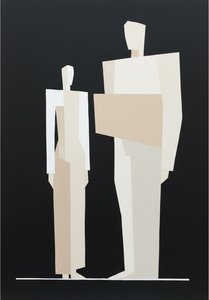
In the modern era, the goal of representing the human form shifted again, moving away from both the ideal and the literal. Artists began to see the body not as a collection of muscles, but as a series of intersecting shapes. This approach uses geometry—spheres for the cranium or cylinders for the torso—to construct the figure, prioritizing the structural essence of the person over their surface details. This movement toward abstraction is clearly seen in the work of Joaquín Torres García, whose 1930 piece, Figure of a Man, utilizes Cubist and Constructivist principles to represent the human form through geometric abstraction. Similarly, Kazimir Malevich’s Standing Figure uses minimalist lines to strip the body down to its most basic, modern essence. These artists were not interested in the texture of skin, but in the rhythm of shape and the power of the simplified silhouette. This deconstruction allows the viewer to engage with the "idea" of a person rather than a specific likeness. It moves the conversation from the physical to the conceptual, asking what remains of a human being when you remove the details of their face and clothing.
The Contemporary Figure: Exploring Identity and the Human Condition
In the contemporary landscape, the human figure has become a tool for exploring the complexities of the human experience. We have moved past the need for perfect proportions or even perfect realism. Instead, artists use the body to investigate identity, memory, and the psychological weight of existence. The figure is no longer just a subject to be drawn; it is a vessel for social and emotional commentary. Contemporary artists often use the body to address the "feeling" of being human in a fragmented world. Some use large-scale, anonymous installations to speak to collective memory, while others use photography to scrutinize the effects of time and aging on the skin. The figure has become a way to explore how we fit into—or are marginalized by—the structures of modern society. Whether through the meticulous, textured layers of a hand-painted oil reproduction or the bold, graphic energy of a modern print, the human figure remains our most enduring way of making sense of our place in the world. At AllPaintingsStore.com, we celebrate this long history by offering everything from highly detailed classical reproductions to contemporary works that push the boundaries of modern design.


