A Life Painted in Emotion: The Journey of Alexej von Jawlensky
Alexej von Jawlensky, born Alexej Georgewitsch von Jawlensky on March 13, 1864, in the Russian town of Torzhok, embarked on a path that would firmly establish him as a pivotal figure within early twentieth-century Expressionism. His formative years were characterized by frequent relocations, culminating in a settling within Moscow at the age of ten—an experience that likely instilled a sense of displacement and perhaps, a yearning for deeper connection, themes subtly woven into the emotional core of his later artistic explorations. Initially drawn to a military career, Jawlensky’s encounter with the vibrant world of art during the 1880 Moscow World Exposition proved transformative. This exposure ignited within him a passion that would ultimately supersede any sense of duty, leading him down a path dedicated to visual expression.
Early Influences and Artistic Foundations
Jawlensky’s early artistic training was somewhat unconventional. He initially pursued a military career, but his encounter with art during the 1880 Moscow World Exposition sparked an immediate and profound interest. This pivotal experience led him to abandon his military aspirations and dedicate himself to painting. He received some formal instruction at the St. Petersburg Academy of Arts, balancing his artistic pursuits with his military obligations. However, it was his association with Ilya Repin, a prominent Russian realist painter, that proved particularly formative. Repin’s influence instilled in Jawlensky a deep appreciation for realism and observation, while simultaneously encouraging him to explore new avenues of expression. Crucially, he met Marianne von Werefkin during this period—an artist of considerable means who became not only his mentor but also a vital supporter, providing the financial stability necessary for him to fully commit to his artistic endeavors. Their relationship was complex and deeply intertwined with shared creative ambitions.
Munich and the Birth of Expressionism
The move to Munich in 1894 marked a decisive turning point in Jawlensky’s career. He enrolled at Anton Ažbe’s private school, immersing himself in an environment that actively encouraged experimentation and challenged traditional academic approaches. This period witnessed a significant shift in his artistic style as he began to absorb the radical ideas circulating within the European art world. He was profoundly influenced by artists like Ferdinand Hodler, whose use of simplified forms and symbolic imagery resonated deeply with Jawlensky’s own evolving aesthetic sensibilities. Jan Verkade and Paul Sérusier further broadened his horizons, introducing him to the principles of symbolism and synthetism—movements that prioritized subjective experience and emotional resonance over strict representational accuracy. Jawlensky's engagement with groups like the Neue Künstlervereinigung München (NKvM) solidified his commitment to artistic innovation, placing him at the heart of a burgeoning Expressionist movement.
The Mystical Heads: A Journey into Inner Space
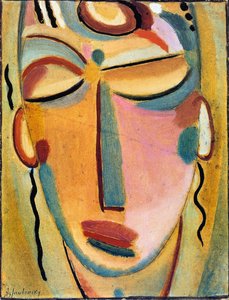
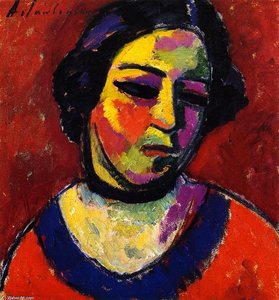
Around 1909, Jawlensky embarked on what would become his most iconic series—the “Mystical Heads.” These intensely colored portraits, often depicting faces reduced to essential forms, are not merely representations of individuals but rather explorations of spiritual essence and inner life. The heads possess a haunting quality, their simplified features and vibrant palettes conveying a sense of profound emotion and psychological depth. Works like Schokko with Red Hat (1909) and Portrait of Alexander Sakharoff (1909) exemplify this period, showcasing his mastery of color and composition. These weren’t portraits in the traditional sense; they were attempts to capture something beyond physical likeness—the soul, the inner landscape of the sitter. He distilled faces into geometric shapes, emphasizing the power of color to evoke emotion and spiritual resonance. Throughout the 1910s, Jawlensky continued to refine his style, moving towards an even greater degree of abstraction. His compositions became increasingly geometric, with forms distilled to their most fundamental elements. He developed a formulaic approach, often employing a limited range of colors arranged in carefully balanced configurations.
Exile, Legacy and Lasting Influence
The outbreak of World War I brought upheaval to Jawlensky’s life. Expelled from Germany in 1914 due to his Russian origins, he sought refuge in Switzerland, where he encountered Emmy Scheyer. Scheyer became a devoted champion of his work, tirelessly promoting it in the United States and securing him recognition on an international stage. Despite facing increasing health challenges—including severe arthritis that progressively limited his ability to paint—Jawlensky continued to create until his death in Wiesbaden, Germany, on March 15, 1941. His later works, created under immense physical hardship, are a testament to his unwavering dedication to artistic expression. Today, Alexej von Jawlensky is celebrated as a key figure in the development of Expressionism. His paintings are held in prominent museum collections worldwide, including the Museum Ostwall in Dortmund and the Städtische Galerie im Lenbachhaus in Munich. His exploration of color, form, and spiritual themes continues to resonate with audiences, solidifying his place as one of the most important artists of the early twentieth century. He left behind a body of work that is both visually striking and emotionally profound, offering a glimpse into the inner world of an artist who dared to challenge conventions and embrace the power of subjective expression.