Early Life and Training
Charles Marie Bouton, a French painter born on May 16, 1781, in Paris, embarked on his artistic journey under the mentorship of influential figures like Jacques-Louis David, Jean-Victor Bertin, and Pierre Prévost—the visionary pioneer of the diorama. David’s neoclassical style instilled in Bouton a disciplined approach to form and composition, while Bertin fostered an understanding of expressive color palettes. Prévost's groundbreaking technique of recreating atmospheric conditions within painted canvases profoundly impacted Bouton’s artistic sensibilities. These formative experiences shaped his distinctive vision—a dedication to perspective and the masterful manipulation of light—laying the groundwork for his remarkable contributions to art history.Artistic Innovations: The Diorama and Perspective
Bouton’s artistic breakthroughs centered around a revolutionary concept: the diorama, a theatrical spectacle that combined immense paintings with colored lights and natural ventilation to simulate realistic environments. Collaborating closely with Louis-Jacques Mandé Daguerre, he spearheaded its creation in Paris from 1822 to 1839, transforming entertainment into an immersive art form. This endeavor demanded unparalleled precision in perspective—a skill Bouton honed diligently—allowing him to convincingly portray spatial depth and create breathtaking illusions of reality. His meticulous attention to detail extended beyond mere visual representation; he sought to evoke emotion and transport audiences into vividly recreated scenes.Notable Works: Capturing French Heritage
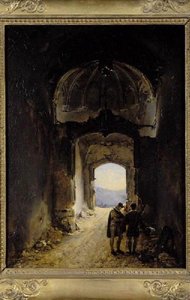
Bouton’s artistic output encompassed a diverse range of subjects, reflecting his fascination with both architectural grandeur and the subtleties of Parisian life. Among his most celebrated paintings are “Interior View of the Colosseum,” showcasing his masterful grasp of perspective and dramatic lighting—a piece featured prominently on AllPaintingsStore's artist profile: Charles Marie Bouton. Similarly, "Souterrains de Saint-Denis" powerfully conveys the spirit of medieval France through its evocative depiction of subterranean spaces. His portrayal of “La Cathédrale de Chartres” exemplifies his ability to reproduce the majesty of French Gothic architecture with remarkable accuracy—a work showcased in the Musée des Beaux-Arts de Carcassonne. Finally, "Interior View of the Church of Saint-Étienne-du-Mont" captures the serene beauty of Parisian churches, demonstrating Bouton’s sensitivity to light and color.Legacy and Historical Significance
Charles Marie Bouton stands as a pivotal figure in 19th-century French art—a pioneer who elevated painting beyond mere representation into an experience of immersive storytelling. His influence extended far beyond his immediate contemporaries, shaping the development of scenographic art and establishing new standards for realism and theatrical presentation. Through his groundbreaking work on the diorama and his unwavering commitment to artistic excellence, Bouton cemented his place in art history as a visionary innovator who profoundly impacted both the aesthetic landscape and the cultural consciousness of his time. His legacy continues to inspire artists today—a testament to the enduring power of perspective and light to transform visual perception.- Learn more about Charles Marie Bouton’s life and works at AllPaintingsStore: AllPaintingsStore's artist profile: charles marie bouton
- Explore the Musée des Beaux-Arts de Carcassonne’s collection, which features works by various artists—including Bouton—who have contributed to French artistic heritage.
Preguntas y respuestas
¿En qué ciudad y país nació Charles Marie Bouton?
Charles Marie Bouton nació en París, Francia.
¿Puedo visitar un museo virtual con las obras de Charles Marie Bouton?
La Galería 3D de Charles Marie Bouton es una página que muestra las obras del artista en una galería virtual tridimensional.
¿Dónde se pueden ver las obras de Charles Marie Bouton agrupadas por movimiento artístico?
Puedes explorar las obras de Charles Marie Bouton por movimiento en su página de Todos los movimientos.