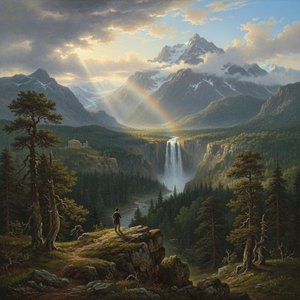
Francesco Fidanza: A Romantic Vision of Italian Landscapes
Francesco Fidanza (born , ) stands as a prominent figure within the Romantic landscape tradition of 19th-century Italy, renowned for his ability to translate the sublime grandeur of nature onto canvas with remarkable precision and emotional resonance. His artistic journey commenced under the guidance of Vincenzo Camuccini and Francesco Podesti in Rome, where he absorbed the stylistic currents emanating from masters like Vernet and Charles-François Lacroix de Marseille (1700–1782), establishing a bedrock for his distinctive visual language—a style characterized by Romantic realism infused with atmospheric perspective. Early collaborations with Eugène Beauharnais yielded monumental harbor depictions – two canvases portraying Ancona and Malamocco – each meticulously crafted to capture the drama of maritime vistas. These ambitious projects, now residing within the gallery of the Castello Brera at Milan, exemplify Fidanza’s mastery in conveying the sheer scale and emotive power of coastal panoramas. His skillful manipulation of light and shadow directly mirrored Vernet's pioneering techniques, cementing his position as a disciple of the celebrated French Romantic painter. Beyond commissioned commissions, Fidanza pursued an independent artistic path marked by unwavering dedication to observation and meticulous execution. He possessed a particular fascination with nocturnal landscapes—particularly rocky shorelines bathed in moonlight—where he achieved breathtaking results. This preoccupation aligns perfectly with the broader Romantic ethos – a fervent desire to confront the sublime, to grapple with feelings of awe and terror before the immensity of creation. Fidanza’s canvases pulsate with an inner luminescence, reflecting not merely visual beauty but also profound psychological depth. Francesco Fidanza's brother, Gregorio, similarly embraced the artistic legacy of Claude Lorrain and Salvator Rosa, diligently honing his skills through imitation and stylistic assimilation. Gregorio’s landscapes share a fundamental understanding of tonal gradation and compositional balance—skills cultivated through rigorous artistic training—demonstrating the enduring influence of classical masters on Italian Romantic painters. Like Filippo Fidanza, his father, who was born at Città di Castello (Sabina) in 1720; he received instruction from Marco Benefial at Rome. This formative experience solidified his commitment to capturing the essence of nature’s majesty and conveying its emotional impact with unwavering conviction. His artistic output spanned a considerable period, culminating in his death in Milan in 1819. Fidanza's contribution to Italian art transcends mere aesthetic considerations; it embodies the core tenets of Romanticism—a celebration of untamed beauty alongside an exploration of human emotion—continuing to inspire admiration for its luminous color palettes, meticulous detailing, and profound psychological insight. His paintings remain a testament to the transformative power of artistic vision and serve as enduring reminders of Italy’s pivotal role in shaping the Romantic movement's expressive landscape genre.- Key Influences: Vernet, Charles-François Lacroix de Marseille
- Notable Works: Ancona Harbor Scene; Malamocco Harbor Scene
- Style: Romantic Realism; Atmospheric Perspective