Hendrick van der Burgh: A Quiet Observer of Dutch Domestic Life
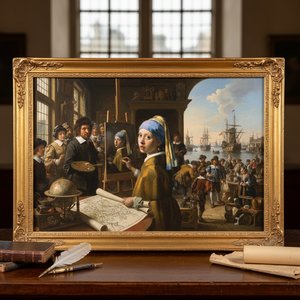
Hendrick van der Burgh (1627 – after 1664), a Delft painter active during the Dutch Golden Age, distinguishes himself from many of his contemporaries as an artist singularly focused on capturing the subtle nuances of everyday existence. Unlike Pieter de Hooch and others who prioritized monumental landscapes or dramatic portraits, Van der Burgh’s artistic vision centered on interiors—domestic scenes depicting ordinary people immersed in commonplace activities – milking time, a merry company at a table, and even a dentist’s consultation. While scholarly debate persists regarding whether these artists constituted a unified “school,” the rkd identifies Van der Burgh alongside luminaries like Isaías Boursse, Pieter Janssens Elinga, Cornelis de Man, Hendrick Ten Oever, and Jacob Vrel as practitioners of this distinctive genre style—a stylistic hallmark that sets him apart from his peers.
Born in Delft around 1627, biographical details concerning Van der Burgh’s formative years remain scarce beyond confirmation of his residency in Leiden between 1658 and 1659. His artistic education undoubtedly transpired within the framework of Delft’s established guild system—a tradition where meticulous observation and masterful rendering were considered indispensable virtues. The artist's monogram “hvb,” appearing prominently on numerous prints and portraits, served as a marker of his prolific output, reflecting the prevailing values of his era: piety, familial devotion, and unwavering respect for established customs.
Van der Burgh’s artistic style embodies remarkable restraint—a deliberate rejection of flamboyant ornamentation or dramatic chiaroscuro effects favored by painters of his time. Instead, he skillfully employed soft lighting and muted palettes to engender a palpable atmosphere within his canvases. Figures rendered with painstaking detail capture expressions of emotion, conveying an astute understanding of human psychology. Crucially, Van der Burgh’s meticulous attention to texture—the rough weave of woolen garments, the luminous sheen of polished surfaces—further amplifies the realism inherent in his compositions. This dedication to capturing tactile sensations elevates his artwork beyond mere visual representation, immersing viewers in a sensory experience that mirrors the realities of seventeenth-century Dutch life.
His prints, particularly those depicting scenes from daily life, achieved considerable acclaim during his lifetime and continue to captivate audiences today. These images offer invaluable insight into the social mores and beliefs prevalent in Holland during the Golden Age—individuals engaged in activities ranging from domestic chores to scholarly pursuits. The artist’s ability to convey emotion through subtle gestures and facial expressions underscores his mastery of artistic technique and his profound empathy for human experience—qualities that resonate powerfully across centuries.
Despite uncertainties surrounding his final years—estimated to have transpired Delft or Leiden after 1664—Hendrick van der Burgh secured his place in art history as a pivotal figure within Dutch genre painting. His unwavering commitment to portraying the quiet dignity of ordinary life, coupled with his exceptional artistic skill, ensures that his works endure as timeless representations of human experience and inspire ongoing admiration for their understated beauty. He remains an artist whose legacy resides not in grand spectacle but in the profound observation of the human condition—a testament to the enduring power of simplicity and sensitivity within the context of the Dutch Golden Age.
Por el equipo editorial de AllPaintingsStore.com
Cuestionario de arte
Cada pregunta tiene una única respuesta correcta.
Pregunta 1:
¿Dónde nació Hendrick van der Burgh?
Pregunta 2:
¿Qué estilo artístico está asociado con Hendrick van der Burgh?
Pregunta 3:
Hendrick van der Burgh es conocido por su monograma distintivo:
Pregunta 4:
¿Qué tipo de obras produjo principalmente Hendrick van der Burgh?
Pregunta 5:
¿En qué año murió aproximadamente Hendrick van der Burgh?
Descubra la riqueza y el detalle de la pintura barroca holandesa del Siglo de Oro. Explore las obras maestras de Rembrandt, Vermeer y otros artistas clave. Análisis experto e historia cultural.
Descubre los 10 imprescindibles del Siglo de Oro Holandés: Rembrandt, Vermeer y más. Explora la historia, técnica y belleza de estos lienzos clásicos. Encuentra reproducciones de arte exclusivas para decorar tu hogar en .
Embark on a cultural journey through the Dutch Golden Age. Explore the masterful interplay of light and shadow in 17th-century masterpieces, from Rembrandt to Vermeer, and discover how this era of profound realism continues to inspire fine art collectors today.
AAsistente del AtelierEn línea · responde en un minuto
¡Hola! Puedo ayudarte a elegir una obra de arte, realizar el seguimiento de un pedido o resolver tus dudas sobre la garantía. ¿En qué puedo ayudarte hoy?