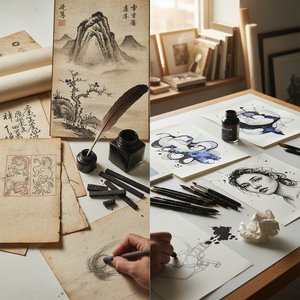
Huang Zuo: A Pioneer of Ming Dynasty Landscape Painting
Huang Zuo (1490–1566), born Liang-Cantang in Xiangshan City, Guangdong Province, stands as a pivotal figure in the annals of Ming Dynasty art history. Though overshadowed by contemporaries like Wang Meng and Zhu Da, Huang’s contribution to landscape painting—specifically his masterful depiction of misty mountains—established a distinctive aesthetic that continues to inspire artists today. His work transcends mere representation; it embodies a profound understanding of Daoist philosophy and seeks to capture the sublime beauty of nature as a reflection of cosmic harmony.
- Early Life & Education: Huang Zuo’s formative years were steeped in scholarly pursuits, nurtured under the watchful eye of influential Confucian thinkers. This intellectual grounding profoundly shaped his artistic vision, prioritizing observation and contemplation over flamboyant virtuosity—a characteristic that distinguished him from many later Ming landscape painters. He excelled in calligraphy and poetry, demonstrating a sensitivity to both visual and literary expression that would inform his artistic endeavors throughout his life.
- The Guangzhou Ren Wu Chuan: Huang Zuo’s magnum opus, “Guangzhou Ren Wu Chuan,” is more than just a chronicle of notable figures; it's a meticulously crafted panorama of Guangzhou’s urban landscape. The painting’s hazy atmosphere—achieved through subtle tonal variations and layering—mirrors the misty mountains favored by Huang himself. Scholars believe this technique was profoundly influenced by Tao Yuanming's poetry, which championed simplicity and communion with the natural world – a sentiment that resonated deeply within Huang Zuo’s artistic soul. The composition deliberately avoids ostentation, prioritizing harmony and balance to convey a sense of tranquility amidst the bustling city life.
- Technique & Style: Huang Zuo’s distinctive style is characterized by remarkable restraint in brushwork and color palette. He perfected “Yunshan” (雲山)—translating to "misty mountains"—a technique wherein he utilized soft, diffused tones—primarily blues and greens—to evoke the ethereal quality of mountainous terrain. This approach deliberately eschewed precise topographical accuracy, instead focusing on conveying mood and atmosphere with unparalleled subtlety. Huang Zuo’s meticulous layering of pigments created an illusionistic depth that captured not just the visual appearance of mountains but also their spiritual essence – a testament to his mastery of artistic technique.
- Influence & Legacy: Huang Zuo's influence extended far beyond his own lifetime, shaping the trajectory of Lingnan Universi
ty’s artistic curriculum and fostering generations of landscape painters who embraced Daoist ideals. His “Yunshan” style became a cornerstone of Ming Dynasty art, establishing a precedent for capturing beauty through atmospheric perspective and tonal harmony. Furthermore, Huang Zuo's unwavering dedication to observation and contemplation served as an inspiration for subsequent artists striving to elevate landscape painting to new heights—a legacy that continues to endure today.
- Notable Works: Among Huang Zuo’s celebrated paintings are “Bamboo Grove,” “Pine Mountain,” and “Snowy Peak.” These works exemplify his masterful command of tonal harmony and demonstrate a deep appreciation for the grandeur and serenity of mountainous landscapes. They remain treasured examples of Ming Dynasty landscape painting, embodying the spirit of Daoist contemplation and artistic innovation—a testament to Huang Zuo’s enduring contribution to Chinese art history.
Huang Zuo’s Role in Lingnan University & Artistic Education
Huang Zuo's scholarly pursuits extended beyond his personal life; he served as a professor at Lingnan University, establishing it as one of the first universities in Guangdong Province. During this time, he championed Daoist philosophy and its influence on artistic expression, shaping the curriculum and fostering an environment conducive to contemplative observation—a core element of Huang Zuo’s artistic vision. He instilled in his students the importance of capturing the essence of nature through subtle tonal variations and layering techniques—methods directly traceable to his own groundbreaking style. His teachings emphasized the pursuit of inner harmony alongside aesthetic appreciation, cementing Lingnan University's reputation as a bastion of intellectual and artistic excellence.
The Guangzhou Ren Wu Chuan: A Portrait of Urban Harmony
“Guangzhou Ren Wu Chuan,” Huang Zuo’s monumental chronicle of Guangzhou’s prominent figures, stands as a testament to his artistic prowess and intellectual curiosity. More than just a historical record, the painting embodies a profound understanding of Daoist principles—specifically the concept of “wu” (無)—which emphasizes emptiness and spontaneity. The hazy atmosphere—achieved through masterful tonal blending—mirrors the misty mountains favored by Huang Zuo himself, reflecting his belief that true beauty resides in embracing impermanence. The deliberate simplicity of composition underscores the importance of balance and harmony – a principle central to Huang Zuo’s artistic philosophy.
Huang Zuo’s Artistic Technique: Mastering Yunshan
Huang Zuo's signature technique—the “Yunshan” method—involved utilizing soft, diffused tones—primarily blues and greens—to evoke the ethereal quality of mountainous terrain. This approach deliberately eschewed precise topographical accuracy, instead focusing on conveying mood and atmosphere with unparalleled subtlety. By meticulously layering pigments and manipulating brushstrokes to create subtle tonal variations, Huang Zuo achieved a remarkable feat of artistic illusionism, capturing the sublime beauty of nature as a reflection of cosmic harmony. His unwavering dedication to observation and contemplation solidified his position as one of Ming Dynasty’s foremost landscape painters—a legacy that continues to inspire artists today.