Jan Willem van Borselen: A Quiet Master of Dutch Landscape
Jan Willem van Borselen (dates unknown) was a Dutch landscape painter who emerged during the Hague School, a movement that championed realism and atmospheric perspective in depicting the Dutch countryside. Though overshadowed by his contemporaries like Jacob Maris and Anton Mauve, Van Borselen’s serene canvases offer a glimpse into Holland's tranquil beauty and reflect the artistic sensibilities of his time—a testament to the enduring power of observation and meticulous detail.
Early Life & Training: Precise biographical details about Van Borselen remain elusive. He was born in Gouda, Netherlands, likely around 1830, though definitive records are scarce. His formative years were spent absorbing influences from Rembrandt and Jan van Goyen, masters of chiaroscuro and capturing the essence of Dutch landscapes with remarkable accuracy. These giants of art instilled within him a profound understanding of light and shadow—a cornerstone of his distinctive style—and fueled his unwavering commitment to portraying natural scenes with breathtaking realism.
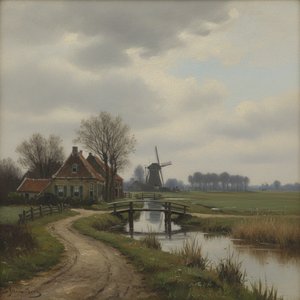
Style & Technique: Van Borselen’s artistic style is characterized by a meticulous attention to detail and an unwavering devotion to portraying natural vistas with profound realism. He excelled in watercolor painting, favoring subtle tonal gradations and delicate brushstrokes that conveyed the atmospheric conditions—misty mornings, hazy sunsets—with breathtaking subtlety. Like many Hague School artists, he skillfully employed atmospheric perspective, placing distant objects in paler hues to simulate depth and creating a sense of spaciousness within his compositions. This technique wasn’t merely stylistic; it represented a fundamental shift away from idealized representations toward an honest depiction of the observable world – a pursuit that resonated deeply with the intellectual currents of the era. His landscapes are imbued with a palpable stillness, inviting contemplation and capturing a mood of peaceful solitude—a characteristic found throughout his oeuvre.
Notable Works: Van Borselen’s artistic legacy rests upon numerous landscapes featuring windmills, reeds, marshes, and expansive views of the Dutch polderlands. “Landscape with windmill in the distance” exemplifies his signature style—a luminous depiction of rural Holland bathed in soft light. These paintings are notable for their quiet contemplation and understated beauty, capturing a mood of peaceful solitude that resonated deeply with viewers of his era. Consider "The Willow Tree," a masterful watercolor showcasing the iconic Dutch willow – a motif frequently revisited by Van Borselen throughout his career, symbolizing resilience and harmony with nature. His works were recognized through connections to prominent patrons and institutions; notably, he was associated with Gemeenlanthuis van Rijnland in Leiden, where he admired Pieter Post’s courtroom masterpiece—a testament to Leiden’s artistic heritage.
Connections & Patronage: Furthermore, his paintings were exhibited at Museum Smidt Van Gelder in Antwerp, showcasing Flemish art alongside Dutch masterpieces – a deliberate effort to foster dialogue between artistic traditions. The King himself recognized Van Borselen's talent and invited him to Paleis Het Loo, their summer residence, where he continued to produce works that celebrated the splendor of Holland’s countryside. His dedication to capturing nature as realistically as possible—without embellishment—was widely appreciated by both art connoisseurs and the public alike.
Legacy & Significance: While not as prominently lauded as some of his contemporaries, Jan Willem van Borselen remains a significant figure within the Hague School canon. His unwavering commitment to portraying Holland’s natural splendor with masterful watercolor technique contributes to an enduring appreciation for his artistic vision—a quiet voice amidst the bustling movement that reminds us that beauty can be found in understated observation and meticulous execution—qualities that continue to inspire artists today. He embodies a profound respect for the natural world, translating its serene grandeur onto canvas with unparalleled grace.