


The Impulse to Record: From Prehistoric Marks to Symbolic Scale
Before the development of complex writing systems, the human urge to leave a mark was expressed through the simplest of tools. Prehistoric artists used sticks to make marks on cave walls, capturing the essence of movement and presence. These early gestures were not attempts at photographic accuracy but were fundamental acts of recording existence. They represent the earliest bridge between lived experience and the physical medium of the wall.
This drive to communicate through the figure evolved into highly structured systems as civilizations grew. In Ancient Egypt, the approach to the human form became a tool for social and spiritual hierarchy. Rather than focusing on anatomical realism, Egyptian artists utilized scale to denote importance. A Pharaoh was rendered significantly larger than a commoner, a visual shorthand to indicate god-like status. These figures were designed for religious necessity, intended to accompany the deceased into the afterlife to ensure spiritual continuity. The body was not just a subject; it was a vessel for permanence.
The transition from these rigid, symbolic representations to more fluid forms marks a significant shift in how humanity perceived its own image. What began as a stick mark on a stone wall eventually became a sophisticated language of status and divinity.
The Mathematical Body: Renaissance Proportions and the Ideal Form
 The Proportions of the Human Figure
, Leonardo da Vinci
As the focus shifted from the symbolic to the observational, the human body became a subject of intense scientific inquiry. During the Renaissance, the pursuit of beauty was inseparable from the pursuit of mathematical truth. Artists began to look beneath the skin to understand the mechanics of the frame, seeking a way to map the relationship between various anatomical measurements and the principles of harmony.
A primary example of this investigation is Leonardo da Vinci’s The Proportions of the Human Figure, sketched around 1487. Held today in the Gallerie dell'Accademia di Venezia, this work functions as a visual investigation into the mathematical ratios that define the physical form. Leonardo approached the subject through a synthesis of observation and theoretical inquiry, using the Vitruvian Canon to explore how the human frame relates to geometric symmetry. His work moved the study of anatomy from mere observation into the realm of precise scientific illustration.
This era established a blueprint for the human form that would influence Western art for centuries. By applying geometry to the flesh, the Renaissance artist sought to find the divine through the perfection of proportion.
Weight and Volume: The Transition from Symbol to Substance
The move toward realism did not happen overnight; it was a gradual realization that the human figure could occupy a tangible, three-dimensional space. For much of history, religious art functioned as a symbolic language, often utilizing flat planes and gold backgrounds to represent a spiritual reality rather than a physical one. The figures were icons, existing outside of time and gravity.
This changed when artists like Giotto began to introduce weight and volume into their compositions. By moving away from purely symbolic representations, painters started to ground divine figures in a recognizable, physical reality. This shift allowed the viewer to see the sacred as something occupying the same physical space as themselves. It was a revolution of presence, where the human figure gained the ability to cast a shadow and hold a pose.
This introduction of mass and volume changed the viewer's relationship to the artwork. The figure was no longer a flat icon to be contemplated from a distance, but a solid presence that commanded space within a room.
Light and Shadow: The Psychological Depth of the Human Presence
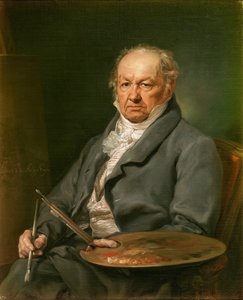 Francisco Goya
. Spanish Romanticist of dark, visceral etchings and haunting, psychological black paintings that capture the raw suffering of war and madness.
Once the human figure had gained weight and volume, artists began to explore the internal landscape of the subject. The focus shifted from how the body occupies space to how the body experiences emotion and mortality. The surface of the skin became a canvas for the play of light and the weight of the human condition.
Caravaggio utilized chiaroscuro to create dramatic tension, using extreme contrasts between light and dark to pull the figure out of the shadows. This technique added a sense of theatricality and psychological immediacy to the human form. Later, Francisco Goya’s works moved into even deeper territory, using the figure to convey intense psychological states. In these hands, the human body became a vehicle for exploring the complexities of the human soul, moving beyond the physical to the visceral.
The use of light transformed the figure from a study in anatomy into a study in character. Through the manipulation of shadow, artists found a way to depict the invisible: the weight of thought and the intensity of feeling.
The Fragmented Form: Geometry and the Modern Deconstruction
 Standing Figure
, Kazimir Malevich
The modern era brought a radical departure from the idea that the human figure must be a cohesive, whole entity. As the world became increasingly complex and industrial, the traditional rules of perspective and proportion were challenged. Artists began to deconstruct the body, breaking it down into its fundamental geometric components to explore how we perceive form in a fragmented world.
Kazimir Malevich’s Standing Figure exemplifies this move toward minimalism and geometric abstraction. By stripping the human form down to its essential lines and shapes, Malevich moved away from the descriptive toward the conceptual. Similarly, Paul Klee’s Collection of Figurines uses angular lines and layered washes of color to create stylized, almost surrealist versions of the human form. These works do not seek to replicate the body as it appears to the eye, but rather as it is understood by the mind.
This deconstruction allowed for a new kind of expression, where the essence of a person could be captured through a single line or a geometric block, rather than a detailed anatomical study.
The Kinetic Figure: Identity and Emotion in Contemporary Expression
 Bruno Alexandre Vilela Gama
Explore the captivating portraits & human figures of Brazilian artist Bruno Alexandre Vilela Gama (Bruno Vilela). Trained by a Japanese master, his anatomical realism blends art & science. View his work on AllPaintingsStore!
In the contemporary landscape, the human figure has moved beyond the need for perfect proportions or even perfect realism. The body is now used as a tool to investigate identity, memory, and the psychological weight of existence. The figure is no longer just a subject to be drawn; it is a vessel for social and emotional commentary, addressing the feeling of being human in a fragmented, modern world.
Contemporary artists often use abstraction to suggest movement and energy. A gestural splatter of cadmium orange or cobalt blue can suggest the kinetic energy of a body in motion more effectively than a literal depiction. This is seen in the work of artists like Bruno Alexandre Vilela Gama, who blends anatomical realism with symbolic exploration. His work, such as Fragmented Soul in Cobalt and Crimson, explores the duality between human vulnerability and raw, kinetic energy, using color and form to speak to the internal state of the individual.
From the first marks on a cave wall to the complex layers of modern abstraction, the human figure remains our most enduring way of making sense of our place in the world. At AllPaintingsStore.com, we celebrate this long history by providing high-quality, hand-painted reproductions and custom commissions that bring these historical and contemporary moments into your space.


