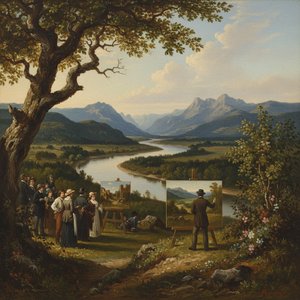
Robert Hannah (1812 – 1909): A Painter of Faedal Visions
Robert Hannah, born in London in 1812, emerged as a singular figure within the British artistic landscape of the Victorian era. Unlike many of his contemporaries who adhered to established academic conventions, Hannah cultivated a distinctive style characterized by an ethereal quality and imbued with symbolic resonance – a style often described as “Faedal,” referencing folklore tales depicting mischievous spirits inhabiting remote landscapes.
- Early Life & Artistic Training: Details about his upbringing and initial artistic education remain somewhat elusive. However, anecdotal evidence suggests he received instruction from John Ruskin, the influential Victorian critic and artist, fostering a preoccupation with Ruskin’s Romantic ideals of beauty and moral seriousness.
- The Faedal Aesthetic: Hannah's paintings are instantly recognizable for their luminous palettes, hazy atmospheric perspective, and depictions of solitary figures amidst desolate vistas. He deliberately eschewed meticulous realism, prioritizing instead the conveyance of mood and emotion—a technique that aligns closely with Ruskin’s advocacy for imaginative interpretation.
- Notable Subjects & Techniques: Hannah excelled in portraiture, capturing the dignity and melancholy of his subjects with remarkable sensitivity. His genre scenes explored themes of rural life and folklore, reflecting a fascination with Celtic mythology and traditions. He employed glazing techniques—applying thin layers of translucent pigment over underlying colors—to achieve unparalleled luminosity and depth.
- Major Achievements & Recognition: Hannah’s oeuvre comprises approximately 350 paintings, showcasing his versatility across various mediums and genres. His works gained acclaim within British artistic circles and were exhibited extensively throughout Europe. He was particularly celebrated for his landscapes depicting the Scottish Highlands, where he resided for much of his adult life.
- Legacy & Historical Significance: Hannah’s contribution to Victorian art lies not merely in stylistic innovation but also in his embodiment of Ruskinian principles—a commitment to imaginative vision and moral contemplation. He stands as a testament to the enduring power of artistic individualism and continues to inspire artists today with his evocative depictions of Faedal landscapes and portraits imbued with profound psychological insight.
Küsimused ja vastused
Kas saan Robert Hannah teoseid värvi järgi sorteerida?
Robert Hannah Värvitoonide indeks on leht, kus kunstniku teosed on sorteeritud nende värvide järgi.
Kas saan Robert Hannah teoseid meediumi järgi sirvida?
Et leida kõik Robert Hannah teosed teatud tehnikas, külastage artisti lehte Kõik tehnikad.
Kas Robert Hannah teoste täielik nimekiri on olemas?
Kõiki Robert Hannah teoseid see veebileht lehel saab vaadata artisti Kõik teosed lehelt.