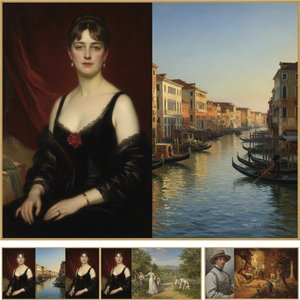
Robert John Swan: A Victorian Master of Portraiture and Historical Reproduction
Robert John Swan (1888-1980) stands as a quietly significant figure in 19th and early 20th-century British art, primarily recognized for his meticulously detailed portraiture and his remarkable skill in creating historically accurate copies of celebrated paintings. While not always commanding the immediate attention of the most prominent artists of his era, Swan’s dedication to craft and his ability to capture both likeness and character resulted in a body of work that offers a fascinating glimpse into Victorian society and a testament to the enduring appeal of traditional artistic techniques.
Born in England, Swan's early life remains somewhat shrouded in detail. He received formal training at the Royal Academy Schools, an institution renowned for its rigorous curriculum and emphasis on classical principles. This foundation proved crucial to his subsequent work, informing his understanding of anatomy, composition, and the nuances of rendering texture and light. Swan’s artistic journey was marked by a deliberate choice to specialize in portraiture and historical reproduction – areas where his technical abilities could truly shine.
The Art of Reproduction: Technique and Influence
Swan's most distinctive contribution to the art world lies in his mastery of the art of copying. He didn’t merely replicate images; he painstakingly recreated them, often working from original paintings or detailed engravings. This process demanded an extraordinary level of observation, draughtsmanship, and a deep understanding of the artist’s intentions. His copies weren't simply facsimiles; they were imbued with a sense of the original’s spirit – capturing not just the visual appearance but also the emotional atmosphere conveyed by the artwork.
Swan was heavily influenced by the Luminist movement, a late 19th-century American style characterized by its soft light, atmospheric perspective, and focus on everyday subjects. The Luminists’ emphasis on capturing fleeting moments and conveying a sense of tranquility resonated with Swan's own artistic sensibilities. He also drew inspiration from Robert Henri, a key figure in the Ashcan School movement, whose advocacy for depicting urban life with honesty and realism shaped Swan’s approach to portraiture. The influence of Robert Spencer is also notable, particularly in his use of light and shadow.
Notable Portraits and Historical Copies
Swan's portfolio includes a diverse range of portraits, capturing the likenesses of prominent figures from Victorian society – including members of the Royal Family, such as Queen Elizabeth and George VI. His ability to convey personality through subtle shifts in expression and posture is particularly noteworthy. Beyond portraiture, Swan produced numerous historically accurate copies of celebrated paintings, demonstrating his deep knowledge of art history and his commitment to preserving artistic heritage.
Among his most significant works are several meticulously rendered copies of paintings by artists such as Robert Henri and other masters of the era. These reproductions offer valuable insights into the original artworks and showcase Swan’s exceptional technical skills. His work was frequently commissioned by private collectors and institutions, solidifying his reputation as a skilled and reliable artist.
Legacy and Historical Significance
Robert John Swan's legacy is one of quiet dedication and unwavering craftsmanship. While he may not be as widely celebrated as some of his contemporaries, his meticulous portraits and historically accurate reproductions represent a significant contribution to British art history. His work provides a valuable window into Victorian society and demonstrates the enduring appeal of traditional artistic techniques.
Swan’s commitment to preserving artistic heritage through faithful reproduction speaks to a broader appreciation for the value of cultural memory. His meticulous attention to detail, combined with his deep understanding of art history, ensures that his work will continue to be admired and studied by art historians and enthusiasts alike. His influence can still be seen in contemporary artists who strive to emulate the precision and elegance of 19th-century portraiture.
Küsimused ja vastused
Kas saan Robert John Swan teoseid värvispektri järgi uurida?
Robert John Swan Värvitoonide indeks on leht, kus kunstniku teosed on sorteeritud nende värvide järgi.
Kas Robert John Swan teoste täielik nimekiri on olemas?
Kõiki Robert John Swan teoseid see veebileht lehel saab vaadata artisti Kõik teosed lehelt.
Kust leida Robert John Swan teoseid tehnika järgi grupeerituna?
Et leida kõik Robert John Swan teosed teatud tehnikas, külastage artisti lehte Kõik tehnikad.