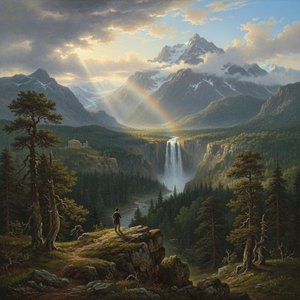
François Diday: A Pioneer of Alpine Landscape Painting
François Diday (1802-1877) stands as a significant figure in Swiss art history, particularly renowned for his captivating depictions of the Bernese Alps and Lake Geneva during the Romantic era. Born in Geneva, Switzerland, Diday’s artistic journey began amidst the burgeoning fascination with nature and emotion that characterized the period—a movement profoundly shaped by artists like Jean-François Millet and François Boucher. His work embodies a dedication to capturing the grandeur and tranquility of the mountainous terrain, establishing him as one of the foremost landscape painters of his time.- Early Life & Education: Diday received his formative artistic training in Geneva, immersing himself in the traditions of Swiss painting while simultaneously absorbing influences from European Romanticism.
- Notable Works: His oeuvre comprises numerous landscapes showcasing breathtaking vistas of the Alps and Lake Geneva, executed with meticulous detail and imbued with a palpable sense of atmosphere. Particularly noteworthy are “Waterfall,” “Paysage De Montagnes,” and “Mountain Landscape With Farmhouse And Figure.”
- Technique & Style: Diday’s artistic style aligns closely with the Hudson River School tradition—characterized by expansive canvases, luminous color palettes, and a commitment to portraying nature with scientific accuracy blended seamlessly with poetic expression. He skillfully employed oil paints on canvas to convey textures and tonal variations that faithfully reproduce the grandeur of the Alpine landscape.
- Artistic Legacy & Patronage: Beyond his individual paintings, Diday played an instrumental role in promoting art within Geneva and Switzerland. His dedication to artistic excellence fostered collaborations with prominent collectors and contributed to elevating the status of Swiss landscape painting on a national scale.
Romantic Influences & Artistic Vision
Diday’s artistic sensibilities were undeniably shaped by the Romantic movement—a reaction against Enlightenment rationalism that prioritized emotion, imagination, and individualism. Artists like Millet and Boucher served as crucial models for Diday, demonstrating how to convey profound feelings through visual representation. The Romantic emphasis on sublime landscapes—those capable of inspiring awe and terror—directly informed Diday’s approach to capturing the majesty of the Alps. He sought not merely to depict mountains but to evoke a sense of wonder and contemplation in his viewers.Major Achievements & Recognition
Diday achieved considerable acclaim during his lifetime for his artistic prowess and unwavering commitment to portraying the beauty of Switzerland’s natural environment. His landscapes gained recognition from discerning collectors and critics alike, securing his place as a celebrated artist within the Swiss art community. Furthermore, his advocacy for artistic endeavors helped solidify Geneva's reputation as a center for cultural innovation—a legacy that continues to resonate today.Historical Significance & Enduring Appeal
François Diday’s contribution to Swiss landscape painting transcends mere stylistic imitation; he embodies the spirit of Romanticism itself—a yearning for connection with nature and an embrace of emotional expression. His paintings remain treasured examples of 19th-century art, captivating audiences with their serene beauty and masterful technique. They serve as a testament to Diday’s artistic vision and his enduring influence on subsequent generations of Swiss painters.Kysymykset ja vastaukset
Mistä Francois Diday on kotoisin?
Francois Diday on syntynyt Switzerland.
Mistä voin löytää tilastoja Francois Diday teoksista?
Francois Diday-artistille on olemassa Tilastot-sivu, joka esittää tilastoja artistin teoksista tämä sivusto-sivustolla.
Miten löydän tietyn teeman mukaisia Francois Diday teoksia?
Francois Diday-taiteilijan Avainsanojen mukaan -sivu ryhmittelee taiteilijan teokset niiden avainsanojen mukaan.