The Alchemist of the Microscopic: The Life and Vision of Shinya Inoue
To look into the work of Shinya Inoue is to witness a profound convergence of two seemingly disparate worlds: the rigorous, empirical precision of biophysics and the ethereal, rhythmic beauty of abstract art. Born in London in 1921 as the son of a diplomat, Inoue’s early life was shaped by a global perspective and an adventurous spirit that would later define his scientific and creative pursuits. His journey from the bustling streets of England to the prestigious laboratories of Princeton and eventually to the Marine Biological Laboratory in Woods Hole, Massachusetts, was marked by an extraordinary capacity for seeing what others could not. Long before he was recognized as a titan of cell biology, Inoue demonstrated a legendary ingenuity, famously constructing his first polarized light microscope from the discarded remnants of a machine gun base and a simple tin tea can. This act of transformative creation—turning industrial waste into a window onto the invisible—serves as the perfect metaphor for his entire life’s work.
Inoue’s scientific odyssey was nothing short of revolutionary. Often revered as the father of cytoskeleton dynamics, he possessed an uncanny ability to capture the fleeting, kinetic energy of life itself. In the 1940s and 50s, through his pioneering use of polarized light microscopy, he achieved what many thought impossible: the visualization of dynamic processes within living cells. He meticulously documented the intricate dance of microtubules, proving that the mitotic spindle is not a static structure but a vibrant, shifting assembly of protein fibers in a state of rapid equilibrium. His mastery of light allowed him to peel back the layers of cellular mystery, revealing the mechanical forces that drive chromosome movement during mitosis. By developing video microscopy and inventing techniques to perturb cellular structures with precision, he laid the foundational stones for modern cell biology, earning his place within the National Academy of Sciences.
A Tapestry of Light and Motion
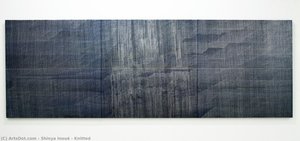
As his scientific career reached its zenith, Inoue’s artistic sensibilities began to weave themselves into the very fabric of his biological observations. He did not merely observe the cell; he felt its rhythm. This deep, intuitive connection to the movement of microscopic filaments inspired a unique aesthetic language that bridged the gap between the laboratory and the studio. His work often reflects the structural elegance found in nature, where the boundaries between organic growth and geometric pattern dissolve. In his celebrated 'Knitted' series, one can see the echoes of his scientific fascination with polymerization and depolymerization—the way fibers interlock and pull, much like the very microtubules he spent decades studying. The textures in his work evoke a sense of biological architecture, suggesting a world that is both intricately constructed and fluidly changing.
The historical significance of Shinya Inoue lies in this rare duality. He did not view science and art as competing disciplines, but as complementary lenses through which to understand the universe. His legacy is found not only in the textbooks that bear his name but in the way he taught us to perceive the invisible. Through his eyes, a microscopic filament becomes a stroke of light; a cellular division becomes a choreographed ballet. He leaves behind a profound testament to the power of interdisciplinary thought, reminding us that the most profound truths are often found at the intersection of what we can measure and what we can feel.
- Early Life: Born in London (1921), raised with a global perspective as a diplomat's son.
- Scientific Breakthroughs: Pioneer of cytoskeleton dynamics and the use of polarized light microscopy to view living cells.
- Artistic Legacy: Creator of works that translate biological movement into visual poetry, notably the 'Knitted' series.
- Major Honors: Member of the National Academy of Sciences and a foundational figure in modern light microscopy.
Kysymykset ja vastaukset
Mitä värejä Shinya Inoué käytti useimmiten?
Shinya Inoué-taiteilijan Paletin sielunmaisema esittelee taiteilijan tuotannon väriprofiilin.
Kuinka monta Shinya Inoué teosta on katseltavissa?
Voit selata taiteilijan Shinya Inoué 3 teosta teosta sivulla Kaikki teokset.
Missä ja minä vuonna Shinya Inoué on syntynyt?
Shinya Inoué syntyi Londonssä vuonna 1921.