


 Aperçu en situation
 Envoyer
 Partager
 Détails de l'œuvre
 Guide
Guide

 Télécharger l'image
 Articles similaires
 Radiographie
 Diaporama
 Statistiques
Autoportrait
 Huile sur toile
- Art mural
- Baroque
 1650
1650 107.0 x 77.0 cm
 La Frick Collection
 Lire la suite
Giclées et impressions d'art
Impressions giclées ou sur toile de qualité musée, avec une production rapide et des finitions au choix. ( Commander la reproduction peinte à la main Passer au format numérique)




P118B €10

P118H €10

P118W €10

P438Z €10

P508JH €12

P508YH €12

P805H €10

P805Z €10

P919BZ €10

P919G €10

P919XJ €10

P959ZH €10

P968JZ €12

W106C €8

W218G €10

W218JH €8

W218Y €10

W307PJ €10

W316G €10

W316PJ €8

W316Y €10

W398PJ €8

W4111J €10

W500HY €15

W500JH €15

W692G €12

W849H €8

W940BG €15

W953PJ €8




Choisissez parmi nos formats prédéfinis qui respectent les proportions originales de l’œuvre.

Saisissez la largeur et la hauteur souhaitées pour qu'elles s'adaptent à votre cadre ou à votre mur. Une impression peut être recadrée, mais jamais agrandie au-delà de l'image originale ; ainsi, un format de forme différente entraînera la perte d'une partie de l'image. Nous vous envoyons une maquette numérique pour approbation avant toute impression. L'image présentée sur cette page ne montre pas le recadrage réel — seule la maquette le permet.
Livraison dans le monde entier () en 2 semaines au lieu des 4/5 semaines habituelles. (27 octobre)

Livraison express gratuite dans le monde entier

Toile de lin de qualité supérieure

Assurance transport complète

Garantie de remboursement des droits de douane

Garantie de fidélité des couleurs

Politique de retour de 100 jours (uniquement en cas de défaut)

Garantie de remboursement à 100%

Offre de tarifs dégressifs
 L'option verre n'est disponible que pour les dimensions inférieures à 110 cm.

Autoportrait
Giclées et impressions d'art
Format de la reproduction
-


Prix total
€ 56
L'Autoportrait de Bartolomé Esteban Murillo : Une Fenêtre sur la Dignité Baroque
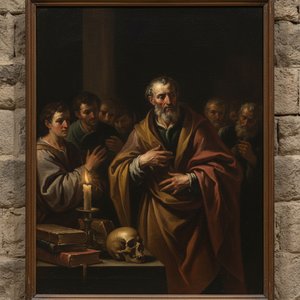
Peint durant ses années de formation à Séville, entre 1650 et 1655 environ, l'autoportrait de Bartolomé Esteban Murillo transcende la simple ressemblance physique ; il incarne l'essence même du baroque espagnol, capturant un profond sentiment de composure aristocratique et de contemplation intellectuelle. Bien plus qu'une simple image d'un homme, cette œuvre est une méditation méticuleusement élaborée sur l'identité artistique au sein d'un paysage culturel plus vaste. Dans cette composition, Murillo se présente dans une pose contemplative devant un arrière-plan de pierre érodée — un choix délibéré qui évoque le passage du temps et imprègne le portrait d'une aura de dignité solennelle. Son regard est direct, mais tourné vers l'intérieur, suggérant une préoccupation pour les principes artistiques et l'enquête philosophique. Le tableau illustre parfaitement le style baroque emblématique de Murillo, caractérisé par un clair-obscur dramatique — ce jeu magistral entre l'ombre et la lumière — qui confère profondeur et réalisme à la représentation. Contrairement à nombre de ses contemporains qui privilégiaient une ornamentation flamboyante, Murillo a opté pour la retenue, privilégiant la clarté des formes et la gradation tonale. L'artiste a employé une technique de peinture à l'huile magistrale, superposant les pigments avec une précision minutieuse pour obtenir des transitions fluides et de subtiles nuances de tons. Il a modelé les carnations avec une grande habileté, capturant les nuances de la lumière et de l'ombre — une marque de fabrique du réalisme baroque qui distingue le travail de Murillo des traditions artistiques antérieures. Ce chef-d'œuvre s'inscrit dans le contexte historique de la Séville de l'époque, alors centre vibrant de mécénat artistique et de bouillonnement intellectuel, siège de la monarchie des Habsbourg et carrefour du commerce et des échanges culturels. Le portrait reflète l'éthos prédominant de cette ère, qui valorisait l'érudition, la piété et des sensibilités esthétiques raffinées.Symbolisme : Pierre, Lumière et Réflexion Artistique
Le rebord de pierre sur lequel repose la main de Murillo est chargé d'une signification symbolique profonde, représentant la permanence, la stabilité et l'héritage durable de l'effort artistique. La surface érodée suggère que le temps a laissé sa marque tant sur l'artiste que sur son art, rappelant aux spectateurs la nature éphémère de l'existence humaine face à la beauté intemporelle de l'art. Simultanément, l'éclairage directionnel projette des ombres marquées qui accentuent les traits du visage et les vêtements de Murillo — une technique employée pour intensifier l'effet dramatique et transmettre un sentiment de tridimensionnalité.- La Pierre : Symbolisant la permanence et la stabilité, elle reflète le désir de l'artiste d'une reconnaissance durable.
- <La Lumière : Utilisée de manière dramatique pour illuminer le visage et les vêtements de Murillo, elle renforce la profondeur et le réalisme, pierre angulaire de l'expression artistique baroque.
Impact Émotionnel : La Dignité au Cœur de l'Imperfection
Malgré les signes subtils du vieillissement — une ligne frontale qui recule et une moustache grisonnante — Murillo dégage un sentiment inébranlable de dignité et d'assurance. Le regard de l'artiste est serein, mais imprégné d'une curiosité intellectuelle, suggérant un engagement profond envers les principes artistiques et la contemplation philosophique. En fin de compte, l'autoportrait de Murillo invite le spectateur à contempler les complexités de l'expérience humaine, embrassant à la fois la beauté et l'imperfection comme des composantes intégrales du voyage de la vie. Il témoigne de la capacité de Murillo à capturer non seulement la ressemblance physique, mais aussi l'esprit intérieur de son sujet — un exploit qui a scellé sa place parmi les artistes les plus vénérés de la période baroque.Conclusion : Un Héritage Illuminé
L'autoportrait de Murillo demeure un emblème durable de la réussite artistique baroque — un chef-d'œuvre qui continue d'inspirer l'admiration et la réflexion des siècles après sa création. Sa technique méticuleuse, sa richesse symbolique et son profond impact émotionnel consolident la réputation de Murillo comme l'un des plus grands peintres d'Espagne, une figure dont l'héritage brille avec éclat à travers le prisme de l'histoire de l'art.Questions et réponses
Quelle place occupe « Autoportrait » parmi les thèmes récurrents de Bartolomé Esteban Murillo ?
«Autoportrait» dépeint portrait espagnol, autoportrait baroque, œuvres de murillo, style d'art religieux, composition classique, tandis que les thèmes récurrents de Bartolomé Esteban Murillo sont influence du réalisme flamand, portrait de cour espagnol, piété religieuse évidente, drame et détails baroques, autopromotion, statut de l'artiste, héritage familial, art personnel. La comparaison des deux montre comment l'œuvre s'inscrit dans la lignée des sujets habituels de l'artiste.
Quelle intensité lumineuse les couleurs de "Autoportrait" semblent-elles refléter ?
Les couleurs de « Autoportrait » présentent une luminance Sombre.
Quelle est la technique utilisée pour « Autoportrait » ?
Bartolomé Esteban Murillo a utilisé la technique du Huile sur toile pour « Autoportrait ». Cette technique définit la nature matérielle de l'œuvre originale.
Œuvres similaires


Biographie de l'artiste
Premières années et formation
Bartolomé Esteban Murillo, un peintre baroque espagnol de premier plan, est né à Séville, en Espagne, fin décembre 1617 et a été baptisé le 1er janvier 1618. Il était le plus jeune des quatorze enfants de Gaspar Esteban et María Pérez. Après la mort de ses parents en 1627 et 1628, Murillo devint l'ami de son beau-frère, Juan Agustín Lagares. Murillo commença ses études artistiques à Séville sous la direction de Juan del Castillo, un parent de sa mère qui était également artiste. Ses premières œuvres furent influencées par l’approche réaliste et forte de Zurbarán, Jusepe de Ribera et Alonzo Cano.Évolution artistique et style
Le style artistique de Murillo évolua au fil du temps, initialement influencé par la peinture flamande et le « traité sur les images sacrées » de Molanus. À mesure qu'il mûrit, son travail développa un style raffiné qui convenait aux goûts bourgeois et aristocratiques de l’époque, en particulier dans ses œuvres religieuses catholiques romaines.- Jeune homme avec un panier de fruits ou Personification de l'été (c. 1640-50), illustrant son approche réaliste précoce.
- Le Jeune Mendiant (c. 1645, Musée du Louvre, Paris, France), démontrant l’influence de Velázquez.
- Saint Jérôme (c. 1650-52), exemplifiant son style mature, doucement lumineux.
Œuvres majeures et thèmes
Murillo est particulièrement connu pour ses représentations touchantes de l'Enfant Jésus, souvent dépeint comme un enfant jouant ou distribuant de la nourriture aux pauvres. Ces œuvres, empreintes d’une tendresse particulière, captivent par leur réalisme et leur émotion. Il a également peint des scènes de la Vierge Marie avec l'Enfant Jésus, ainsi que des saints et des figures religieuses, toujours caractérisées par une lumière douce et une composition harmonieuse. Ses tableaux de genre, comme Le Jeune Mendiant, témoignent de son intérêt pour les sujets contemporains et de sa capacité à capturer la vie quotidienne avec réalisme et compassion.Collections et héritage
Les peintures de Murillo se trouvent dans divers musées du monde entier, notamment :- Le Museo del Prado (Madrid, Espagne)
- L’Ermitage (Saint-Pétersbourg, Russie)
- La Wallace Collection (Londres)
- Le Timken Museum of Art (San Diego, présentant le Christ sur la croix)
- Le Krannert Art Museum (Champaign, Illinois, présentant le Christ après la flagellation)

Bartolomé Esteban Murillo
1618 - 1682 , Espagne
L'essentiel de l'artiste
- Artistic Movement Or Style: Baroque espagnol
- Artists Or Movements Influenced By This Artist:
- Gainsborough
- Greuze
- Artists Who Influenced This Artist:
- Zurbarán
- Jusepe de Ribera
- Alonzo Cano
- Velázquez
- Date Of Birth: 1618
- Date Of Death: 1682
- Full Name: Bartolomé Esteban Murillo
- Nationality: Espagnol
- Notable Artworks:
- Jeune homme avec un panier de fruits
- Le Jeune Mendiant
- Saint Jérôme
- L'Adoration des bergers
- Place Of Birth (City And Country): Séville, Espagne
Articles connexes

The Golden Age Reforged: Dramatic Realism & Religious Zeal in Spanish Baroque Art
Explore the dramatic world of Spanish Baroque art! Discover masters like Zurbarán & the powerful influence of religious zeal on painting techniques – a guide for collectors and enthusiasts.

Les 10 Chefs-d'œuvre Baroques qui ont Révolutionné l'Art |
Plongez au cœur du baroque avec les 10 chefs-d'œuvre de Caravaggio, Rembrandt et Rubens. Découvrez l'histoire fascinante de ces artistes et leurs tableaux célèbres. Reproductions d'art de qualité muséale sur – Explorez la collection !
Spanish Baroque Art: The Dramatic Mastery of Light and Shadow in the Age of Velázquez
Explore the profound drama of Spanish Baroque art. Delve into the mastery of light, shadow, and realism through the legendary works of Diego Velázquez and the Spanish Golden Age.

The Dramatic Flourish: Exploring the Baroque Movement's Enduring Legacy in Art History
Explore the dramatic world of Baroque art! Discover iconic artists like Caravaggio & Rubens, defining techniques, and its lasting impact on art history. Expert insights for collectors & enthusiasts at AllPaintingsStore.

Bartolomé Esteban Murillo: Divine Light & Social Commentary in Golden Age Seville
Explore the captivating world of Bartolomé Esteban Murillo, a master of Spanish Baroque painting. Discover his luminous religious scenes, tender genre paintings & lasting legacy in Golden Age Seville. Learn more at AllPaintingsStore.


