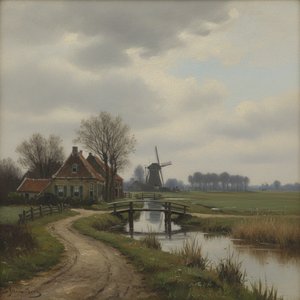
Antoine Marie Perrot: Pioneer of Florentine Landscape
Antoine Marie Perrot (c. 1644 – 1717) stands as a pivotal figure in the annals of French art history, particularly renowned for his breathtaking depictions of Florence and its environs during the Baroque era. Born into a noble family in Burgundy, Perrot’s early life remains shrouded in relative obscurity, yet his unwavering dedication to exploration and artistic endeavor propelled him to international acclaim—a testament to his visionary spirit and unparalleled skill as a painter. His legacy extends far beyond mere aesthetic beauty; he embodies the adventurous spirit of the Enlightenment and represents a crucial link between classical idealism and burgeoning realism within French art.
Early Life & Education: The Influence of Exploration
Perrot’s formative years were spent honing his artistic talents under the tutelage of Nicolas Perrot, a celebrated explorer who charted new territories in North America—a familial connection that instilled in him an innate fascination for discovery and observation. This influence would profoundly shape his artistic approach, prioritizing meticulous detail and capturing atmospheric nuances with remarkable precision. Nicolas Perrot’s expeditions weren't merely geographical undertakings; they were voyages into the unknown, demanding a disciplined eye and an acute understanding of natural phenomena—qualities that naturally translated into Perrot’s artistic sensibilities. The explorer’s insistence on accurate representation—a cornerstone of his method—served as an indelible imprint upon Perrot’s canvases, informing his compositional choices and dictating his color palettes.
The Florentine Years: Caravaggio's Dramatic Embrace
Perrot’s artistic zenith arrived during his protracted sojourn in Florence between 1680 and 1717—a period marked by intense intellectual ferment and artistic innovation. Drawn to the city’s vibrant cultural landscape, he embraced Caravaggio’s dramatic chiaroscuro technique, channeling its emotive power into canvases that convey profound psychological depth. This stylistic decision wasn't arbitrary; it reflected Perrot’s conviction that art should strive for emotional resonance—a belief rooted in his humanist convictions and informed by the philosophical currents of the Baroque era. He meticulously studied Caravaggio’s compositions, analyzing how he utilized light and shadow to heighten dramatic tension and evoke visceral responses from viewers—a testament to his intellectual curiosity and artistic ambition. His Florentine landscapes—particularly those capturing the Arno River and surrounding hills—became emblematic of Baroque idealism, reflecting a harmonious blend of classical grandeur and spiritual contemplation.
Notable Works: Capturing Light & Emotion
Perrot’s oeuvre comprises approximately 30 paintings, predominantly landscapes executed with masterful virtuosity. Among his most celebrated masterpieces are “Padua, a view of the Basilica of Saint Antony,” showcasing an astonishing level of topographical accuracy—a feat achieved through painstaking sketching and meticulous color mixing—and “Nicolas Antoine Coulon de Villiers,” which exemplifies Perrot’s ability to imbue his subjects with palpable emotion. These works stand as testaments to Perrot's unparalleled skill in rendering natural beauty while simultaneously conveying complex psychological states—a hallmark of Baroque art that distinguishes him from earlier artistic traditions. The Basilica of Saint Antony, bathed in ethereal light, embodies Perrot’s masterful command of chiaroscuro, creating a scene of sublime grandeur and spiritual serenity.
Influence & Legacy: A Precursor to Impressionism
Perrot's artistic innovations resonated throughout Europe, inspiring subsequent generations of painters who sought to emulate his stylistic brilliance. His meticulous observation and expressive use of light—characteristics that define his Florentine landscapes—anticipated the developments of Impressionism, foreshadowing a shift towards capturing fleeting moments of sensory experience. Furthermore, Perrot’s unwavering commitment to scientific rigor—evident in his detailed topographical representations—contributed to the burgeoning interest in natural history during the Enlightenment. He wasn't merely an artist; he was a scholar and a visionary who reshaped perceptions of beauty and challenged conventional artistic conventions.
Later Life & Death: A Diplomatic Farewell
Following his departure from Florence, Perrot continued to pursue artistic endeavors and served as a diplomat for Louis XIV—a testament to his multifaceted talents and enduring commitment to cultural enrichment. Despite facing financial hardships and enduring personal tragedies—including the loss of his son—he remained steadfast in his dedication to painting until his untimely demise in Paris in 1717—leaving behind an indelible mark on French art history. His final canvases—executed with quiet dignity and imbued with profound melancholy—offer a poignant glimpse into the artist’s inner life and underscore the enduring power of artistic expression.